Passa al contenuto
Merck

Vai a

T0813

Anti-Tumor Necrosis Factor-α antibody produced in goat

affinity isolated antibody, lyophilized powder

Sinonimo/i:

Anti-TNF-α

Autenticati per visualizzare i prezzi organizzativi e contrattuali.

Scegli un formato

Cambia visualizzazione
Taglio della confezioneSKUDisponibilitàPrezzo
0.1 mg
Per conoscere la disponibilità, visualizza il carrello
CHF 515.00

Informazioni su questo articolo

NACRES:
NA.41
UNSPSC Code:
51111800
Conjugate:
unconjugated
Clone:
polyclonal
Application:
IHC, Neutral, WB
Citations:
6

CHF 515.00


Per conoscere la disponibilità, visualizza il carrello
Per il tuo target è disponibile un anticorpo ricombinante privo di conservanti. Prova ZRB2420

Servizio Tecnico
Hai bisogno di aiuto? Il nostro team di scienziati qualificati è a tua disposizione.
Permettici di aiutarti


biological source

goat

Quality Level

conjugate

unconjugated

antibody form

affinity isolated antibody

antibody product type

primary antibodies

clone

polyclonal

form

lyophilized powder

species reactivity

human

technique(s)

immunohistochemistry: suitable, neutralization: suitable, western blot: suitable

UniProt accession no.

storage temp.

−20°C

target post-translational modification

unmodified

Gene Information

human ... TNF(7124)

General description

Tumor Necrosis Factor-α (TNF-α) is a cytokine produced by macrophages in response to stimulus by LPS. It plays a major role in mediating inflammation, tissue injury, pathogenic shock, innate immunity, apoptosis and autoimmunity. The physiological effects of TNF-α are mediated by receptors of TNFR super family. The TNF/TNFR signaling axis plays a critical role in mediating either survival or apoptosis depending on the class of adaptor proteins recruited in the cell. Association of receptors with a death domain causes rapid activation of caspases and results in cell death. TNF/TNFR also results in the activation of downstream pathways involving MAPK, p38, JNK and NF-κB that play a major role in innate immunity, acute inflammatory responses and homeostasis. The TNF/TNFR axis is also important in the pathology of various autoimmune and inflammatory disorders including a variety of malignancies and Alzheimer′s disease. Anti-Tumor Necrosis Factor-α antibody is specific for human TNF-α. The antibody shows less than 10% cross reactivity with recombinant rabbit TNF-α and less than 5% cross reactivity with recombinant mouse TNF-α.

Immunogen

recombinant human TNF-α.

Application

Anti-Tumor Necrosis Factor-α (TNF- α) antibody produced in goat has been used to study the release of TNF- α from the cocultured lung carcinoma cells A427:AML-193.
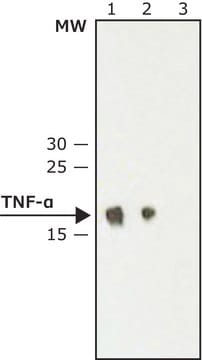
Anti-Tumor Necrosis Factor-α antibody may be used for immunoblotting at a working antibody concentration of 0.1 μg/ml. For immunohistochemistry a concentration range of 5-15 μg/ml is recommended. The antibody may be used for neutralization assay; the ND50 is 0.01-0.06 μg/mL in the presence of 1.5ng/mL Recombinant Human TNF-alpha.

Biochem/physiol Actions

The antibody neutralizes the biological activity of recombinant human TNF-α. The antibody shows <10% cross-reactivity with recombinant rat TNF-α and <5% cross-reactivity with recombinant mouse TNF-α.

Physical form

Lyophilized from 0.2 μm filtered solution in phosphate buffered saline containing 5% trehalose.

Preparation Note

The antibody is purified using TNF-α affinity chromatography.

Disclaimer

Unless otherwise stated in our catalog or other company documentation accompanying the product(s), our products are intended for research use only and are not to be used for any other purpose, which includes but is not limited to, unauthorized commercial uses, in vitro diagnostic uses, ex vivo or in vivo therapeutic uses or any type of consumption or application to humans or animals.

Confronta articoli simili

Visualizza il confronto per intero

Mostra le differenze

1 of 1

Questo articolo
T2824T0938T6817
conjugate

unconjugated

conjugate

unconjugated

conjugate

unconjugated

conjugate

unconjugated

antibody form

affinity isolated antibody

antibody form

purified immunoglobulin

antibody form

affinity isolated antibody

antibody form

purified immunoglobulin

Quality Level

100

Quality Level

200

Quality Level

100

Quality Level

100

biological source

goat

biological source

hamster

biological source

goat

biological source

mouse

technique(s)

immunohistochemistry: suitable, western blot: suitable, neutralization: suitable

technique(s)

immunoprecipitation (IP): suitable, indirect ELISA: suitable, microarray: suitable, neutralization: suitable, western blot: 0.25-0.5 μg/mL using recombinant mouse TNF-α

technique(s)

capture ELISA: suitable, flow cytometry: 5-25 μg/mL, indirect immunofluorescence: 15 μg/mL using mouse cells and tissues, neutralization: suitable, western blot: 0.1-0.2 μg/mL

technique(s)

capture ELISA: 4 μg/mL, immunocytochemistry: 8-25 μg/mL using Immersion fixed human peripheral blood mononuclear cells (PBMSs) stimulated with LPS and monensin., neutralization: suitable, western blot: 1.0-2.0 μg/mL

species reactivity

human

species reactivity

rat, mouse

species reactivity

mouse

species reactivity

human


Still not finding the right product?

Explore all of our products under

o

Provate il nostro Motore di ricerca dei prodotti per restringere le opzioni.


Classe di stoccaggio

11 - Combustible Solids

wgk

WGK 1

flash_point_f

Not applicable

flash_point_c

Not applicable


Scegli una delle versioni più recenti:

Certificati d'analisi (COA)

Lot/Batch Number

Non trovi la versione di tuo interesse?

Se hai bisogno di una versione specifica, puoi cercare il certificato tramite il numero di lotto.

Possiedi già questo prodotto?

I documenti relativi ai prodotti acquistati recentemente sono disponibili nell’Archivio dei documenti.

Visita l’Archivio dei documenti


Contenuto correlato

Instructions


Biochanin A extirpates the epithelial-mesenchymal transition in a human lung cancer.
Wang Y, et al.
Experimental and Therapeutic Medicine, 15(3), 2830-2836 (2018)
The TNF receptor superfamily of cellular and viral proteins: activation, costimulation, and death.
C A Smith et al.
Cell, 76(6), 959-962 (1994-03-25)
K A Papadakis et al.
Annual review of medicine, 51, 289-298 (2000-04-25)
Recent advances in the drug treatment of inflammatory bowel disease (IBD) have paralleled our understanding of the pathophysiology of ulcerative colitis and Crohn's disease. Several proinflammatory and immune-regulatory cytokines are upregulated in the mucosa of patients with IBD, and differences


Numero articolo commerciale globale

SKUGTIN
T0813-.1MG04061832717210

Questions

Reviews

No rating value

Active Filters