Passa al contenuto
Merck

Vai a

MABC667

Anti-GPC3 Antibody, clone 9C2

ascites fluid, clone 9C2, from mouse

Sinonimo/i:

SGB, DGSX, MXR7, SDYS, SGBS, OCI-5, SGBS1, GTR2-2, Glypican-3, Intestinal protein OCI-5

Autenticati per visualizzare i prezzi organizzativi e contrattuali.

Scegli un formato

Cambia visualizzazione
Taglio della confezioneSKUDisponibilitàPrezzo
100 μL
Per conoscere la disponibilità, visualizza il carrello
CHF 466.00

Informazioni su questo articolo

UNSPSC Code:
12352203
NACRES:
NA.41
eCl@ss:
32160702
Conjugate:
unconjugated
Clone:
9C2, monoclonal
Application:
FACS, IF, IHC, WB
Citations:
2

CHF 466.00


Per conoscere la disponibilità, visualizza il carrello

Richiedi un ordine in blocco
Servizio Tecnico
Hai bisogno di aiuto? Il nostro team di scienziati qualificati è a tua disposizione.
Permettici di aiutarti


biological source

mouse

Quality Segment

conjugate

unconjugated

antibody form

ascites fluid

antibody product type

primary antibodies

clone

9C2, monoclonal

species reactivity

mouse, human

technique(s)

flow cytometry: suitable, immunofluorescence: suitable, immunohistochemistry: suitable, western blot: suitable

isotype

IgG1

UniProt accession no.

shipped in

wet ice

target post-translational modification

unmodified

Gene Information

human ... GPC3(2719)

General description

Glypican-3 or GTR2-2 is the protein product of the gene GPC3. It is a cell surface heparin sulfate containing glycoprotein that plays an important role in the modulation of growth and development of mesodermal tissues and organs, as well as various cancers. Among its many known functions, it is a regulator of the dipeptidyl peptidase DPP4 (CD26). DPP4 plays an important role in glucose metabolism via its action on incretin and GLP-1 hormones. DPP4 also is a cancer marker and thought to function as a cancer suppressor. Thus acting as a regulator of DPP4, Glypican-3 (GPC3) participates in everything from glucose and blood sugar regulation to tumor growth. Glypican-3 (GPC3) is most highly expressed in the lung, liver and kidney, and typically a secreted form, secreted glypican-3, is found in the extracellular space generated as a cleavage product by the action of a convertase. Defects in GPC3 cause Simpson-Golabi-Behmel syndrome type 1 (SGBS1) or Simpson dysmorphia syndrome (SDYS). This is a condition characterized by pre-and postnatal overgrowth (gigantism) with visceral and skeletal anomalies. EMD-Millipore’s anti-GPC3 mouse monoclonal antibody, clone 9C2, has been tested in western blot against recombinant human protein, human HepG2, HEK293, Jurkat, and SK-N-SH cell line lysates, as well as rat PC-12 and mouse liver cell lysates. In addition, the clone as been successfully used in paraffin-embedded immunohistochemistry on human liver and breast cancer tissues and in immunofluorescent immunocytochemistry on human HeLa cells in culture. Finally, the clone has been tested successfully on human cells by flow cytometry and against the recombinant antigen by ELISA.
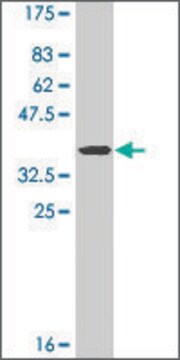
~66 kDa observed. Uncharacterized bands may appear in some lysate(s).

Immunogen

Purified recombinant fragment of human GPC3 expressed in E. Coli.

Application

Detect Glypican using this mouse monoclonal antibody, Anti-GPC3 Antibody, clone 9C2 validated for use in western blotting, Immunofluorescence, IHC & Flow Cytometry.
Immunohistochemistry Analysis: A 1:100 dilution from a representative lot detected GPC3 in human liver and kidney tissues.

Immunofluorescence Analysis: A 1:200-1,000 dilution from a representative lot detected GPC3 in HeLa cells.

Flow Cytometry Analysis: A 1:200-400 dilution from a representative lot detected GPC3 in Jurkat cells.

Optimal working dilutions must be determined by end user.
Research Category
Apoptosis & Cancer
Research Sub Category
Apoptosis - Additional

Physical form

Protein G Purified
Purified mouse monoclonal in PBS containing up to 0.1% sodium azide

Preparation Note

Stable for 1 year at 2-8°C from date of receipt.

Analysis Note

Control
Mouse liver, HepG2, HEK293, Jurkat, SK-N-SH, PC-12, and F9 cell lysates
Evaluated by Western Blotting in mouse liver, HepG2, HEK293, Jurkat, SK-N-SH, PC-12, and F9 cell lysates.

Western Blotting Analysis: A 1:500-2,000 dilution of this antibody detected GPC3 in mouse liver, HepG2, HEK293, Jurkat, SK-N-SH, PC-12, and F9 cell lysates.

Disclaimer

Unless otherwise stated in our catalog or other company documentation accompanying the product(s), our products are intended for research use only and are not to be used for any other purpose, which includes but is not limited to, unauthorized commercial uses, in vitro diagnostic uses, ex vivo or in vivo therapeutic uses or any type of consumption or application to humans or animals.

Confronta articoli simili

Visualizza il confronto per intero

Mostra le differenze

1 of 1

Questo articolo
SAB1402788SAB2108511WH0002262M1
Anti-GPC3 IgG fraction of antiserum

Sigma-Aldrich

SAB2108511

Anti-GPC3

species reactivity

mouse, human

species reactivity

human

species reactivity

mouse, horse, dog, rabbit, bovine, guinea pig, rat, human

species reactivity

human

clone

9C2, monoclonal

clone

2C12, monoclonal

clone

polyclonal

clone

1C9, monoclonal

antibody form

ascites fluid

antibody form

ascites fluid

antibody form

IgG fraction of antiserum

antibody form

purified immunoglobulin

Gene Information

human ... GPC3(2719)

Gene Information

human ... GPC3(2719)

Gene Information

human ... GPC3(2719)

Gene Information

human ... GPC5(2262)

biological source

mouse

biological source

mouse

biological source

rabbit

biological source

mouse

conjugate

unconjugated

conjugate

unconjugated

conjugate

unconjugated

conjugate

unconjugated


Still not finding the right product?

Provate il nostro Motore di ricerca dei prodotti per restringere le opzioni.


pictograms

Health hazard

signalword

Danger

Hazard Classifications

Aquatic Chronic 3 - Repr. 1A

wgk

WGK 2

flash_point_f

Not applicable

flash_point_c

Not applicable


Certificati d'analisi (COA)

Cerca il Certificati d'analisi (COA) digitando il numero di lotto/batch corrispondente. I numeri di lotto o di batch sono stampati sull'etichetta dei prodotti dopo la parola ‘Lotto’ o ‘Batch’.

Possiedi già questo prodotto?

I documenti relativi ai prodotti acquistati recentemente sono disponibili nell’Archivio dei documenti.

Visita l’Archivio dei documenti


Numero articolo commerciale globale

SKUGTIN
MABC66704053252918056

Questions

Reviews

No rating value

Active Filters