Passa al contenuto
Merck

Vai a

MABC202

Anti-APC Antibody, clone FE9

clone FE9, from mouse

Sinonimo/i:

Adenomatous polyposis coli protein, Protein APC, Deleted in polyposis 2.5

Autenticati per visualizzare i prezzi organizzativi e contrattuali.

Scegli un formato

Cambia visualizzazione
Taglio della confezioneSKUDisponibilitàPrezzo
100 μg
Per conoscere la disponibilità, visualizza il carrello
CHF 482.00

Informazioni su questo articolo

UNSPSC Code:
12352203
NACRES:
NA.41
eCl@ss:
32160702
Conjugate:
unconjugated
Clone:
FE9, monoclonal
Application:
WB
Citations:
8

CHF 482.00


Per conoscere la disponibilità, visualizza il carrello

Richiedi un ordine in blocco
Servizio Tecnico
Hai bisogno di aiuto? Il nostro team di scienziati qualificati è a tua disposizione.
Permettici di aiutarti


biological source

mouse

Quality Level

conjugate

unconjugated

antibody form

purified immunoglobulin

antibody product type

primary antibodies

clone

FE9, monoclonal

species reactivity

human

technique(s)

western blot: suitable

isotype

IgG1κ

NCBI accession no.

UniProt accession no.

shipped in

wet ice

target post-translational modification

unmodified

Gene Information

human ... APC(324)

General description

Adenomatous polyposis coli protein (APC) is a ubiquitous multidomain protein that has a well documented role as a tumor suppressor. The mechanism of APC-mediated tumor suppression is still an area of active investigation; however, several studies suggest that APC is a negative regulator of the Wnt signaling pathway as it downregulates β-catenin via interactions with Axin/GSK3-β complex, thereby preventing transcription of genes such as MYC that contribute to cell proliferation. Defective APC proteins contribute to the initiation and proliferation of various types of cancers, including familial adenomatous polyposis. However, other studies have shown that APC interacts with a range of other proteins such as the EB1 microtubule-binding proteins, to regulate other processes such as cell migration.
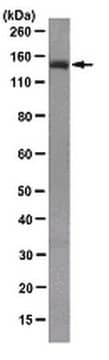
~147 kDa observed. Uniprot describes the full length protein at ~312 kDa This antibody was shown to detect the truncated form at ~147 kDa

Immunogen

Linear peptide corresponding to the N-terminus of human APC.

Application

Anti-APC Antibody, clone FE9 is an antibody against APC for use in Western Blotting.

Biochem/physiol Actions

This antibody recognizes the N-terminus of APC.

Physical form

Format: Purified

Analysis Note

Evaluated by Western Blot in SW480 cell lysate.

Western Blot Analysis: 0.5 µg/mL of this antibody detected APC in 10 µg of SW480 cell lysate.

Other Notes

Concentration: Please refer to the Certificate of Analysis for the lot-specific concentration.

Confronta articoli simili

Visualizza il confronto per intero

Mostra le differenze

1 of 1

Questo articolo
SAB4501438SAB4200594HPA013349
biological source

mouse

biological source

rabbit

biological source

rabbit

biological source

rabbit

Gene Information

human ... APC(324)

Gene Information

human ... APC(324)

Gene Information

human ... APC(324)

Gene Information

human ... APC(324)

clone

FE9, monoclonal

clone

polyclonal

clone

polyclonal

clone

polyclonal

conjugate

unconjugated

conjugate

unconjugated

conjugate

unconjugated

conjugate

unconjugated

species reactivity

human

species reactivity

rat, mouse, human

species reactivity

human

species reactivity

human

antibody form

purified immunoglobulin

antibody form

affinity isolated antibody

antibody form

affinity isolated antibody

antibody form

affinity isolated antibody


Still not finding the right product?

Provate il nostro Motore di ricerca dei prodotti per restringere le opzioni.


Classe di stoccaggio

12 - Non Combustible Liquids

wgk

WGK 1

flash_point_f

Not applicable

flash_point_c

Not applicable


Certificati d'analisi (COA)

Cerca il Certificati d'analisi (COA) digitando il numero di lotto/batch corrispondente. I numeri di lotto o di batch sono stampati sull'etichetta dei prodotti dopo la parola ‘Lotto’ o ‘Batch’.

Possiedi già questo prodotto?

I documenti relativi ai prodotti acquistati recentemente sono disponibili nell’Archivio dei documenti.

Visita l’Archivio dei documenti


Weiran Feng et al.
Proceedings of the National Academy of Sciences of the United States of America, 118(32) (2021-08-07)
The increasing complexity of different cell types revealed by single-cell analysis of tissues presents challenges in efficiently elucidating their functions. Here we show, using prostate as a model tissue, that primary organoids and freshly isolated epithelial cells can be CRISPR
Maria Paz Zafra et al.
Nature biotechnology, 36(9), 888-893 (2018-07-04)
CRISPR base editing enables the creation of targeted single-base conversions without generating double-stranded breaks. However, the efficiency of current base editors is very low in many cell types. We reengineered the sequences of BE3, BE4Gam, and xBE3 by codon optimization
Inducible in vivo genome editing with CRISPR-Cas9.
Dow, LE; Fisher, J; O'Rourke, KP; Muley, A; Kastenhuber, ER; Livshits, G; Tschaharganeh et al.
Nature Biotechnology null


Numero articolo commerciale globale

SKUGTIN
MABC20204053252439049

Questions

Reviews

No rating value

Active Filters