Passa al contenuto
Merck

Vai a

ABC451

Anti-Dihydropyrimidine dehydrogenase/DPYD Antibody

from rabbit, purified by affinity chromatography

Sinonimo/i:

Dihydropyrimidine dehydrogenase [NADP(+)], DHPDHase, DPD, Dihydrothymine dehydrogenase, Dihydrouracil dehydrogenase, DPYD

Autenticati per visualizzare i prezzi organizzativi e contrattuali.

Scegli un formato

Cambia visualizzazione
Taglio della confezioneSKUDisponibilitàPrezzo
100 μg
Per conoscere la disponibilità, visualizza il carrello
CHF 440.00

Informazioni su questo articolo

UNSPSC Code:
12352203
NACRES:
NA.41
eCl@ss:
32160702
Conjugate:
unconjugated
Clone:
polyclonal
Application:
IHC, WB
Citations:
2

CHF 440.00


Per conoscere la disponibilità, visualizza il carrello

Richiedi un ordine in blocco
Servizio Tecnico
Hai bisogno di aiuto? Il nostro team di scienziati qualificati è a tua disposizione.
Permettici di aiutarti


biological source

rabbit

Quality Level

conjugate

unconjugated

antibody form

affinity isolated antibody

antibody product type

primary antibodies

clone

polyclonal

purified by

affinity chromatography

species reactivity

human

species reactivity (predicted by homology)

bovine (based on 100% sequence homology), primate (based on 100% sequence homology), horse (based on 100% sequence homology), porcine (based on 100% sequence homology)

technique(s)

immunohistochemistry: suitable, western blot: suitable

NCBI accession no.

UniProt accession no.

shipped in

wet ice

target post-translational modification

unmodified

Gene Information

human ... DPYD(1806)

General description

DPYD is an important enzyme involved in pyrimidine base degradation and catabolism. DPYD catalyzes the reduction of uracil and thymine and also is a critical enzyme in the degradation of the chemotherapeutic drug 5-fluoruracil. DPYD is expressed in most cells and has highest activity in the liver and monocytes. Mutations in DPYD give rise to a range of symptoms and syndromes in patients ranging from no symptoms to highly convulsive and mental retardation caused by excessive amounts of uracil or thymine present in the blood. Because of its ability to degrade 5-fluorouracil, DPYD is studied as a cancer marker and a measure of therapeutic effects in many cancers. Recent research also shows that DPYD levels in the liver are regulated via microRNA interactions and an offer a new opportunity for modulation of this critical enzyme in health and disease.
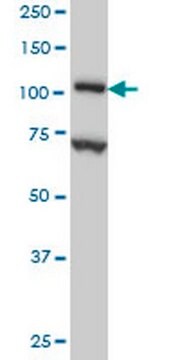
~110 kDa observed. Uncharacterized band at ~47 kDa may be observed in some lysates.

Immunogen

Epitope: Near N-terminus
KLH-conjugated linear peptide corresponding to human Dihydropyrimidine dehydrogenase/DPYD near the N-terminus.

Application

Research Category
Apoptosis & Cancer
Research Sub Category
Apoptosis - Additional
This Anti-Dihydropyrimidine dehydrogenase/DPYD Antibody is validated for use in Western Blotting and Immunohistochemistry for the detection of Dihydropyrimidine dehydrogenase/DPYD.
Western Blotting Analysis: 2.0 µg/mL from a representative lot detected Dihydropyrimidine dehydrogenase/DPYD in 10 µg of human liver tissue lysate.
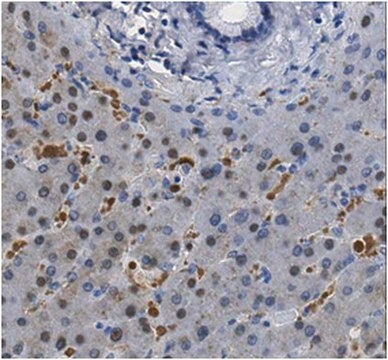
Immunohistochemistry Analysis: A 1:50 dilution from a representative lot detected Dihydropyrimidine dehydrogenase/DPYD in human liver tissue.

Physical form

Affinity purified
Purified rabbit polyclonal in buffer containing 0.1 M Tris-Glycine (pH 7.4), 150 mM NaCl with 0.05% sodium azide.

Preparation Note

Stable for 1 year at 2-8°C from date of receipt.

Analysis Note

Evaluated by Western Blotting in human small intestine tissue lysate.

Western Blotting Analysis: 2.0 µg/mL of this antibody detected Dihydropyrimidine dehydrogenase/DPYD in 10 µg of human small intestine tissue lysate.

Other Notes

Concentration: Please refer to lot specific datasheet.

Disclaimer

Unless otherwise stated in our catalog or other company documentation accompanying the product(s), our products are intended for research use only and are not to be used for any other purpose, which includes but is not limited to, unauthorized commercial uses, in vitro diagnostic uses, ex vivo or in vivo therapeutic uses or any type of consumption or application to humans or animals.

Confronta articoli simili

Visualizza il confronto per intero

Mostra le differenze

1 of 1

Questo articolo
ST1672ABC138SAB4200522
conjugate

unconjugated

conjugate

-

conjugate

unconjugated

conjugate

unconjugated

biological source

rabbit

biological source

mouse

biological source

rabbit

biological source

rabbit

Quality Level

100

Quality Level

100

Quality Level

100

Quality Level

-

antibody form

affinity isolated antibody

antibody form

purified antibody

antibody form

affinity isolated antibody

antibody form

affinity isolated antibody

UniProt accession no.

Q12882

UniProt accession no.

-

UniProt accession no.

Q02127

UniProt accession no.

O75874

technique(s)

immunohistochemistry: suitable, western blot: suitable

technique(s)

-

technique(s)

immunohistochemistry: suitable (paraffin), western blot: suitable

technique(s)

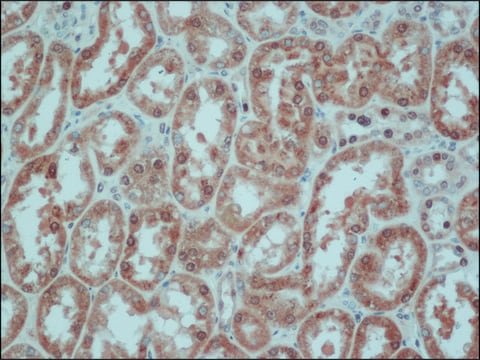
immunohistochemistry: 20 μg/mL using human kidney., indirect immunofluorescence: 1-2 μg/mL using SHSY5Y cells., western blot: 1-2 μg/mL using extracts of NIH3T3 cells and of rat cerebellum (S1 fraction).


Still not finding the right product?

Provate il nostro Motore di ricerca dei prodotti per restringere le opzioni.


Classe di stoccaggio

12 - Non Combustible Liquids

wgk

WGK 1

flash_point_f

Not applicable

flash_point_c

Not applicable


Certificati d'analisi (COA)

Cerca il Certificati d'analisi (COA) digitando il numero di lotto/batch corrispondente. I numeri di lotto o di batch sono stampati sull'etichetta dei prodotti dopo la parola ‘Lotto’ o ‘Batch’.

Possiedi già questo prodotto?

I documenti relativi ai prodotti acquistati recentemente sono disponibili nell’Archivio dei documenti.

Visita l’Archivio dei documenti


Masaaki Murakawa et al.
Oncology letters, 14(2), 1505-1511 (2017-08-10)
The predictive roles of dihydropyrimidine dehydrogenase (DPD) in patients who undergo curative resection and adjuvant chemotherapy with S-1, which is the oral 5-fluorouracil prodrug tegafur combined with oteracil and gimeracil, remain unclear. In the present study, the clinical data from
Eiji Hishinuma et al.
Frontiers in pharmacology, 13, 930470-930470 (2022-07-06)
Dihydropyrimidine dehydrogenase (DPD), encoded by the DPYD gene, is the rate-limiting enzyme in 5-fluorouracil (5-FU) degradation. In Caucasians, four DPYD risk variants are recognized to be responsible for interindividual variations in the development of 5-FU toxicity. However, these risk variants


Numero articolo commerciale globale

SKUGTIN
ABC45104055977109191

Questions

Reviews

No rating value

Active Filters