Passa al contenuto
Merck

Vai a

M4528

Monoclonal Anti-MAP1b antibody produced in mouse

clone AA6, ascites fluid

Sinonimo/i:

Anti-MAP1.2, Anti-MAP1X, Anti-MAP5

Autenticati per visualizzare i prezzi organizzativi e contrattuali.

Scegli un formato

Cambia visualizzazione
Taglio della confezioneSKUDisponibilitàPrezzo
100 μL
Per conoscere la disponibilità, visualizza il carrello
CHF 596.00
0.2 mL
Per conoscere la disponibilità, visualizza il carrello
CHF 645.00

Informazioni su questo articolo

UNSPSC Code:
12352203
NACRES:
NA.41
MDL number:
Conjugate:
unconjugated
Clone:
AA6, monoclonal
Application:
ARR, WB
Citations:
11

CHF 596.00


Per conoscere la disponibilità, visualizza il carrello

Richiedi un ordine in blocco
Servizio Tecnico
Hai bisogno di aiuto? Il nostro team di scienziati qualificati è a tua disposizione.
Permettici di aiutarti


biological source

mouse

Quality Level

conjugate

unconjugated

antibody form

ascites fluid

antibody product type

primary antibodies

clone

AA6, monoclonal

contains

15 mM sodium azide

species reactivity

human, feline, bovine, hamster, chicken, mouse, rat

technique(s)

microarray: suitable, western blot: 1:500 using a fresh total rat brain extract or an enriched microtubule protein preparation

isotype

IgG1

UniProt accession no.

shipped in

dry ice

storage temp.

−20°C

target post-translational modification

unmodified

Gene Information

human ... MAP1B(4131)
mouse ... Mtap1b(17755)
rat ... Map1b(29456)

General description

MAP1b is a microtubule associated protein that interacts with actin filaments. MAP1b regulates microtubule stabilization and the development of axons. It may also act as a scaffolding protein Addition of antibody to microtubule proteins before polymerization in immunoassays results in abnormally short (but otherwise morphologically normal) microtubules. Immunohistochemical staining of brain tissue with the product shows selective labeling of dendritic trees throughout the brain. Monoclonal Anti-MAP1b does not react with tubulin of other microtubule associated proteins.
Monoclonal Anti-MAP1b (MAP5) (mouse IgG1 isotype) is derived from the hybridoma produced by the fusion of mouse myeloma cells and splenocytes from an immunized mouse. Microtubule-associated protein (MAP1B) is the major microtubule associated protein in developing brain which changes its expression during development. In the new born rat brain, it is a major component of microtubules but in the adult its level is ten-fold lower.

Immunogen

rat brain microtubule-associated proteins (MAPs)

Application

Monoclonal Anti-MAP1b antibody produced in mouse has been used in:
  • immunohistochemistry
  • immunostaining
  • fluorescence microscopy

Biochem/physiol Actions

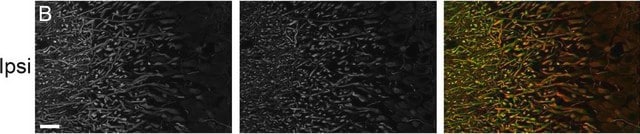
Microtubule-associated protein (MAP1B) is the first MAP to appear in growing axons during development as it is present from the first emergence of the nascent axon from the cell body. Monoclonal Anti-MAP1b may be used to study MAP expression and cytological localization both in tissues and cell lines, under different developmental and environmental circumstances.
Monoclonal Anti-MAP1b antibody is specific for MAP1b in humans, mice, rats, bovines, cats, hamsters and chickens. The antibody does not cross-react with other MAPs or tubulin. Addition of the antibody to microtubule proteins before polymerization results in abnormally short (but otherwise morphologically normal) microtubules. In immunohistochemical staining of brain tissue, the antibody shows selective labeling of neurons with stronger staining of axons, dendrites and cell bodies.

Disclaimer

Unless otherwise stated in our catalog or other company documentation accompanying the product(s), our products are intended for research use only and are not to be used for any other purpose, which includes but is not limited to, unauthorized commercial uses, in vitro diagnostic uses, ex vivo or in vivo therapeutic uses or any type of consumption or application to humans or animals.

Confronta articoli simili

Visualizza il confronto per intero

Mostra le differenze

1 of 1

Questo articolo
M4278M9942M2320
species reactivity

human, feline, bovine, hamster, chicken, mouse, rat

species reactivity

mouse, rat

species reactivity

rat, chicken, human, mouse, bovine, quail

species reactivity

Xenopus, mouse, quail, human, bovine, rat, aquatic salamander

conjugate

unconjugated

conjugate

unconjugated

conjugate

unconjugated

conjugate

unconjugated

clone

AA6, monoclonal

clone

HM-1, monoclonal

clone

HM-2, monoclonal

clone

AP-20, monoclonal

biological source

mouse

biological source

mouse

biological source

mouse

biological source

mouse

Gene Information

human ... MAP1B(4131)
mouse ... Mtap1b(17755)
rat ... Map1b(29456)

Gene Information

mouse ... Mtap1a(17754)
rat ... Map1a(25152)

Gene Information

human ... MAP2(4133)
mouse ... Mtap2(17756)
rat ... Map2(25595)

Gene Information

human ... MAP2(4133)
mouse ... Mtap2(17756)
rat ... Map2(25595)

antibody form

ascites fluid

antibody form

ascites fluid

antibody form

purified immunoglobulin

antibody form

purified from hybridoma cell culture


Still not finding the right product?

Provate il nostro Motore di ricerca dei prodotti per restringere le opzioni.


Classe di stoccaggio

10 - Combustible liquids

wgk

WGK 2

flash_point_f

Not applicable

flash_point_c

Not applicable


Scegli una delle versioni più recenti:

Certificati d'analisi (COA)

Lot/Batch Number

Non trovi la versione di tuo interesse?

Se hai bisogno di una versione specifica, puoi cercare il certificato tramite il numero di lotto.

Possiedi già questo prodotto?

I documenti relativi ai prodotti acquistati recentemente sono disponibili nell’Archivio dei documenti.

Visita l’Archivio dei documenti


Contenuto correlato


Masamitsu Shimazawa et al.
The Journal of pharmacology and experimental therapeutics, 332(2), 380-387 (2009-11-17)
We examined whether ((1S)-1-((((1S)-1-benzyl-3-cyclopropylamino-2,3-di-oxopropyl)amino)carbonyl)-3-methylbutyl)carbamic acid 5-methoxy-3-oxapentyl ester (SNJ-1945), a new orally available calpain inhibitor, might reduce retinal cell death in vivo and/or in vitro. Retinal cell damage was induced in vivo in mice by intravitreal injection of N-methyl-d-aspartate (NMDA), and
Human mesenchymal precursor cells (Stro-1+) from spinal cord injury patients improve functional recovery and tissue sparing in an acute spinal cord injury rat model
Hodgetts SI, et al.
Cell Transplantation, 22(3), 393-412 (2013)
Association of microtubule-associated protein (MAP1B) with growing axons in cultured hippocampal neurons
Fischer I and Romano CG
Molecular and Cellular Neurosciences, 2(1), 39-51 (1991)


Numero articolo commerciale globale

SKUGTIN
M4528-.2ML04061838099563
M4528-100UL04061838025777

Questions

Reviews

No rating value

Active Filters