Passa al contenuto
Merck

Vai a

C0715

Monoclonal Anti-Cathepsin D antibody produced in mouse

clone CTD-19, ascites fluid

Sinonimo/i:

Anti-CLN10, Anti-CPSD, Anti-HEL-S-130P

Autenticati per visualizzare i prezzi organizzativi e contrattuali.

Scegli un formato

Cambia visualizzazione
Taglio della confezioneSKUDisponibilitàPrezzo
0.5 mL
Per conoscere la disponibilità, visualizza il carrello
CHF 624.00
CHF 530.40

Informazioni su questo articolo

UNSPSC Code:
12352203
NACRES:
NA.41
MDL number:
Conjugate:
unconjugated
Clone:
CTD-19, monoclonal
Application:
ARR, ELISA (i), IHC (p), WB
Citations:
13

CHF 530.40

Prezzo di listinoCHF 624.00Risparmia il 15%
Promozione valida solo online

Per conoscere la disponibilità, visualizza il carrello
Per il tuo target è disponibile un anticorpo ricombinante privo di conservanti. Prova ZRB1958

Richiedi un ordine in blocco
Servizio Tecnico
Hai bisogno di aiuto? Il nostro team di scienziati qualificati è a tua disposizione.
Permettici di aiutarti


biological source

mouse

Quality Level

conjugate

unconjugated

antibody form

ascites fluid

antibody product type

primary antibodies

clone

CTD-19, monoclonal

mol wt

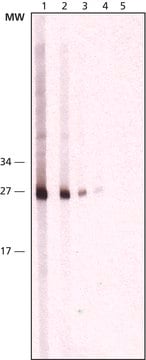
antigen 34 kDa, antigen 52 kDa (weaker band)

species reactivity

human

technique(s)

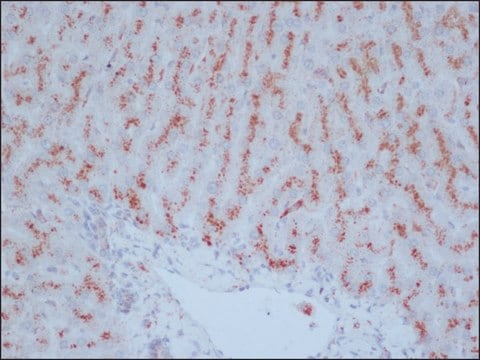
immunohistochemistry (formalin-fixed, paraffin-embedded sections): 1:200 using human breast carcinoma tissue, indirect ELISA: suitable, microarray: suitable, western blot: 1:1,000 using human breast carcinoma cell line extract

isotype

IgG2a

UniProt accession no.

shipped in

dry ice

storage temp.

−20°C

target post-translational modification

unmodified

Gene Information

human ... CTSD(1509)

General description

Cathepsins are lysosomal proteases that play an important role in the intracellular degradation of exogenous and endogenous proteins, in activation of enzyme precursors, and in tumor invasion and metastasis. They are normally localized in lysosomes of almost all mammalian cells, but under certain conditions they can be secreted from the cells.
Cathepsin D (CD, EC 3.4.23.5), an aspartyl endopeptidase, is induced by estrogen in certain estrogen receptor (ER)-positive breast cancer cell lines, but is produced constitutively by ER-negative cell lines. Cathepsin D is synthesized as a 52 kDa inactive precursor (pro-cathepsin D). Proteolytic removal of the amino-terminal 43 amino acid fragment and cleavage at an internal site results in an enzymatically active 48 kDa heterodimer consisting of two chains of 14 and 34 kDa.
The level of CD synthesized by cells is increased in response to mitogenic signals from estrogen, EGF, FGF, and IGF- I. The ability of tumor cells to invade the extracellular matrix has been attributed to cathepsins released by tumor cells or associated with the plasma membrane of tumor cells. CD is capable of digesting extracellular matrix proteins in in vivo models. Transfection of the CD gene into rat cells increases their tumorigenicity when injected into nude mice. Indeed, the concentrations of CD are significantly higher in breast carcinomas than in either normal breast tissues or benign breast tumors.

Immunogen

human liver cathepsin D.

Application

Applications in which this antibody has been used successfully, and the associated peer-reviewed papers, are given below.
Immunohistochemistry (1 paper)
Western Blotting (1 paper)
Monoclonal Anti-Cathepsin D may be used for the localization of cathepsin D using various immunochemical assays such as ELISA, immunoblotting, and immunohistochemistry. Antibodies that react specifically with cathepsin D may be used to study the distribution of CD in human breast cancers and to relate its concentrations to various biochemical, histological, and clinical characteristics.

Biochem/physiol Actions

Monoclonal Anti-Cathepsin D reacts specifically with cathepsin D (34 kDa with a weaker band at 52 kDa) in immunoblotting. It is also reactive in ELISA and in immunohistochemical staining of formalin-fixed paraffin-embedded human tissue sections. The product does not react with bovine cathepsins D and B, nor with human cathepsins B, C, G, and H.

Disclaimer

Unless otherwise stated in our catalog or other company documentation accompanying the product(s), our products are intended for research use only and are not to be used for any other purpose, which includes but is not limited to, unauthorized commercial uses, in vitro diagnostic uses, ex vivo or in vivo therapeutic uses or any type of consumption or application to humans or animals.

Confronta articoli simili

Visualizza il confronto per intero

Mostra le differenze

1 of 1

Questo articolo
SAB4200767C8243C6243
Gene Information

human ... CTSD(1509)

Gene Information

human ... CTSD(1509)

Gene Information

human ... CTSK(1513)

Gene Information

human ... CTSB(1508)
rat ... CTSB(64529)

clone

CTD-19, monoclonal

clone

CTD-19, monoclonal

clone

CL124-1H6, monoclonal

clone

CB59-4B11, monoclonal

conjugate

unconjugated

conjugate

unconjugated

conjugate

unconjugated

conjugate

unconjugated

biological source

mouse

biological source

mouse

biological source

mouse

biological source

mouse

antibody form

ascites fluid

antibody form

purified from hybridoma cell culture

antibody form

purified immunoglobulin

antibody form

purified immunoglobulin

species reactivity

human

species reactivity

human, rabbit

species reactivity

human

species reactivity

rat, human


Still not finding the right product?

Provate il nostro Motore di ricerca dei prodotti per restringere le opzioni.


Classe di stoccaggio

10 - Combustible liquids

wgk

WGK 3


Scegli una delle versioni più recenti:

Certificati d'analisi (COA)

Lot/Batch Number

Non trovi la versione di tuo interesse?

Se hai bisogno di una versione specifica, puoi cercare il certificato tramite il numero di lotto.

Possiedi già questo prodotto?

I documenti relativi ai prodotti acquistati recentemente sono disponibili nell’Archivio dei documenti.

Visita l’Archivio dei documenti


Maria Qatato et al.
Frontiers in pharmacology, 9, 221-221 (2018-04-05)
Trace amine-associated receptor 1 (Taar1) has been suggested as putative receptor of thyronamines. These are aminergic messengers with potential metabolic and neurological effects countering their contingent precursors, the thyroid hormones (THs). Recently, we found Taar1 to be localized at the
Arezoo Daryadel et al.
The Journal of biological chemistry, 281(37), 27653-27661 (2006-07-25)
Macrophage migration inhibitory factor (MIF) is an important cytokine involved in the regulation of innate immunity and present at increased levels during inflammatory responses. Here we demonstrate that mature blood and tissue neutrophils constitutively express MIF as a cytosolic protein
Amrita Khakurel et al.
Methods in molecular biology (Clifton, N.J.), 2557, 349-364 (2022-12-14)
The Golgi-associated retrograde protein (GARP) complex is proposed to tether endosome-derived transport vesicles, but the exact function and mechanism of GARP action are not completely understood. To uncover the GARP function in human cells, we employ CRISPR/Cas9 strategy and knock


Numero articolo commerciale globale

SKUGTIN
C0715-.5ML04061838162533

Questions

Reviews

No rating value

Active Filters