
33684

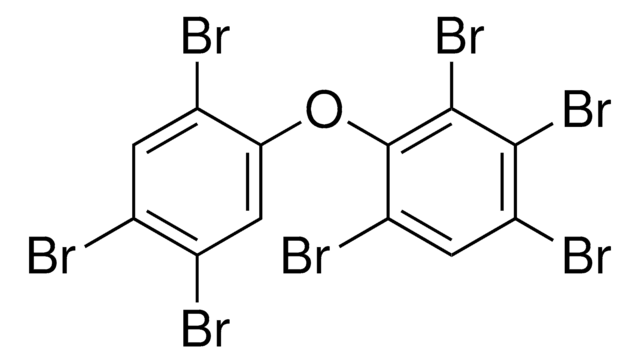
BDE Nr. 154
50 μg/mL in isooctane, analytical standard
Sinonimo/i:
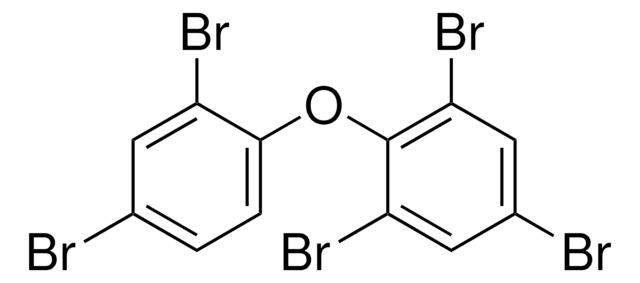
2,2′,4,4′,5,6′-Hexabromodiphenyl ether, PBDE 154
Scegli un formato
| Taglio della confezione | SKU | Disponibilità | Prezzo |
|---|---|---|---|
| 1 mL | Per conoscere la disponibilità, visualizza il carrello | CHF 470.00 |
Informazioni su questo articolo
grade
analytical standard
Quality Level
shelf life
limited shelf life, expiry date on the label
concentration
50 μg/mL in isooctane
technique(s)
HPLC: suitable, gas chromatography (GC): suitable
application(s)
environmental
format
single component solution
storage temp.
2-8°C
SMILES string
Brc1cc(Br)c(Oc2cc(Br)c(Br)cc2Br)c(Br)c1
InChI
1S/C12H4Br6O/c13-5-1-9(17)12(10(18)2-5)19-11-4-7(15)6(14)3-8(11)16/h1-4H
InChI key
VHNPZYZQKWIWOD-UHFFFAOYSA-N
General description
Application
- House dust samples using isotope dilution method combined with liquid chromatography coupled to negative ionization atmospheric pressure photoionization tandem mass spectrometry (LC-NI-APPI-MS/MS).
- Adipose tissue samples using gas chromatography coupled to ion-trap mass spectrometry (GC-ITMS).
Other Notes
The standard should be transferred to a clean and appropriate vial or flask using clean pipettes or micro pipettes. The vial should be immediately capped to avoid any loss or evaporation of the solvent.
After opening the ampoule, the standard should not be stored or kept in the ampoule. To preserve the integrity of the product, the standard should be transferred to an appropriate vial that must be capped and stored according to the recommendation on the Certificate of Analysis.
1 of 1
Questo articolo | |||
|---|---|---|---|
| grade analytical standard | grade analytical standard | grade analytical standard | grade analytical standard |
| format single component solution | format single component solution | format single component solution | format single component solution |
| application(s) environmental | application(s) environmental | application(s) environmental | application(s) environmental |
| concentration 50 μg/mL in isooctane | concentration 50 μg/mL in isooctane | concentration 50 μg/mL in isooctane | concentration 50 μg/mL in isooctane |
| storage temp. 2-8°C | storage temp. 2-8°C | storage temp. 2-8°C | storage temp. 2-8°C |
| shelf life limited shelf life, expiry date on the label | shelf life limited shelf life, expiry date on the label | shelf life limited shelf life, expiry date on the label | shelf life limited shelf life, expiry date on the label |




signalword
Danger
hcodes
Hazard Classifications
Aquatic Acute 1 - Aquatic Chronic 1 - Asp. Tox. 1 - Flam. Liq. 2 - Skin Irrit. 2 - STOT SE 3
target_organs
Central nervous system
Classe di stoccaggio
3 - Flammable liquids
wgk
WGK 2
flash_point_f
10.4 °F
flash_point_c
-12 °C
ppe
Eyeshields, Faceshields, Gloves, type ABEK (EN14387) respirator filter
Scegli una delle versioni più recenti:
Possiedi già questo prodotto?
I documenti relativi ai prodotti acquistati recentemente sono disponibili nell’Archivio dei documenti.
Numero articolo commerciale globale
| SKU | GTIN |
|---|---|
| 33684-1ML | 04061826743300 |