Passa al contenuto
Merck

Vai a

ABD29

Anti-Twist1 (Twist-related protein 1) Antibody

from rabbit, purified by affinity chromatography

Sinonimo/i:

Twist-related protein 1, Class A basic helix-loop-helix protein 38, bHLHa38, H-twist

Autenticati per visualizzare i prezzi organizzativi e contrattuali.

Scegli un formato

Cambia visualizzazione
Taglio della confezioneSKUDisponibilitàPrezzo

Informazioni su questo articolo

UNSPSC Code:
12352203
NACRES:
NA.41
eCl@ss:
32160702
Conjugate:
unconjugated
Clone:
polyclonal
Application:
ICC, IHC
Citations:
14
Prezzi e disponibilità al momento non sono disponibili
Servizio Tecnico
Hai bisogno di aiuto? Il nostro team di scienziati qualificati è a tua disposizione.
Permettici di aiutarti


biological source

rabbit

Quality Level

conjugate

unconjugated

antibody form

affinity isolated antibody

antibody product type

primary antibodies

clone

polyclonal

purified by

affinity chromatography

species reactivity

human, rhesus macaque, mouse, horse

species reactivity (predicted by homology)

canine (based on 100% sequence homology), pig (based on 100% sequence homology), equine (based on 100% sequence homology), chimpanzee (based on 100% sequence homology), rhesus monkey (based on 100% sequence homology), gorilla (based on 100% sequence homology)

packaging

antibody small pack of 25 μg

technique(s)

immunocytochemistry: suitable, immunohistochemistry: suitable (paraffin)

NCBI accession no.

UniProt accession no.

shipped in

ambient

storage temp.

2-8°C

target post-translational modification

unmodified

Gene Information

human ... TWIST1(7291)

General description

21 kDa calculated
Twist1 is the basic helix-loop-helix transcription factor that regulates embryonic progenitor and transformed tumor cell proliferation, migration and differentiation and is also important in limb development. It has been shown that twist1 expression is high in patients suffering from rheumatic inflammatory disorders with chronically activated T helper lymphocytes and may be used as a biomarker for chronic t-cell activation. Mutations in twist1 are often associated with craniofacial and limb abnormalities in humans with Saethre-Chotzen syndrome. Twist1 dimer affinity can modify the DNA binding affinity. Twist1 has also been implicated as a promoter of tumor growth, invasion and anti-cancer-drug resistance.

Immunogen

Epitope: Near N-terminus
KLH-conjugated linear peptide corresponding to human Twist1 near the N-terminus.

Application

Detect Twist1 (Twist-related protein 1) using this Anti-Twist1 (Twist-related protein 1) Antibody validated for use in IH(P) & IC.
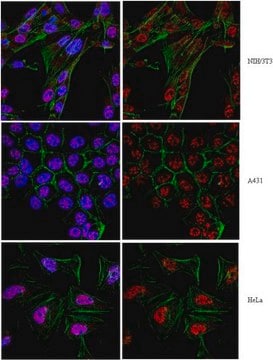
Immunocytochemistry Analysis: 1:500 dilution from a representative lot detected Twist1 in NIH/3T3, A431, and HeLa cells.
Research Category
Stem Cell Research
Research Sub Category
Transcription Factors

Biochem/physiol Actions

Other homologies: Rat (92% sequence homology).
This antibody recognizes Twist1 near the N-terminus.

Physical form

Affinity purified
Purified rabbit polyclonal in buffer containing 0.1 M Tris-Glycine (pH 7.4), 150 mM NaCl with 0.05% sodium azide.

Preparation Note

Stable for 1 year at 2-8°C from date of receipt.

Analysis Note

Control
Ductal breast fibroadenoma and stratified squamous epithelium and cartilage of human trachea tissues
Evaluated by Immunohistochemistry in ductal breast fibroadenoma and stratified squamous epithelium and cartilage of human trachea tissues.

Immunohistochemistry Analysis: 1:500 dilution of this antibody detected Twist1 in ductal breast fibroadenoma and stratified squamous epithelium and cartilage of human trachea tissues.

Other Notes

Concentration: Please refer to the Certificate of Analysis for the lot-specific concentration.

Disclaimer

Unless otherwise stated in our catalog or other company documentation accompanying the product(s), our products are intended for research use only and are not to be used for any other purpose, which includes but is not limited to, unauthorized commercial uses, in vitro diagnostic uses, ex vivo or in vivo therapeutic uses or any type of consumption or application to humans or animals.

Confronta articoli simili

Visualizza il confronto per intero

Mostra le differenze

1 of 1

Questo articolo
WH0007291M1SAB1409778SAB1411370
antibody form

affinity isolated antibody

antibody form

purified immunoglobulin

antibody form

purified immunoglobulin

antibody form

purified immunoglobulin

conjugate

unconjugated

conjugate

unconjugated

conjugate

unconjugated

conjugate

unconjugated

biological source

rabbit

biological source

mouse

biological source

mouse

biological source

rabbit

Quality Level

100

Quality Level

100

Quality Level

-

Quality Level

100

shipped in

ambient

shipped in

dry ice

shipped in

dry ice

shipped in

dry ice

clone

polyclonal

clone

3E11, monoclonal

clone

3H5, monoclonal

clone

polyclonal


Still not finding the right product?

Provate il nostro Motore di ricerca dei prodotti per restringere le opzioni.


Classe di stoccaggio

12 - Non Combustible Liquids

wgk

WGK 1

flash_point_f

Not applicable

flash_point_c

Not applicable


Certificati d'analisi (COA)

Cerca il Certificati d'analisi (COA) digitando il numero di lotto/batch corrispondente. I numeri di lotto o di batch sono stampati sull'etichetta dei prodotti dopo la parola ‘Lotto’ o ‘Batch’.

Possiedi già questo prodotto?

I documenti relativi ai prodotti acquistati recentemente sono disponibili nell’Archivio dei documenti.

Visita l’Archivio dei documenti


Maria-Vittoria Sepporta et al.
Communications biology, 5(1), 42-42 (2022-01-14)
The embryonic transcription factors TWIST1/2 are frequently overexpressed in cancer, acting as multifunctional oncogenes. Here we investigate their role in neuroblastoma (NB), a heterogeneous childhood malignancy ranging from spontaneous regression to dismal outcomes despite multimodal therapy. We first reveal the
Xiaoyin Lu et al.
Placenta, 39, 45-54 (2016-03-20)
The multinucleated syncytiotrophoblast (STB) is maintained and regenerated by the fusion of underlying cytotrophoblast cells (CTBs) and is responsible for a number of functions in the human placenta. Deficiencies in this structure may result in pregnancy-associated diseases. However, the detailed
Xingbo Xu et al.
Circulation research, 116(5), 857-866 (2015-01-15)
Endocardial fibroelastosis (EFE) is a unique form of fibrosis, which forms a de novo subendocardial tissue layer encapsulating the myocardium and stunting its growth, and which is typically associated with congenital heart diseases of heterogeneous origin, such as hypoplastic left


Numero articolo commerciale globale

SKUGTIN
ABD29-25UG04054839342585

Questions

Reviews

No rating value

Active Filters