
AB15097

Anti-mGluR4 Antibody
from rabbit
Sinonimo/i:
glutamate metabotropic receptor 4, glutamate receptor, metabotropic 4
Scegli un formato
| Taglio della confezione | SKU | Disponibilità | Prezzo |
|---|---|---|---|
| 50 μg | Per conoscere la disponibilità, visualizza il carrello | CHF 417.00 |
Informazioni su questo articolo
biological source
rabbit
Quality Level
conjugate
unconjugated
antibody form
affinity isolated antibody
antibody product type
primary antibodies
clone
polyclonal
species reactivity
mouse, rat
technique(s)
western blot: suitable
NCBI accession no.
UniProt accession no.
shipped in
wet ice
target post-translational modification
unmodified
Gene Information
mouse ... Grm4(268934)
General description
Immunogen
Application
Neuroscience
Neurotransmitters & Receptors
Biochem/physiol Actions
Physical form
Preparation Note
Analysis Note
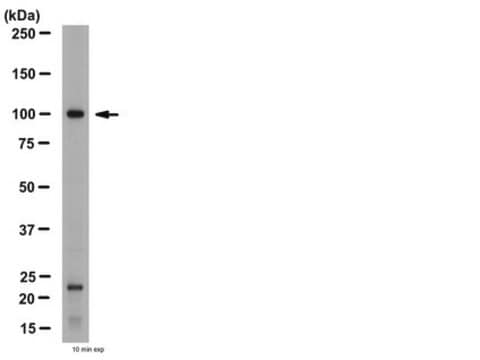
Mouse Brain Lysate.
Mouse Brain Lysate.
Other Notes
Disclaimer
1 of 1
Questo articolo | |||
|---|---|---|---|
| biological source rabbit | biological source rabbit | biological source mouse | biological source rabbit |
| Quality Level 100 | Quality Level 200 | Quality Level - | Quality Level 100 |
| antibody form affinity isolated antibody | antibody form affinity isolated antibody | antibody form purified immunoglobulin | antibody form affinity isolated antibody |
| conjugate unconjugated | conjugate unconjugated | conjugate unconjugated | conjugate unconjugated |
| UniProt accession no. | UniProt accession no. | UniProt accession no. | UniProt accession no. |
| clone polyclonal | clone polyclonal | clone polyclonal | clone polyclonal |

Still not finding the right product?
Provate il nostro Motore di ricerca dei prodotti per restringere le opzioni.
Classe di stoccaggio
12 - Non Combustible Liquids
wgk
WGK 1
flash_point_f
Not applicable
flash_point_c
Not applicable
Certificati d'analisi (COA)
Cerca il Certificati d'analisi (COA) digitando il numero di lotto/batch corrispondente. I numeri di lotto o di batch sono stampati sull'etichetta dei prodotti dopo la parola ‘Lotto’ o ‘Batch’.
Possiedi già questo prodotto?
I documenti relativi ai prodotti acquistati recentemente sono disponibili nell’Archivio dei documenti.
Contenuto correlato
Glutamate is an excitatory neurotransmitter found in the synaptic vesicles of glutamatergic synapses. The post-synaptic neurons in these synapses contain ionotropic and metabotropic glutamate receptors. Glutamate binds to AMPA (α-amino-3-hydroxy-5- methylisoxazole-4-propionic acid) subtype glutamate receptors, leading to sodium influx into the post-synaptic cell and resulting in neuronal excitability and synaptic transmission. The NMDA (N-methyl-d-aspartate) subtype glutamate receptors, on the other hand, regulate synaptic plasticity, and can influence learning and memory. The metabotropic g-protein coupled mGluRs modulate downstream calcium signaling pathways and indirectly influence the synapse’s excitability. The synaptic architecture includes intracellular scaffolding proteins (PSD-95, GRIP), intercellular cell adhesion molecules (NCAMs, N-Cadherins), and a variety of signaling proteins (CaMKII/PKA, PP1/PP2B). Processes critical for synaptic transmission and plasticity are influenced by these molecules and their interactions. When the function of these molecules is disrupted, it leads to synaptic dysfunction and degeneration, and can contribute to dementia as seen in Alzheimer’s disease.
Numero articolo commerciale globale
| SKU | GTIN |
|---|---|
| AB15097 | 04053252739743 |