
07-645

Anticorpo anti-Sp1
Upstate®, from rabbit
Sinonimo/i:
Sp1 transcription factor, specificity protein 1
Scegli un formato
| Taglio della confezione | SKU | Disponibilità | Prezzo |
|---|
Informazioni su questo articolo
biological source
rabbit
Quality Level
conjugate
unconjugated
antibody form
purified immunoglobulin
antibody product type
primary antibodies
clone
polyclonal
species reactivity
mouse, human, rat
packaging
antibody small pack of 25 μg
manufacturer/tradename
Upstate®
technique(s)
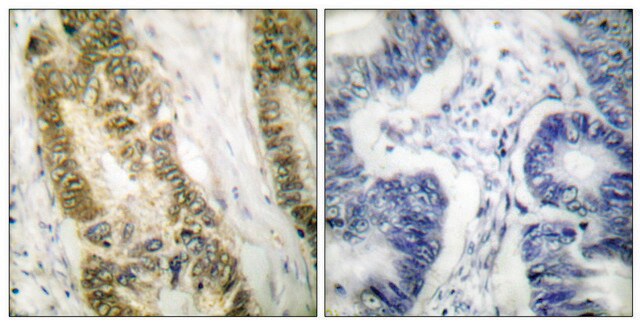
ChIP: suitable, electrophoretic mobility shift assay: suitable, immunofluorescence: suitable, immunoprecipitation (IP): suitable, western blot: suitable
isotype
IgG
NCBI accession no.
UniProt accession no.
shipped in
ambient
target post-translational modification
unmodified
Gene Information
human ... SP1(6667)
General description
Immunogen
Application
Epigenetica & funzione nucleare
con 4 µg di un lotto di questo anticorpo è stata ottenuta l'immunoprecipitazione di Sp1 da 500 µg di estratto nucleare di cellule HeLa.
NOTA: la subunità α-1 è stata immunoprecipitata utilizzando un lotto rappresentativo di questo anticorpo insieme al sistema di immunoprecipitazione reversibile Catch and Release v2.0 (N° Cat. 17-500). Per maggiori informazioni e per il protocollo, si rimanda al sito www.millipore.com
Immunoprecipitazione della cromatina:
riportata da un laboratorio indipendente.
Immunofluorescenza:
riportata da un laboratorio indipendente.
Saggio di spostamento della mobilità elettroforetica (EMSA):
come riportato da un laboratorio indipendente, in un saggio EMSA l'uso di 1 µL di un lotto rappresentativo ha causato un netto rallentamento dei complessi di DNA contenenti Sp1 ricombinante e Sp1 endogena ottenuta da cellule HeLa.
Fattori di trascrizione
Biochem/physiol Actions
Physical form
Preparation Note
Analysis Note
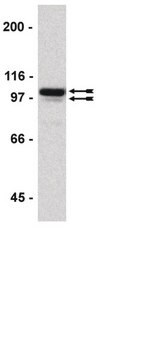
Controllo antigenico positivo: N.Cat. 12-309, estratto nucleare di cellule HeLa. A 10 μL di lisato aggiungere un egual volume di tampone riducente Laemmli e fare bollire per 5 minuti per ottenere un campione ridotto. Caricare 20 μg di lisato ridotto/pozzetto in un minigel.
Saggio di Western blotting:
questo anticorpo alla diluizione 1:500 ha permesso di rivelare la proteina SP1 in 10 μg di lisato di cellule HeLa.
Other Notes
Legal Information
Disclaimer
1 of 1
Questo articolo | |||
|---|---|---|---|
| conjugate unconjugated | conjugate unconjugated | conjugate unconjugated | conjugate - |
| biological source rabbit | biological source rabbit | biological source mouse | biological source rabbit |
| antibody form purified immunoglobulin | antibody form affinity isolated antibody | antibody form purified immunoglobulin | antibody form - |
| species reactivity mouse, human, rat | species reactivity rat, human, mouse | species reactivity mouse | species reactivity rat, human, mouse |
| clone polyclonal | clone polyclonal | clone 1A5, monoclonal | clone polyclonal |
| technique(s) ChIP: suitable, immunofluorescence: suitable, western blot: suitable, electrophoretic mobility shift assay: suitable, immunoprecipitation (IP): suitable | technique(s) ELISA: 1:20000, immunofluorescence: 1:100-1:500, immunohistochemistry: 1:50-1:100, western blot: 1:500-1:1000 | technique(s) immunohistochemistry (formalin-fixed, paraffin-embedded sections): suitable, indirect ELISA: suitable, indirect immunofluorescence: suitable, western blot: 1-5 μg/mL | technique(s) ChIP: suitable, western blot: suitable |


Still not finding the right product?
Explore all of our products under Anticorpo anti-Sp1
— o —
Provate il nostro Motore di ricerca dei prodotti per restringere le opzioni.
Classe di stoccaggio
12 - Non Combustible Liquids
wgk
WGK 1
flash_point_f
Not applicable
flash_point_c
Not applicable
Certificati d'analisi (COA)
Cerca il Certificati d'analisi (COA) digitando il numero di lotto/batch corrispondente. I numeri di lotto o di batch sono stampati sull'etichetta dei prodotti dopo la parola ‘Lotto’ o ‘Batch’.
Possiedi già questo prodotto?
I documenti relativi ai prodotti acquistati recentemente sono disponibili nell’Archivio dei documenti.
Contenuto correlato
Cancer is a complex disease manifestation. At its core, it remains a disease of abnormal cellular proliferation and inappropriate gene expression. In the early days, carcinogenesis was viewed simply as resulting from a collection of genetic mutations that altered the gene expression of key oncogenic genes or tumor suppressor genes leading to uncontrolled growth and disease (Virani, S et al 2012). Today, however, research is showing that carcinogenesis results from the successive accumulation of heritable genetic and epigenetic changes. Moreover, the success in how we predict, treat and overcome cancer will likely involve not only understanding the consequences of direct genetic changes that can cause cancer, but also how the epigenetic and environmental changes cause cancer (Johnson C et al 2015; Waldmann T et al 2013). Epigenetics is the study of heritable gene expression as it relates to changes in DNA structure that are not tied to changes in DNA sequence but, instead, are tied to how the nucleic acid material is read or processed via the myriad of protein-protein, protein-nucleic acid, and nucleic acid-nucleic acid interactions that ultimately manifest themselves into a specific expression phenotype (Ngai SC et al 2012, Johnson C et al 2015). This review will discuss some of the principal aspects of epigenetic research and how they relate to our current understanding of carcinogenesis. Because epigenetics affects phenotype and changes in epigenetics are thought to be key to environmental adaptability and thus may in fact be reversed or manipulated, understanding the integration of experimental and epidemiologic science surrounding cancer and its many manifestations should lead to more effective cancer prognostics as well as treatments (Virani S et al 2012).
Numero articolo commerciale globale
| SKU | GTIN |
|---|---|
| 07-645-25UG | 04054839337390 |