
07-448

Anti-monomethyl-Histone H3 (Lys27) Antibody
Upstate®, from rabbit
Sinonimo/i:
H3K27me1, Histone H3 (mono methyl K27), H3 histone family, member T, histone 3, H3, histone cluster 3, H3, H3K27me1
Scegli un formato
| Taglio della confezione | SKU | Disponibilità | Prezzo |
|---|---|---|---|
| 200 μg | Per conoscere la disponibilità, visualizza il carrello | CHF 529.00 |
Informazioni su questo articolo
biological source
rabbit
Quality Level
antibody form
purified antibody
antibody product type
primary antibodies
clone
polyclonal
species reactivity
human, vertebrates
manufacturer/tradename
Upstate®
technique(s)
ChIP: suitable (ChIP-seq), dot blot: suitable, immunocytochemistry: suitable, western blot: suitable
isotype
IgG
NCBI accession no.
UniProt accession no.
shipped in
wet ice
target post-translational modification
monomethylation (Lys27)
Gene Information
human ... HIST1H3F(8968)
General description
Immunogen
Application
Reported by an independent laboratory (Kohlmaier, A., 2004; Perez-Burgos, L., 2004; Peters, A. H., 2003).
Epigenetics & Nuclear Function
Histones
Biochem/physiol Actions
Physical form
Preparation Note
Analysis Note
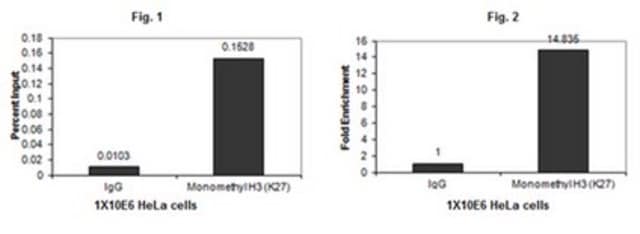
HeLa acid extract
Western Blot Analysis:
0.1-0.2 μg/mL had detected monomethylated histone H3 in acid extracted proteins from HeLa cells.
Other Notes
Legal Information
Disclaimer
1 of 1
Questo articolo | |||
|---|---|---|---|
| biological source rabbit | biological source rabbit | biological source rabbit | biological source rabbit |
| antibody form purified antibody | antibody form purified immunoglobulin | antibody form purified immunoglobulin | antibody form purified immunoglobulin |
| species reactivity human, vertebrates | species reactivity human, mouse | species reactivity human, vertebrates | species reactivity chicken, mouse, human |
| clone polyclonal | clone polyclonal | clone polyclonal | clone polyclonal |
| UniProt accession no. | UniProt accession no. | UniProt accession no. | UniProt accession no. |
| technique(s) ChIP: suitable (ChIP-seq), immunocytochemistry: suitable, dot blot: suitable, western blot: suitable | technique(s) immunocytochemistry: suitable, immunohistochemistry: suitable, immunoprecipitation (IP): suitable, multiplexing: suitable, western blot: suitable | technique(s) ChIP: suitable (ChIP-seq), dot blot: suitable, immunocytochemistry: suitable, western blot: suitable | technique(s) dot blot: suitable, immunocytochemistry: suitable, inhibition assay: suitable (peptide), western blot: suitable |


Still not finding the right product?
Provate il nostro Motore di ricerca dei prodotti per restringere le opzioni.
Classe di stoccaggio
12 - Non Combustible Liquids
wgk
WGK 1
flash_point_f
Not applicable
flash_point_c
Not applicable
Certificati d'analisi (COA)
Cerca il Certificati d'analisi (COA) digitando il numero di lotto/batch corrispondente. I numeri di lotto o di batch sono stampati sull'etichetta dei prodotti dopo la parola ‘Lotto’ o ‘Batch’.
Possiedi già questo prodotto?
I documenti relativi ai prodotti acquistati recentemente sono disponibili nell’Archivio dei documenti.
Contenuto correlato
"Epigenetics describes heritable changes in gene expression caused by non-genetic mechanisms instead of by alterations in DNA sequence. These changes can be cell- or tissue-specific, and can be passed on to multiple generations. Epigenetic regulation enriches DNAbased information, allowing a cell to vary its response across diverse biological and environmental contexts. Although epigenetic mechanisms are primarily centered in the nucleus, these mechanisms can be induced by environmental signals such as hormones, nutrients, stress, and cellular damage, pointing to the involvement of cytoplasmic and extracellular factors in epigenetic regulation."
Signaling Product Guide: Antibodies, small molecule inhibitors, kits, assays and proteins for signaling research.
Cancer is a complex disease manifestation. At its core, it remains a disease of abnormal cellular proliferation and inappropriate gene expression. In the early days, carcinogenesis was viewed simply as resulting from a collection of genetic mutations that altered the gene expression of key oncogenic genes or tumor suppressor genes leading to uncontrolled growth and disease (Virani, S et al 2012). Today, however, research is showing that carcinogenesis results from the successive accumulation of heritable genetic and epigenetic changes. Moreover, the success in how we predict, treat and overcome cancer will likely involve not only understanding the consequences of direct genetic changes that can cause cancer, but also how the epigenetic and environmental changes cause cancer (Johnson C et al 2015; Waldmann T et al 2013). Epigenetics is the study of heritable gene expression as it relates to changes in DNA structure that are not tied to changes in DNA sequence but, instead, are tied to how the nucleic acid material is read or processed via the myriad of protein-protein, protein-nucleic acid, and nucleic acid-nucleic acid interactions that ultimately manifest themselves into a specific expression phenotype (Ngai SC et al 2012, Johnson C et al 2015). This review will discuss some of the principal aspects of epigenetic research and how they relate to our current understanding of carcinogenesis. Because epigenetics affects phenotype and changes in epigenetics are thought to be key to environmental adaptability and thus may in fact be reversed or manipulated, understanding the integration of experimental and epidemiologic science surrounding cancer and its many manifestations should lead to more effective cancer prognostics as well as treatments (Virani S et al 2012).