Direkt zum Inhalt
Merck

Fortfahren mit

F6258

Anti-Rat IgG (whole molecule)–FITC antibody produced in goat

affinity isolated antibody, buffered aqueous solution

Synonym(e):

Goat Anti-Rat IgG (whole molecule)–Fluorescein isothiocyanate

Anmelden zur Ansicht der Organisations- und Vertragspreise.

Größe auswählen

Ansicht ändern
PackungsgrößeSKUVerfügbarkeitPreis
0.5 mL
Warenkorb auf Verfügbarkeit prüfen
CHF 86.00
1 mL
Warenkorb auf Verfügbarkeit prüfen
CHF 169.00
CHF 143.65
2 mL
Warenkorb auf Verfügbarkeit prüfen
CHF 256.00
CHF 217.60

Über diesen Artikel

UNSPSC Code:
12352203
NACRES:
NA.46
MDL number:
Conjugate:
FITC conjugate
Clone:
polyclonal
Application:
IF (d)
Citations:
51

CHF 86.00


Warenkorb auf Verfügbarkeit prüfen

Großbestellung anfragen
Technischer Dienst
Benötigen Sie Hilfe? Unser Team von erfahrenen Wissenschaftlern ist für Sie da.
Unterstützung erhalten


biological source

goat

Quality Level

conjugate

FITC conjugate

antibody form

affinity isolated antibody

antibody product type

secondary antibodies

clone

polyclonal

form

buffered aqueous solution

technique(s)

direct immunofluorescence: 1:32

storage temp.

2-8°C

target post-translational modification

unmodified

General description

An immunoglobulin has two heavy chain and two light chain connected by disulfide bond. It mainly helps in immune defense. It is a glycoprotein. IgG is a major class of immunoglobulin. Immunoglobulin G (IgG) participates in hypersensitivity type II and type III. Rat has five immunoglobulin classes- IgM, IgG, IgA, IgD and IgGE. IgG has four subclasses- IgG1, IgG2a, IgG2b and IgG2c. It helps in opsonization, complement fixation and antibody dependent cell mediated cytotoxicity.
IgG antibody subtype is the most abundant serum immunoglobulins of the immune system. It is secreted by B cells and is found in blood and extracellular fluids and provides protection from infections caused by bacteria, fungi and viruses. Maternal IgG is transferred to fetus through the placenta that is vital for immune defence of the neonate against infections. Anti-Rat IgG (whole molecule)-FITC antibody is specific for all rat IgG subclasses. Goat anti-rat IgG is purified by affinity isolation and then conjugated to FITC.
IgG is the main antibody type found in plasma and extracellular fluid and is expressed on B cell membrane. It regulates several functions such as complement activation and phagocytosis and hence plays a pivotal role in facilitating cytological immune responses. Anti-rat IgG (whole molecule)-FITC antibody can be used as a secondary antibody in indirect immunofluorescence. Goat anti- rat IgG (whole molecule)-FITC antibody reacts specifically with all rat immunoglobulins.

Immunogen

Purified rat IgG
Purified rat IgG.

Application

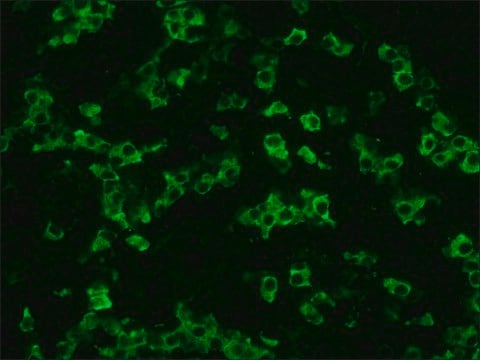
Anti-Rat IgG (whole molecule)−FITC antibody has been used in immunofluorescence measurement of antibody-treated cells and staining of monolayers.
Anti-Rat IgG (whole molecule)-FITC antibody may be used for immunofluorescent labeling of rat spleen cells. For immunofluorescence of rat cartilage tissue sections, a concentration of 5-10 μg/ml was used. The range of dilutions of anti-rat IgG used for immunofluorescence is between 1:10 and 1:250 in various studies.. The antibody was also used in flow cytometry applications.
Anti-rat IgG (whole molecule)-FITC antibody (diluted 1:20 in PBS) can be used as a secondary antibody in immunolabelling. It can also be used in flow cytometry.

Physical form

Solution in 0.01 M phosphate buffered saline, pH 7.4, containing 1% bovine serum albumin and 15 mM sodium azide

Disclaimer

Unless otherwise stated in our catalog or other company documentation accompanying the product(s), our products are intended for research use only and are not to be used for any other purpose, which includes but is not limited to, unauthorized commercial uses, in vitro diagnostic uses, ex vivo or in vivo therapeutic uses or any type of consumption or application to humans or animals.

Ähnliche Artikel vergleichen

Vollständigen Vergleich anzeigen

Unterschiede anzeigen

1 of 1

Dieser Artikel
F1763F0382F2012
antibody form

affinity isolated antibody

antibody form

affinity isolated antibody

antibody form

affinity isolated antibody

antibody form

affinity isolated antibody

technique(s)

direct immunofluorescence: 1:32

technique(s)

immunohistochemistry (formalin-fixed, paraffin-embedded sections): 1:320, indirect immunofluorescence: 1:320

technique(s)

indirect immunofluorescence: 1:80

technique(s)

direct immunofluorescence: 1:64 (minimum)

conjugate

FITC conjugate

conjugate

FITC conjugate

conjugate

FITC conjugate

conjugate

FITC conjugate

biological source

goat

biological source

rabbit

biological source

goat

biological source

goat

clone

polyclonal

clone

polyclonal

clone

polyclonal

clone

polyclonal

storage temp.

2-8°C

storage temp.

−20°C

storage temp.

2-8°C

storage temp.

2-8°C


Still not finding the right product?

Probieren Sie unser Produkt-Auswahlhilfe, um Ihre Auswahl einzugrenzen


Lagerklasse

10 - Combustible liquids

flash_point_f

Not applicable

flash_point_c

Not applicable


Hier finden Sie alle aktuellen Versionen:

Analysenzertifikate (COA)

Lot/Batch Number

Die passende Version wird nicht angezeigt?

Wenn Sie eine bestimmte Version benötigen, können Sie anhand der Lot- oder Chargennummer nach einem spezifischen Zertifikat suchen.

Besitzen Sie dieses Produkt bereits?

In der Dokumentenbibliothek finden Sie die Dokumentation zu den Produkten, die Sie kürzlich erworben haben.

Die Dokumentenbibliothek aufrufen


Receptors involved in lymphocyte homing: relationship between a carbohydrate-binding receptor and the MEL-14 antigen.
Yednock T A, et al.
The Journal of cell biology, 104(3), 725-731 (1987)
Yung-I Lee et al.
American journal of botany, 100(11), 2121-2131 (2013-10-19)
Protocorm-like bodies (PLBs) of orchids are important in orchid micropropagation and outwardly resemble somatic embryos in form and development. To determine whether PLBs are truly embryogenetic, we compared PLBs with somatic embryos and zygotic embryos to determine whether they had
Aged HCT-8 cell monolayers support Cryptosporidium parvum infection
Sifuentes L Y, et al.
Applied and Environmental Microbiology, 73(23), 7548-7551 (2007)


Global Trade Item Number

SKUGTIN
F6258-2ML04061833618585
F6258-.5ML04061837516986
F6258-1ML04061833618578

Questions

Reviews

No rating value

Active Filters