Direkt zum Inhalt
Merck

Fortfahren mit

A8848

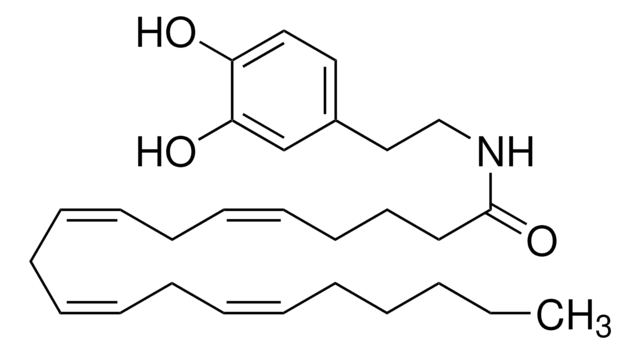
Arachidonoyl dopamine

≥98% (HPLC), ethanol solution

Synonym(e):

AA-DA, Arachidonyl dopamine, N-[2,3-(4-Dihydroxyphenyl)ethyl]-5Z,8Z,11Z,14Z-eicosatetraenamide, NADA

Anmelden zur Ansicht der Organisations- und Vertragspreise.

Größe auswählen

Ansicht ändern
PackungsgrößeSKUVerfügbarkeitPreis
5 mg
Warenkorb auf Verfügbarkeit prüfen
CHF 177.00

Über diesen Artikel

Empirische Formel (Hill-System):
C28H41NO3
Molekulargewicht:
439.63
NACRES:
NA.77
PubChem Substance ID:
UNSPSC Code:
12352116
MDL number:
Assay:
≥98% (HPLC)
Form:
ethanol solution
Quality level:

CHF 177.00


Warenkorb auf Verfügbarkeit prüfen

Großbestellung anfragen
Technischer Dienst
Benötigen Sie Hilfe? Unser Team von erfahrenen Wissenschaftlern ist für Sie da.
Unterstützung erhalten


Quality Level

assay

≥98% (HPLC)

form

ethanol solution

drug control

regulated under CDSA - not available from Sigma-Aldrich Canada

shipped in

wet ice

storage temp.

−20°C

SMILES string

CCCCC\C=C/C\C=C/C\C=C/C\C=C/CCCC(=O)NCCc1ccc(O)c(O)c1

InChI

1S/C28H41NO3/c1-2-3-4-5-6-7-8-9-10-11-12-13-14-15-16-17-18-19-28(32)29-23-22-25-20-21-26(30)27(31)24-25/h6-7,9-10,12-13,15-16,20-21,24,30-31H,2-5,8,11,14,17-19,22-23H2,1H3,(H,29,32)/b7-6-,10-9-,13-12-,16-15-

InChI key

MVVPIAAVGAWJNQ-DOFZRALJSA-N

General description

The endogenous cannabinoid system is comprised of two cannabinoid-receptor subtypes (CB1 and CB2 endocannabinoids (endogenous agonists of the receptors), and other supporting proteins.[1] This system is involved in brain neuromodulation and has been reported to affect physiological processes such as appetite, pain, and movement, as well as others. Arachidonoyl Dopamine (AA-DA) is the amide of the neurotransmitter bioactive amine, dopamine, and the polyunsaturated fatty acid, arachidonic acid. AA-DA displays cannabimimetic activity in vitro and in vivo, has been shown to activate the CB1 receptor, and is a ligand for the endogenous VR1 vanilloid receptor.

Application

Used in studies of the endogenous cannabinoid system.

Biochem/physiol Actions

AA-DA competitively inhibits fatty acid amide hydrolase (IC50 = approx. 22 μM) from N18TG2 neuroblastoma cells and inhibits binding (Ki = 0.25 μM) of the selective cannabinoid receptor subtype 1 (CB1) ligand, [3H]SR141716A, to rat brain membrane. AA-DA also inhibits the anandamide membrane transporter in BL-2H3 basophilic leukemia and C6 glioma cells.[1] AA-DA has at least a 40 fold greater selectivity for CB1 than CB2 receptors in rat brain membranes and has been shown to be more potent than anandamide as a CB1 agonist in undifferentiated N18TG2 neuroblastoma cells. AA-DA induces hypothermia and immobility, and decreases spontaneous activity and pain perception in mice and rats, which supports its action as a CB1 agonist in vivo.[1][2] AA-DA has been shown to inhibit (IC50 = 0.25 μM) proliferation of human breast MCF-7 cancer cells.

Ähnliche Artikel vergleichen

Vollständigen Vergleich anzeigen

Unterschiede anzeigen

1 of 1

Dieser Artikel
SML0563SML0384857465W
AEA-d4 C20:4 anandamide-d4, methanol solution

Avanti

857465W

AEA-d4

assay

≥98% (HPLC)

assay

≥98% (HPLC)

assay

≥98% (HPLC)

assay

>99% (TLC)

form

ethanol solution

form

ethanol solution (5 mg/ml)

form

solution

form

methanol solution

drug control

regulated under CDSA - not available from Sigma-Aldrich Canada

drug control

regulated under CDSA - not available from Sigma-Aldrich Canada

drug control

regulated under CDSA - not available from Sigma-Aldrich Canada

drug control

-

Quality Level

200

Quality Level

100

Quality Level

100

Quality Level

-

storage temp.

−20°C

storage temp.

−20°C

storage temp.

−20°C

storage temp.

−20°C

shipped in

wet ice

shipped in

dry ice

shipped in

-

shipped in

dry ice


pictograms

FlameExclamation mark

signalword

Danger

hcodes

Hazard Classifications

Eye Irrit. 2 - Flam. Liq. 2

Lagerklasse

3 - Flammable liquids

wgk

WGK 3

flash_point_f

57.2 °F - closed cup

flash_point_c

14.0 °C - closed cup


Hier finden Sie alle aktuellen Versionen:

Analysenzertifikate (COA)

Lot/Batch Number

Die passende Version wird nicht angezeigt?

Wenn Sie eine bestimmte Version benötigen, können Sie anhand der Lot- oder Chargennummer nach einem spezifischen Zertifikat suchen.

Besitzen Sie dieses Produkt bereits?

In der Dokumentenbibliothek finden Sie die Dokumentation zu den Produkten, die Sie kürzlich erworben haben.

Die Dokumentenbibliothek aufrufen


T Bisogno et al.
The Biochemical journal, 351 Pt 3, 817-824 (2000-10-24)
We reported previously that synthetic amides of polyunsaturated fatty acids with bioactive amines can result in substances that interact with proteins of the endogenous cannabinoid system (ECS). Here we synthesized a series of N-acyl-dopamines (NADAs) and studied their effects on
Tim Ruhl et al.
Experimental cell research, 370(2), 653-662 (2018-07-24)
Multipotent mesenchymal stromal cells (MSCs) support wound healing processes. These cells express toll-like receptors (TLRs). TLRs perform important key functions when the immune system is confronted with danger signals. TLR ligation by lipopolysaccharides (LPS) activates MSCs and induces intracellular signaling
Rakesh Kumar et al.
The Journal of biological chemistry, 291(26), 13855-13863 (2016-05-05)
Vanilloids are pain evoking molecules that serve as ligands of the "heat and capsaicin receptor" TRPV1. Binding of either endogenous or exogenous vanilloids evokes channel and subsequent neuronal activation, leading to pain sensation. Despite its pivotal physiological role, the molecular


Global Trade Item Number

SKUGTIN
A8848-5MG04061833400852

Questions

Reviews

No rating value

Active Filters