Direkt zum Inhalt
Merck

Fortfahren mit

33441

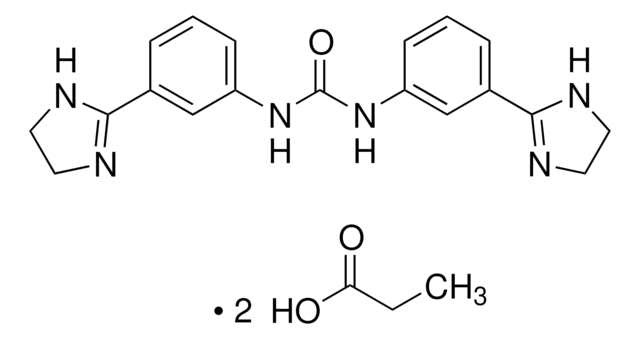
Imidocarb-dipropionat

VETRANAL®, analytical standard

Synonym(e):

N,N′-Bis-[3-(4,5-dihydro-1H-imidazol-2-yl)-phenyl]-harnstoff-dipropanoat

Anmelden zur Ansicht der Organisations- und Vertragspreise.

Größe auswählen

Ansicht ändern
PackungsgrößeSKUVerfügbarkeitPreis
50 mg
Warenkorb auf Verfügbarkeit prüfen
CHF 209.00

Über diesen Artikel

Empirische Formel (Hill-System):
C25H32N6O5
CAS-Nummer:
Molekulargewicht:
496.56
NACRES:
NA.24
PubChem Substance ID:
UNSPSC Code:
41116107
EC Number:
259-791-8
MDL number:

CHF 209.00


Warenkorb auf Verfügbarkeit prüfen

Großbestellung anfragen
Technischer Dienst
Benötigen Sie Hilfe? Unser Team von erfahrenen Wissenschaftlern ist für Sie da.
Unterstützung erhalten


grade

analytical standard

Quality Segment

product line

VETRANAL®

shelf life

limited shelf life, expiry date on the label

technique(s)

HPLC: suitable, gas chromatography (GC): suitable

mp

205 °C (dec.) (lit.)

application(s)

clinical testing

format

neat

SMILES string

CCC(O)=O.CCC(O)=O.O=C(Nc1cccc(c1)C2=NCCN2)Nc3cccc(c3)C4=NCCN4

InChI

1S/C19H20N6O.2C3H6O2/c26-19(24-15-5-1-3-13(11-15)17-20-7-8-21-17)25-16-6-2-4-14(12-16)18-22-9-10-23-18;2*1-2-3(4)5/h1-6,11-12H,7-10H2,(H,20,21)(H,22,23)(H2,24,25,26);2*2H2,1H3,(H,4,5)

InChI key

AFGQXWSHYUHHNV-UHFFFAOYSA-N

General description

Imidocarb dipropionate is an antibiotic and diaminide of the carbanilide series of antiprotozoal compounds. It is commonly used in animals like horses, where it is found to be effective in inhibiting the Theileria equi strains causing infections.

Application

Refer to the product′s Certificate of Analysis for more information on a suitable instrument technique. Contact Technical Service for further support.

Legal Information

VETRANAL is a registered trademark of Merck KGaA, Darmstadt, Germany

Ähnliche Artikel vergleichen

Vollständigen Vergleich anzeigen

Unterschiede anzeigen

1 of 1

Dieser Artikel
317384682646494
technique(s)

HPLC: suitable, gas chromatography (GC): suitable

technique(s)

HPLC: suitable, gas chromatography (GC): suitable

technique(s)

HPLC: suitable, gas chromatography (GC): suitable

technique(s)

HPLC: suitable, gas chromatography (GC): suitable

application(s)

clinical testing

application(s)

clinical testing

application(s)

clinical testing

application(s)

clinical testing

format

neat

format

neat

format

neat

format

neat

Quality Level

100

Quality Level

100

Quality Level

200

Quality Level

200

grade

analytical standard

grade

analytical standard

grade

analytical standard

grade

analytical standard

shelf life

limited shelf life, expiry date on the label

shelf life

limited shelf life, expiry date on the label

shelf life

limited shelf life, expiry date on the label

shelf life

limited shelf life, expiry date on the label


pictograms

Exclamation mark

signalword

Warning

hcodes

Hazard Classifications

Acute Tox. 4 Oral

Lagerklasse

11 - Combustible Solids

wgk

WGK 3

ppe

dust mask type N95 (US), Eyeshields, Gloves


Hier finden Sie alle aktuellen Versionen:

Analysenzertifikate (COA)

Lot/Batch Number

Die passende Version wird nicht angezeigt?

Wenn Sie eine bestimmte Version benötigen, können Sie anhand der Lot- oder Chargennummer nach einem spezifischen Zertifikat suchen.

Besitzen Sie dieses Produkt bereits?

In der Dokumentenbibliothek finden Sie die Dokumentation zu den Produkten, die Sie kürzlich erworben haben.

Die Dokumentenbibliothek aufrufen


Gerhard Bringmann et al.
Veterinary parasitology, 283, 109177-109177 (2020-07-07)
Babesia canis is the predominant and clinically relevant canine Babesia species in Europe. Transmitted by vector ticks, the parasite enters red blood cells and induces a severe, potentially fatal hemolytic anemia. Here, we report on the antibabesial activities of three
Asier Galán et al.
PloS one, 13(1), e0190474-e0190474 (2018-01-06)
Canine babesiosis caused by the intraerythrocytic protozoan parasite Babesia canis is a tick-borne disease characterized by a host response that involves both cellular and humoral immunity. This study focuses on the secretion of cytokines Granulocyte-Macrophage Colony-Stimulating Factor (GM-CSF), Keratinocyte Chemotactic-like
Josipa Kuleš et al.
BMC veterinary research, 13(1), 82-82 (2017-04-02)
Canine babesiosis is a tick-borne disease caused by hemoprotozoan parasites of the genus Babesia. The disease can be clinically classified into uncomplicated and complicated forms. The aim of this study was to assess the level of endothelial activation and alterations


Global Trade Item Number

SKUGTIN
33441-50MG04061826738085

Questions

Reviews

No rating value

Active Filters