Direkt zum Inhalt
Merck

Fortfahren mit

A2951

Monoclonal Anti-Alkaline Phosphatase, Human Placental antibody produced in mouse

clone 8B6, ascites fluid

Synonym(e):

Monoclonal Anti-Alkaline Phosphatase, Human Placental, Anti-Phosphatase, Alkaline, Human Placental, PLAP

Anmelden zur Ansicht der Organisations- und Vertragspreise.

Größe auswählen

Ansicht ändern
PackungsgrößeSKUVerfügbarkeitPreis
0.2 mL
Warenkorb auf Verfügbarkeit prüfen
CHF 490.00
CHF 416.50

Über diesen Artikel

UNSPSC Code:
12352203
NACRES:
NA.46
MDL number:
Conjugate:
unconjugated
Clone:
8B6, monoclonal
Application:
ELISA (i), ICC, IHC (f), IHC (p), RIA, WB
Citations:
26

CHF 416.50

ListenpreisCHF 490.00Sparen Sie 15%
Aktion nur im Web

Warenkorb auf Verfügbarkeit prüfen

Großbestellung anfragen
Technischer Dienst
Benötigen Sie Hilfe? Unser Team von erfahrenen Wissenschaftlern ist für Sie da.
Unterstützung erhalten


biological source

mouse

Quality Segment

conjugate

unconjugated

antibody form

ascites fluid

antibody product type

primary antibodies

clone

8B6, monoclonal

contains

15 mM sodium azide

species reactivity

human

technique(s)

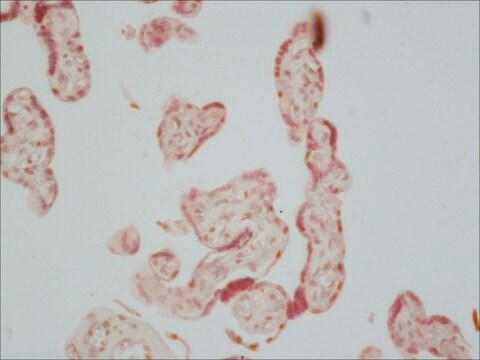
immunocytochemistry: suitable, immunohistochemistry (formalin-fixed, paraffin-embedded sections): 1:4,000 using human placenta, immunohistochemistry (frozen sections): suitable, indirect ELISA: suitable using whole cells, radioimmunoassay: suitable using radio-immunolocalization of xenografts of human cell lines expressing PLAP in nude mice2, western blot: suitable

isotype

IgG2a

UniProt accession no.

shipped in

dry ice

storage temp.

−20°C

target post-translational modification

unmodified

Gene Information

human ... ALPP(250)

General description

In SDS gels, the product reacts with both Regan and Nagao isozymes of human placental alkaline phosphatase (hPLAP, 130 kDa, 67/130 kDa). By RIA, the antibody binds to hPLAP with an affinity constant of 5 × 10⁹ LM-1. It does not react with PLAP-like enzymes.
Monoclonal Anti-Human Placental Alkaline Phosphatase (mouse IgG2a isotype) is derived from the 8B6 hybridoma produced by the fusion of mouse myeloma cells and splenocytes from immunized BALB/c mice. Placental alkaline phosphatase (PLAP) or ALPP is a phosphomonoesterase. It is expressed in the placenta and endometrium. The PLAP gene is localized on human chromosome 2q37.1. Small amounts of hPLAP are found in the endocervix, fallopian tubes and lung. Very small amounts of heat-stable AP resembling hPLAP (hPLAPlike AP) are expressed in the testis, thymus and in rare colon epithelial cells.

Immunogen

Human epidermoid carcinoma cell line expressing placental alkaline phosphatase.

Application

Anti-Alkaline phosphatase human placental antibody coupled to agarose was packed in a column and used to purify alkaline-phosphatase conjugated FGF receptor out of conditioned media from COS-7 cells. Column was washed with 1M NaCl.
Cultured pancreatic islet cells were fixed with cold 4% paraformaldhyde at room temperature for 10 minutes and incubated with mouse monoclonal anti-Alkaline Phosphatase, Human Placental antibody at 1:500. Mouse monoclonal anti-Alkaline Phosphatase, Human Placental antibody was used to detect a unique molecular probe that consisted of the FGFR extracellular domain expressed as a chimera with human PLAP.
Monoclonal Anti-Alkaline Phosphatase, Human Placental antibody produced in mouse has been used in:
  • enzyme-linked immunosorbent assay (ELISA)
  • immunocytochemistry
  • radio-immunolocalization
  • western blot
  • immunofluorescence
  • immunohistochemistry

Biochem/physiol Actions

Placental alkaline phosphatase (PLAP) or ALPP is a hydrolase, which is involved in the hydrolysis of phosphomonoesters. It has been shown to be a biomarker for ovarian cancer. The protein is expressed in carcinomas such as ovarian adenocarcinoma, dysgerminoma, serous cystadenocarcinoma and undifferentiated carcinoma. Although hPLAP has been analyzed as a potential tumor marker, it has not been widely used in the routine clinical laboratory because of its low overall specificity due to heat-inactivation, cross-reactivity with intestinal AP and L-phenylalanine sensitivity. The use of monoclonal antibodies as reagents has greatly improved the sensitivity, reproducibility and accuracy of the tests used to distinguish placental isozymes from their tumor cell counterparts. Thus, monoclonal anti-alkaline phosphatase may be useful as diagnostic tools for tumor detection.

Disclaimer

Unless otherwise stated in our catalog or other company documentation accompanying the product(s), our products are intended for research use only and are not to be used for any other purpose, which includes but is not limited to, unauthorized commercial uses, in vitro diagnostic uses, ex vivo or in vivo therapeutic uses or any type of consumption or application to humans or animals.

Ähnliche Artikel vergleichen

Vollständigen Vergleich anzeigen

Unterschiede anzeigen

1 of 1

Dieser Artikel
A2080A7827A5691
species reactivity

human

species reactivity

human

species reactivity

-

species reactivity

human, mouse, rat, chicken, frog, canine, rabbit, guinea pig, goat, bovine, sheep, snake

biological source

mouse

biological source

mouse

biological source

mouse

biological source

mouse

Gene Information

human ... ALPP(250)

Gene Information

human ... ALPP(250)

Gene Information

-

Gene Information

mouse ... Acta2(11475)
rat ... Acta2(81633)

antibody form

ascites fluid

antibody form

purified immunoglobulin

antibody form

purified immunoglobulin

antibody form

purified from hybridoma cell culture

conjugate

unconjugated

conjugate

agarose conjugate

conjugate

-

conjugate

alkaline phosphatase conjugate

clone

8B6, monoclonal

clone

8B6, monoclonal

clone

AP1B9, monoclonal

clone

1A4, monoclonal


Still not finding the right product?

Probieren Sie unser Produkt-Auswahlhilfe, um Ihre Auswahl einzugrenzen


Lagerklasse

10 - Combustible liquids

wgk

WGK 3

flash_point_f

Not applicable

flash_point_c

Not applicable


Hier finden Sie alle aktuellen Versionen:

Analysenzertifikate (COA)

Lot/Batch Number

Die passende Version wird nicht angezeigt?

Wenn Sie eine bestimmte Version benötigen, können Sie anhand der Lot- oder Chargennummer nach einem spezifischen Zertifikat suchen.

Besitzen Sie dieses Produkt bereits?

In der Dokumentenbibliothek finden Sie die Dokumentation zu den Produkten, die Sie kürzlich erworben haben.

Die Dokumentenbibliothek aufrufen


Verwandter Inhalt


Global Trade Item Number

SKUGTIN
A2951-.2ML04061833360057
A2951-.5ML04061837513954

Questions

Reviews

No rating value

Active Filters