Direkt zum Inhalt
Merck

Fortfahren mit

07-419

Anti-SHP-1/SHPTP-1 Antibody

Upstate®, from rabbit

Synonym(e):

Anti-DRPLA

Anmelden zur Ansicht der Organisations- und Vertragspreise.

Größe auswählen

Ansicht ändern
PackungsgrößeSKUVerfügbarkeitPreis
200 μg
Warenkorb auf Verfügbarkeit prüfen
CHF 438.00

Über diesen Artikel

UNSPSC Code:
12352203
NACRES:
NA.41
eCl@ss:
32160702
Conjugate:
unconjugated
Clone:
polyclonal
Application:
IP, WB
Citations:
13

CHF 438.00


Warenkorb auf Verfügbarkeit prüfen
Für Ihr Target ist ein rekombinanter, konservierungsmittelfreier Antikörper verfügbar. Probieren Sie ZRB2813

Großbestellung anfragen
Technischer Dienst
Benötigen Sie Hilfe? Unser Team von erfahrenen Wissenschaftlern ist für Sie da.
Unterstützung erhalten


biological source

rabbit

Quality Level

conjugate

unconjugated

antibody form

purified immunoglobulin

antibody product type

primary antibodies

clone

polyclonal

species reactivity

human

manufacturer/tradename

Upstate®

technique(s)

immunoprecipitation (IP): suitable, western blot: suitable

isotype

IgG

NCBI accession no.

UniProt accession no.

shipped in

wet ice

target post-translational modification

unmodified

General description

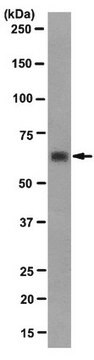
65kDa

Immunogen

Full-length glutathione transferase SHP-1 fusion protein, purified from bacteria

Application

Research Category
Signaling
Research Sub Category
Cytoskeletal Signaling
This Anti-SHP-1/SHPTP-1 Antibody is validated for use in IP, WB for the detection of SHP-1/SHPTP-1.

Biochem/physiol Actions

SHP1

Physical form

0.1M Tris-glycine, pH 7.4, 0.15M NaCl, 0.05% sodium azide
Format: Purified
Protein A purified

Preparation Note

1 year at 2-8°C

Analysis Note

Control
Positive Antigen Control: Catalog #12-301, non-stimulated A431 cell lysate. Add 2.5µL of 2-mercaptoethanol/100µL of lysate and boil for 5 minutes to reduce the preparation. Load 20µg of reduced lysate per lane for mingels.
routinely evaluated by immunoblot in RIPA lysates from human A431 carcinoma cells

Legal Information

UPSTATE is a registered trademark of Merck KGaA, Darmstadt, Germany

Disclaimer

Unless otherwise stated in our catalog or other company documentation accompanying the product(s), our products are intended for research use only and are not to be used for any other purpose, which includes but is not limited to, unauthorized commercial uses, in vitro diagnostic uses, ex vivo or in vivo therapeutic uses or any type of consumption or application to humans or animals.

Ähnliche Artikel vergleichen

Vollständigen Vergleich anzeigen

Unterschiede anzeigen

1 of 1

Dieser Artikel
04-74207-618MABT213
clone

polyclonal

clone

NL213, monoclonal

clone

polyclonal

clone

HG213, monoclonal

conjugate

unconjugated

conjugate

unconjugated

conjugate

unconjugated

conjugate

unconjugated

biological source

rabbit

biological source

rabbit

biological source

rabbit

biological source

rabbit

antibody form

purified immunoglobulin

antibody form

culture supernatant

antibody form

purified immunoglobulin

antibody form

unpurified

species reactivity

human

species reactivity

human, mouse

species reactivity

mouse

species reactivity

human

shipped in

wet ice

shipped in

dry ice

shipped in

dry ice

shipped in

wet ice


Still not finding the right product?

Probieren Sie unser Produkt-Auswahlhilfe, um Ihre Auswahl einzugrenzen


Lagerklasse

10 - Combustible liquids

wgk

WGK 1


Analysenzertifikate (COA)

Suchen Sie nach Analysenzertifikate (COA), indem Sie die Lot-/Chargennummer des Produkts eingeben. Lot- und Chargennummern sind auf dem Produktetikett hinter den Wörtern ‘Lot’ oder ‘Batch’ (Lot oder Charge) zu finden.

Besitzen Sie dieses Produkt bereits?

In der Dokumentenbibliothek finden Sie die Dokumentation zu den Produkten, die Sie kürzlich erworben haben.

Die Dokumentenbibliothek aufrufen


Erythropoietin induces sustained phosphorylation of STAT5 in primitive but not definitive erythrocytes generated from mouse embryonic stem cells.
Kazue Tsuji-Takayama, Takeshi Otani, Toshiya Inoue, Shuji Nakamura, Ryuichi Motoda et al.
Experimental Hematology null
Thierry Voisin et al.
FASEB journal : official publication of the Federation of American Societies for Experimental Biology, 22(6), 1993-2002 (2008-01-17)
Orexins acting at the G protein-coupled receptor (GPCR) OX1R have recently been shown to promote dramatic apoptosis in cancer cells. We report here that orexin-induced apoptosis is driven by an immunoreceptor tyrosine-based inhibitory motif (ITIM) (IIY(358)NFL) present in the OX1R.
Santosh Kumar et al.
Journal of immunology (Baltimore, Md. : 1950), 194(2), 817-826 (2014-12-17)
Signaling by immunoreceptors is often initiated by phosphorylation of cytosolic tyrosines, which then recruit effector molecules. In the case of MHC class I-specific inhibitory receptors, phosphorylation of cytosolic tyrosine residues within ITIMs results in recruitment of a protein tyrosine phosphatase


Questions

Reviews

No rating value

Active Filters