
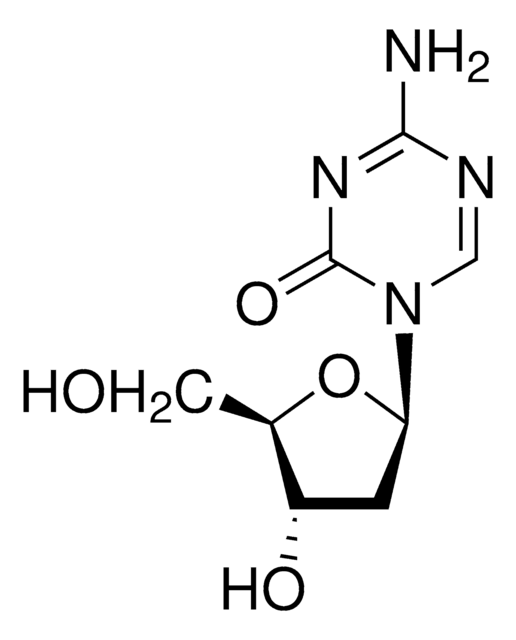


This product is a 100 mM (10 mg/438 µl) solution of 5-Aza-2'-Deoxycytidine in DMSO. Mixing with additional DMSO is not necessary.
189826

5-Aza-2′-Desoxycytidin
≥98% (HPLC), liquid, DNA methyltransferase inhibitor, Calbiochem
Synonym(e):
InSolution 5-Aza-2′-Desoxycytidin, Decitabin
Anmelden zur Ansicht der Organisations- und Vertragspreise.
Größe auswählen
Ansicht ändern
| Packungsgröße | SKU | Verfügbarkeit | Preis |
|---|---|---|---|
| 10 mg | Warenkorb auf Verfügbarkeit prüfen | € 153,00 |
Über diesen Artikel
Empirische Formel (Hill-System):
C8H12N4O4
CAS-Nummer:
Molekulargewicht:
228.21
UNSPSC Code:
12352200
NACRES:
NA.77
MDL number:
Assay:
≥98% (HPLC)
Form:
liquid
Quality level:
Storage condition:
OK to freeze, desiccated (hygroscopic), protect from light
€ 153,00
Warenkorb auf Verfügbarkeit prüfen
Technischer Dienst
Benötigen Sie Hilfe? Unser Team von erfahrenen Wissenschaftlern ist für Sie da.
Unterstützung erhaltenProduktname
5-Aza-2′-Desoxycytidin, InSolution, ≥98%, DNA methyltransferase inhibitor
Quality Level
assay
≥98% (HPLC)
form
liquid
manufacturer/tradename
Calbiochem®
storage condition
OK to freeze, desiccated (hygroscopic), protect from light
shipped in
ambient
storage temp.
−20°C
SMILES string
N2(C=NC(=N)NC2=O)C1OC(C(C1)O)CO
InChI
1S/C8H12N4O4/c9-7-10-3-12(8(15)11-7)6-1-4(14)5(2-13)16-6/h3-6,13-14H,1-2H2,(H2,9,11,15)
InChI key
XAUDJQYHKZQPEU-UHFFFAOYSA-N
General description
Ein Cytosin-Analogon, das als DNA-Methyltransferaseinhibitor dient. Stellt Caspase-8-, Caspase-10-mRNA und die Proteinexpression sowie die TRAIL-Sensitivität (tumor necrosis factor-related apoptosis inducing ligand) in TRAIL-resistenten Zelllinien wieder her. Verstärkt auch die durch HDAC(Histondeacetylase)-Inhibitoren eingeleitete Apoptose. Die feste Form dieser Verbindung (Katalognr. 189825) ist auch erhältlich.
Packaging
Verpackt unter inertem Gas
Physical form
Eine 100-mmol/l-Lösung (10 mg/438 µl) von 5-Aza-2ʹ-desoxycytidin (Katalognr. 189825) in DMSO.
Other Notes
Eggert, A., et al. 2001. Cancer Res.61, 1314.
Takebayashi, S., et al. 2001. Biochem. Biophys. Res. Commun.288, 921.
Zhu, W.G., et al. 2001. Cancer Res.61, 1327.
Hopkins-Donaldson, S., et al. 2000. Cancer Res.60, 4315.
Haaf, T. 1995. Pharmacol. Ther.65, 19.
Jones, P.A. und Taylor, S.M. 1980. Cell20, 85.
Takebayashi, S., et al. 2001. Biochem. Biophys. Res. Commun.288, 921.
Zhu, W.G., et al. 2001. Cancer Res.61, 1327.
Hopkins-Donaldson, S., et al. 2000. Cancer Res.60, 4315.
Haaf, T. 1995. Pharmacol. Ther.65, 19.
Jones, P.A. und Taylor, S.M. 1980. Cell20, 85.
Legal Information
CALBIOCHEM is a registered trademark of Merck KGaA, Darmstadt, Germany
Disclaimer
Toxizität: Zulassungsprüfung (Z)
1 of 1
Dieser Artikel | |||
|---|---|---|---|
| assay ≥98% (HPLC) | assay ≥98% (HPLC) | assay ≥98% (HPLC) | assay ≥97% |
| form liquid | form lyophilized | form solid | form powder |
| Quality Level 100 | Quality Level 200 | Quality Level 100 | Quality Level 200 |
| manufacturer/tradename Calbiochem® | manufacturer/tradename Calbiochem® | manufacturer/tradename Calbiochem® | manufacturer/tradename - |
| storage temp. −20°C | storage temp. 2-8°C | storage temp. −20°C | storage temp. - |
| storage condition OK to freeze, protect from light, desiccated (hygroscopic) | storage condition OK to freeze | storage condition OK to freeze | storage condition - |
Still not finding the right product?
Explore all of our products under 5-Aza-2′-Desoxycytidin
signalword
Danger
hcodes
Hazard Classifications
Muta. 2 - Repr. 1B
Lagerklasse
6.1C - Combustible acute toxic Cat.3 / toxic compounds or compounds which causing chronic effects
wgk
WGK 2
flash_point_f
188.6 °F - closed cup - (Dimethylsulfoxide)
flash_point_c
87 °C - closed cup - (Dimethylsulfoxide)
Analysenzertifikate (COA)
Suchen Sie nach Analysenzertifikate (COA), indem Sie die Lot-/Chargennummer des Produkts eingeben. Lot- und Chargennummern sind auf dem Produktetikett hinter den Wörtern ‘Lot’ oder ‘Batch’ (Lot oder Charge) zu finden.
Besitzen Sie dieses Produkt bereits?
In der Dokumentenbibliothek finden Sie die Dokumentation zu den Produkten, die Sie kürzlich erworben haben.
Verwandter Inhalt
Cancer is a complex disease manifestation. At its core, it remains a disease of abnormal cellular proliferation and inappropriate gene expression. In the early days, carcinogenesis was viewed simply as resulting from a collection of genetic mutations that altered the gene expression of key oncogenic genes or tumor suppressor genes leading to uncontrolled growth and disease (Virani, S et al 2012). Today, however, research is showing that carcinogenesis results from the successive accumulation of heritable genetic and epigenetic changes. Moreover, the success in how we predict, treat and overcome cancer will likely involve not only understanding the consequences of direct genetic changes that can cause cancer, but also how the epigenetic and environmental changes cause cancer (Johnson C et al 2015; Waldmann T et al 2013). Epigenetics is the study of heritable gene expression as it relates to changes in DNA structure that are not tied to changes in DNA sequence but, instead, are tied to how the nucleic acid material is read or processed via the myriad of protein-protein, protein-nucleic acid, and nucleic acid-nucleic acid interactions that ultimately manifest themselves into a specific expression phenotype (Ngai SC et al 2012, Johnson C et al 2015). This review will discuss some of the principal aspects of epigenetic research and how they relate to our current understanding of carcinogenesis. Because epigenetics affects phenotype and changes in epigenetics are thought to be key to environmental adaptability and thus may in fact be reversed or manipulated, understanding the integration of experimental and epidemiologic science surrounding cancer and its many manifestations should lead to more effective cancer prognostics as well as treatments (Virani S et al 2012).
Liangsheng Wang et al.
The Plant journal : for cell and molecular biology, 109(6), 1397-1415 (2021-12-18)
RNA-directed DNA methylation (RdDM) helps to defend plants against invasive nucleic acids. In the canonical form of RdDM, 24-nt small interfering RNAs (siRNAs) are produced by DICER-LIKE 3 (DCL3). The siRNAs are loaded onto ARGONAUTE (AGO) proteins leading ultimately to
Ling-Tong Gao et al.
Cellular and molecular life sciences : CMLS, 80(3), 58-58 (2023-02-07)
The exposure to an unhealthy environment in utero can lead to the occurrence of cardiovascular diseases in the offspring. Glucocorticoids (GC) are essential for normal development and maturation of fetal organs and is a first-line treatment for pregnant women affected
Chuannan Fan et al.
Signal transduction and targeted therapy, 7(1), 126-126 (2022-04-29)
Ovo-like transcriptional repressor 1 (OVOL1) is a key mediator of epithelial lineage determination and mesenchymal-epithelial transition (MET). The cytokines transforming growth factor-β (TGF-β) and bone morphogenetic proteins (BMP) control the epithelial-mesenchymal plasticity (EMP) of cancer cells, but whether this occurs
Global Trade Item Number
| SKU | GTIN |
|---|---|
| 189826-10MG | 04055977222050 |
-
Do I need to mix DMSO with this ?
1 answer-
Helpful?
-