



The optimal working concentration of the product is cell type and application dependent. Typically, a working concentration in the range of 0.5 to 2 uM is recommended.
189825

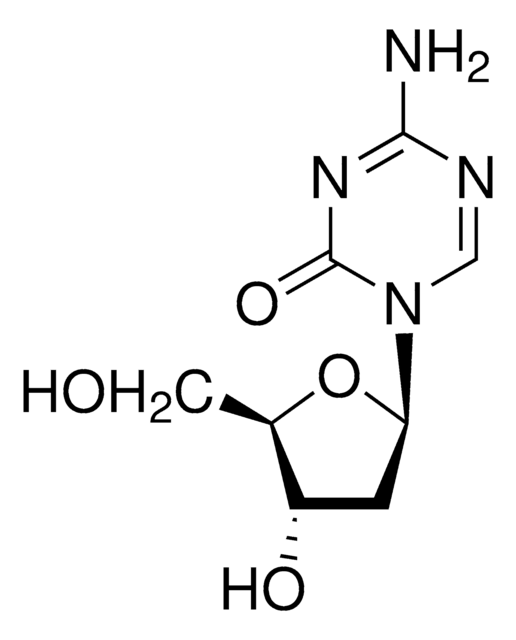
5-Aza-2′-Desoxycytidin
A cytosine analog that acts as a DNA methyltransferase inhibitor.
Synonym(e):
5-Aza-2′-Desoxycytidin, 5-Aza-CdR, 5-Aza-dC, 2′-Desoxy-5-azacytidin, Decitabin
Anmelden zur Ansicht der Organisations- und Vertragspreise.
Größe auswählen
Ansicht ändern
| Packungsgröße | SKU | Verfügbarkeit | Preis |
|---|---|---|---|
| 25 mg | Warenkorb auf Verfügbarkeit prüfen | € 440,00 |
Über diesen Artikel
Empirische Formel (Hill-System):
C8H12N4O4
CAS-Nummer:
Molekulargewicht:
228.21
UNSPSC Code:
12352208
NACRES:
NA.77
MDL number:
Assay:
≥98% (HPLC)
Form:
lyophilized
Storage condition:
OK to freeze
€ 440,00
Warenkorb auf Verfügbarkeit prüfen
Technischer Dienst
Benötigen Sie Hilfe? Unser Team von erfahrenen Wissenschaftlern ist für Sie da.
Unterstützung erhaltenQuality Segment
description
RTECS - XZ3012000
assay
≥98% (HPLC)
form
lyophilized
manufacturer/tradename
Calbiochem®
storage condition
OK to freeze
solubility
methanol: 1 mg/mL, 50% acetic acid: 25 mg/mL, DMSO: 25 mg/mL
shipped in
ambient
storage temp.
2-8°C
SMILES string
N2(C=NC(=N)NC2=O)C1OC(C(C1)O)CO
InChI
1S/C8H12N4O4/c9-7-10-3-12(8(15)11-7)6-1-4(14)5(2-13)16-6/h3-6,13-14H,1-2H2,(H2,9,11,15)
InChI key
XAUDJQYHKZQPEU-UHFFFAOYSA-N
General description
Ein Cytosin-Analogon, das als DNA-Methyltransferaseinhibitor dient. Stellt Caspase-8-, Caspase-10-mRNA und die Proteinexpression sowie die TRAIL-Sensitivität (tumor necrosis factor-related apoptosis inducing ligand) in TRAIL-resistenten Zelllinien wieder her. Verstärkt auch die durch HDAC(Histondeacetylase)-Inhibitoren eingeleitete Apoptose. Auch als 100-mmol/l-Lösung in DMSO erhältlich (Katalognr. 189826).
Biochem/physiol Actions
Primärziel
DNA-Methyltransferaseinhibitor
DNA-Methyltransferaseinhibitor
Packaging
Verpackt unter inertem Gas
Preparation Note
Nach der Rekonstitution in Aliquote aufteilen und einfrieren (-20 °C). Stammlösungen sind bei -20 °C bis zu 3 Monate haltbar.
Um eine vollständige Solubilisierung zu erreichen ist Erwärmen erforderlich
Other Notes
Eggert, A., et al. 2001. Cancer Res.61, 1314.
Takebayashi, S., et al. 2001. Biochem. Biophys. Res. Commun.288, 921.
Zhu, W.G., et al. 2001. Cancer Res.61, 1327.
Hopkins-Donaldson, S., et al. 2000. Cancer Res.60, 4315.
Haaf, T. 1995. Pharmacol. Ther.65, 19.
Jones, P.A. und Taylor, S.M. 1980. Cell20, 85.
Takebayashi, S., et al. 2001. Biochem. Biophys. Res. Commun.288, 921.
Zhu, W.G., et al. 2001. Cancer Res.61, 1327.
Hopkins-Donaldson, S., et al. 2000. Cancer Res.60, 4315.
Haaf, T. 1995. Pharmacol. Ther.65, 19.
Jones, P.A. und Taylor, S.M. 1980. Cell20, 85.
Legal Information
CALBIOCHEM is a registered trademark of Merck KGaA, Darmstadt, Germany
Disclaimer
Toxizität: Gesundheitsschädlich & Karzinogen / Teratogen (E)
1 of 1
Dieser Artikel | |||
|---|---|---|---|
| assay ≥98% (HPLC) | assay ≥98% (HPLC) | assay ≥98% (HPLC) | assay ≥98% (HPLC) |
| form lyophilized | form liquid | form solid | form solid |
| manufacturer/tradename Calbiochem® | manufacturer/tradename Calbiochem® | manufacturer/tradename Calbiochem® | manufacturer/tradename Calbiochem® |
| Quality Level 200 | Quality Level 100 | Quality Level 100 | Quality Level 100 |
| storage temp. 2-8°C | storage temp. −20°C | storage temp. 2-8°C | storage temp. −20°C |
| storage condition OK to freeze | storage condition OK to freeze, desiccated (hygroscopic), protect from light | storage condition OK to freeze | storage condition OK to freeze |
Still not finding the right product?
Explore all of our products under 5-Aza-2′-Desoxycytidin
signalword
Danger
Hazard Classifications
Acute Tox. 4 Oral - Eye Irrit. 2 - Muta. 2 - Repr. 1B - Skin Irrit. 2 - STOT SE 3
target_organs
Respiratory system
Lagerklasse
6.1C - Combustible acute toxic Cat.3 / toxic compounds or compounds which causing chronic effects
wgk
WGK 3
Analysenzertifikate (COA)
Suchen Sie nach Analysenzertifikate (COA), indem Sie die Lot-/Chargennummer des Produkts eingeben. Lot- und Chargennummern sind auf dem Produktetikett hinter den Wörtern ‘Lot’ oder ‘Batch’ (Lot oder Charge) zu finden.
Besitzen Sie dieses Produkt bereits?
In der Dokumentenbibliothek finden Sie die Dokumentation zu den Produkten, die Sie kürzlich erworben haben.
Verwandter Inhalt
Cancer is a complex disease manifestation. At its core, it remains a disease of abnormal cellular proliferation and inappropriate gene expression. In the early days, carcinogenesis was viewed simply as resulting from a collection of genetic mutations that altered the gene expression of key oncogenic genes or tumor suppressor genes leading to uncontrolled growth and disease (Virani, S et al 2012). Today, however, research is showing that carcinogenesis results from the successive accumulation of heritable genetic and epigenetic changes. Moreover, the success in how we predict, treat and overcome cancer will likely involve not only understanding the consequences of direct genetic changes that can cause cancer, but also how the epigenetic and environmental changes cause cancer (Johnson C et al 2015; Waldmann T et al 2013). Epigenetics is the study of heritable gene expression as it relates to changes in DNA structure that are not tied to changes in DNA sequence but, instead, are tied to how the nucleic acid material is read or processed via the myriad of protein-protein, protein-nucleic acid, and nucleic acid-nucleic acid interactions that ultimately manifest themselves into a specific expression phenotype (Ngai SC et al 2012, Johnson C et al 2015). This review will discuss some of the principal aspects of epigenetic research and how they relate to our current understanding of carcinogenesis. Because epigenetics affects phenotype and changes in epigenetics are thought to be key to environmental adaptability and thus may in fact be reversed or manipulated, understanding the integration of experimental and epidemiologic science surrounding cancer and its many manifestations should lead to more effective cancer prognostics as well as treatments (Virani S et al 2012).
Global Trade Item Number
| SKU | GTIN |
|---|---|
| 189825-25MG | 04055977222043 |
-
Please provide a brief idea of how much 5-Aza-2ʹ-Deoxycytidine must be added to cell culture to yield the best results with product number 189825-25MG?
1 answer-
Helpful?
-