Direkt zum Inhalt
Merck

Fortfahren mit

P6140

Peroxidase aus Meerrettich

Type X, ammonium sulfate suspension

Synonym(e):

Donor:hydrogen-peroxide oxidoreductase, Meerrettichperoxidase

Anmelden zur Ansicht der Organisations- und Vertragspreise.

Größe auswählen

Ansicht ändern
Ihnen/SKUVerfügbarkeitPreis
2000 units
Warenkorb auf Verfügbarkeit prüfen
€ 91,60
5000 units
Warenkorb auf Verfügbarkeit prüfen
€ 144,00
25000 units
Warenkorb auf Verfügbarkeit prüfen
€ 516,00

Über diesen Artikel

CAS-Nummer:
eCl@ss:
32160410
UNSPSC Code:
12352204
NACRES:
NA.54
EC Number:
232-668-6
MDL number:
EG-Nummer:
Specific activity:
≥225 units/mg protein (biuret, using pyrogallol)
Biological source:
horseradish
Concentration:
≥1.0 mg/mL

€ 91,60


Warenkorb auf Verfügbarkeit prüfen

Technischer Dienst
Benötigen Sie Hilfe? Unser Team von erfahrenen Wissenschaftlern ist für Sie da.
Unterstützung erhalten


biological source

horseradish

Quality Segment

type

Type X

form

ammonium sulfate suspension

specific activity

≥225 units/mg protein (biuret, using pyrogallol)

mol wt

~44 kDa

concentration

≥1.0 mg/mL

absorbance ratio

RZ 2.5-3.5

storage temp.

2-8°C

SMILES string

[O+H2]O[O-]

InChI

1S/H2O3/c1-3-2/h1-2H

InChI key

JSPLKZUTYZBBKA-UHFFFAOYSA-N

General description

Horseradish peroxidase (HRP) wird aus Meerrettich (Amoracia rusticana) Wurzeln isoliert und ist innerhalb der Peroxidasen der Gruppe der Ferroprotoporpyhrine zuzuordnen. HRP besteht aus einer einzelnen Polypeptidkette und entält vier Disulfidbrücken. Sie ist ein Glykoprotein mit einem Kohlenhydratanteil von 18%. Der Kohlenhydratanteil besteht aus Galactose, Arabinose, Xylose, Fucose, Mannose, Mannosamin und Galactosamin - in Mengenverhältnissen abhängig vom Isoenzym. Ihr Molekulargewicht (~44 kDa) setzt sich aus der Polypeptidkette (33,890 Daltons), dem Hemin plus Ca2+ (~700 Daltons) und der Glykosylierung (~9,400 Daltons) zusammen. Es existieren zumindest sieben Isoenzyme von HRP. Der isoelektrische Punkt von HRP ist in einem Bereich von pH 3 3.0 - 9.0.

Application

Horseradish peroxidase (HRP) is isolated from horseradish roots (Amoracia rusticana). It is used in biochemistry applications such as western blots, ELISA and Immunohistochemistry. Horseradish peroxidase is used to amplify a weak signal and increase detectability of a target molecule, such as a protein[1]. Product P6140 has been used to detect low density lipoprotein (LDL)[2].
The enzyme from Sigma has been used while assessing the skin sensitization potential of pro-haptens.[3] It has also been used to show that peroxidase (PO) activity and its heat stability correlate with the availability of free Ca2+ ions.[4]

Biochem/physiol Actions

When incubated with a substrate, horseradish peroxidase produces a coloured, fluorimetric, or luminescent derivative of the labeled molecule, allowing quantification[1]. Horseradish peroxidase has been shown to slightly reduce the level of inhibition in a cydAB mutant[5].
HRP readily combines with hydrogen peroxide (H2O2) and the resultant [HRP-H2O2] complex can oxidize a wide variety of hydrogen donors. The optimal pH is 6.0-6.5 and the enzyme is most stable in the pH range of 5.0-9.0. HRP can be conjugated to antibodies by several different methods that include the use of glutaraldehyde, periodate oxidation, disulfide bonds, and also via amino- and thiol-directed cross-linkers. It is smaller and more stable than the enzyme labels, β-galactosidase and alkaline phosphatase. Hence, it is the most desired label. Also, its glycosylation leads to lower non-specific binding. It is also used for the determination of glucose and peroxides in solution. Sodium azide, cyanide, L-cystine, dichromate, ethylenethiourea, hydroxylamine, sulfide, vanadate, p-aminobenzoic acid, and Cd2+, Co2+, Cu2+, Fe3+, Mn2+, Ni2+, Pb2+ ions are found to inhibit its enzyme activity.

Physical form

Crystalline suspension in 3.2 M (NH4)2SO4 solution containing potassium phosphate buffer, pH 6.0

Preparation Note

Water may be used to dilute suspension if needed.

Analysis Note

Die RZ (Reinheitszahl) ist das Absorptionsratio A403/A275 bestimmt bei 0.5-1.0 mg/ml in deionisiertem Wasser. Es ist ein Mass für den Hämingehalt, nicht für die Enzymaktivität. Selbst Zubereitungen mit hoher RZ können eine tiefe Enzymaktivität haben.
Preliminary studies indicate the presence of two basic and no acidic isoenzymes

Other Notes

Eine Pyrogalloleinheit bildet in 20 s bei einem pH-Wert von 6,0 und 20 °C 1 mg Purpurogallin aus Pyrogallol.
Weitere Informationen über Peroxidase finden Sie unter www.sigma-aldrich.com/enzymeexplorer.

Ähnliche Artikel vergleichen

Vollständigen Vergleich anzeigen

Unterschiede anzeigen

1 of 1

Dieser Artikel
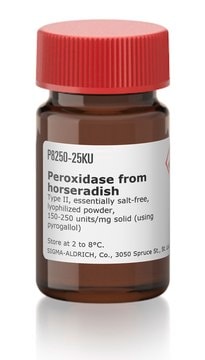
P8250P2088SRE0082
biological source

horseradish

biological source

horseradish

biological source

horseradish

biological source

-

specific activity

≥225 units/mg protein (biuret, using pyrogallol)

specific activity

150-250 units/mg solid (using pyrogallol)

specific activity

200-300 units/mg solid (using pyrogallol)

specific activity

≥250 units/mg solid (using pyrogallol)

concentration

≥1.0 mg/mL

concentration

-

concentration

-

concentration

-

form

ammonium sulfate suspension

form

essentially salt-free, lyophilized powder

form

essentially salt-free, lyophilized powder

form

powder, stabilized

mol wt

~44 kDa

mol wt

~44 kDa

mol wt

~44 kDa

mol wt

-

storage temp.

2-8°C

storage temp.

2-8°C

storage temp.

2-8°C

storage temp.

2-8°C


Still not finding the right product?

Explore all of our products under Peroxidase aus Meerrettich


pictograms

Health hazard

signalword

Danger

hcodes

Hazard Classifications

Resp. Sens. 1

Lagerklasse

11 - Combustible Solids

wgk

WGK 1

ppe

Eyeshields, Gloves, type N95 (US)


Hier finden Sie alle aktuellen Versionen:

Analysenzertifikate (COA)

Lot/Batch Number

It looks like we've run into a problem, but you can still download Certificates of Analysis from our Dokumente section.

Wenn Sie Hilfe benötigen, wenden Sie sich bitte an Kundensupport

Besitzen Sie dieses Produkt bereits?

In der Dokumentenbibliothek finden Sie die Dokumentation zu den Produkten, die Sie kürzlich erworben haben.

Die Dokumentenbibliothek aufrufen


Questions

Reviews

No rating value

Active Filters