Direkt zum Inhalt
Merck

Fortfahren mit

N3289

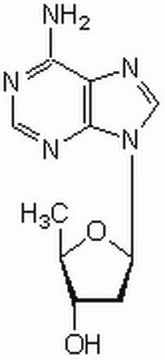
N2-Ethyl-2′-deoxyguanosine

≥98% (HPLC), solid

Synonym(e):

N2-Et-dG

Anmelden zur Ansicht der Organisations- und Vertragspreise.

Über diesen Artikel

Empirische Formel (Hill-System):
C12H17N5O4
CAS-Nummer:
Molekulargewicht:
295.29
NACRES:
NA.77
PubChem Substance ID:
UNSPSC Code:
12352200
MDL number:
Assay:
≥98% (HPLC)
Form:
solid
Quality level:


Quality Level

assay

≥98% (HPLC)

form

solid

color

white to off-white

solubility

H2O: >5 mg/mL

storage temp.

2-8°C

SMILES string

CCNC1=Nc2c(ncn2[C@H]3C[C@H](O)[C@@H](CO)O3)C(=O)N1

InChI

1S/C12H17N5O4/c1-2-13-12-15-10-9(11(20)16-12)14-5-17(10)8-3-6(19)7(4-18)21-8/h5-8,18-19H,2-4H2,1H3,(H2,13,15,16,20)/t6-,7+,8+/m0/s1

InChI key

VOKQFDULHQUWAV-XLPZGREQSA-N

General description

N2-Et-dG, an adduct between DNA and the first metabolite of ethanol (acetaldehyde), strongly blocks transcription by RNA polymerases (RNAPs), including mammalian RNAPII and yeast RNAPII, E. coli RNAP, as well as T7 RNAP. All three of the multisubunit RNAPs incorporate a single rNTP residue opposite the N2-Et-dG lesion. The mammalian RNAPII exclusively incorporates cytidine monophosphate (CMP) opposite the N2-Et-dG lesion. The accessory transcription factor TFIIS does not usually act as a lesion bypass factor; instead, it stimulates the polymerase to remove the CMP incorporated opposite the lesion by mammalian RNAPII. N2-Et-dG reduces CTP incorporation by ~1500 fold.

Ähnliche Artikel vergleichen

Vollständigen Vergleich anzeigen

Unterschiede anzeigen

1 of 1

Dieser Artikel
H5653SML1296288104
form

solid

form

-

form

powder

form

solid

assay

≥98% (HPLC)

assay

≥98% (TLC)

assay

≥97% (HPLC)

assay

≥98% (HPLC)

Quality Level

100

Quality Level

200

Quality Level

100

Quality Level

100

storage temp.

2-8°C

storage temp.

2-8°C

storage temp.

−20°C

storage temp.

2-8°C

solubility

H2O: >5 mg/mL

solubility

-

solubility

DMSO: 5 mg/mL, clear (warmed)

solubility

DMSO: 10 mg/mL

color

white to off-white

color

-

color

white to brown

color

white


pictograms

Skull and crossbonesHealth hazard

signalword

Danger

Hazard Classifications

Acute Tox. 2 Dermal - Acute Tox. 2 Inhalation - Acute Tox. 2 Oral - Carc. 2 - STOT RE 2

Lagerklasse

6.1A - Combustible acute toxic Cat. 1 and 2 / very toxic hazardous materials

wgk

WGK 3

flash_point_f

Not applicable

flash_point_c

Not applicable

ppe

Eyeshields, Faceshields, Gloves, type P2 (EN 143) respirator cartridges


Hier finden Sie alle aktuellen Versionen:

Analysenzertifikate (COA)

Lot/Batch Number

Die passende Version wird nicht angezeigt?

Wenn Sie eine bestimmte Version benötigen, können Sie anhand der Lot- oder Chargennummer nach einem spezifischen Zertifikat suchen.

Besitzen Sie dieses Produkt bereits?

In der Dokumentenbibliothek finden Sie die Dokumentation zu den Produkten, die Sie kürzlich erworben haben.

Die Dokumentenbibliothek aufrufen


Liang Qi et al.
Talanta, 209, 120523-120523 (2020-01-02)
DNA adducts usually occur at a level of 0.1-1 adducts per 108 unmodified DNA bases, which can cause many adverse health effects if not normally repaired. Using microgram amounts of DNA to detect DNA adducts remains challenging due to the
Yuan-Jhe Chang et al.
Archives of toxicology, 92(8), 2665-2680 (2018-06-27)
Adductomics is expected to be useful in the characterization of the exposome, which is a new paradigm for studying the sum of environmental causes of diseases. DNA adductomics is emerging as a powerful method for detecting DNA adducts, but reliable


Global Trade Item Number

SKUGTIN
N3289-25MG04061832632308
N3289-5MG04061832632315

Questions

Reviews

No rating value

Active Filters