


This lectin is soluble in phosphate buffered saline at pH 7.2 (1 mg/ml). Solutions may be stored frozen and protected from light in aliquots at –20 °C. Prolonged storage and repeated freezing and thawing are not recommended.
Fortfahren mit
L7381

Lektin aus Arachis hypogaea (Erdnuss)
FITC conjugate, lyophilized powder
Synonym(e):
Erdnuss-Agglutinin, PNA
Anmelden zur Ansicht der Organisations- und Vertragspreise.
Größe auswählen
Ansicht ändern
| Packungsgröße | SKU | Verfügbarkeit | Preis |
|---|---|---|---|
| 1 mg | Warenkorb auf Verfügbarkeit prüfen | € 92,30 | |
| 2 mg | Warenkorb auf Verfügbarkeit prüfen | € 160,00 | |
| 5 mg | Warenkorb auf Verfügbarkeit prüfen | € 428,00 |
Über diesen Artikel
NACRES:
NA.32
UNSPSC Code:
12352202
Form:
lyophilized powder
€ 92,30
Warenkorb auf Verfügbarkeit prüfen
Technischer Dienst
Benötigen Sie Hilfe? Unser Team von erfahrenen Wissenschaftlern ist für Sie da.
Unterstützung erhaltenconjugate
FITC conjugate
Quality Segment
form
lyophilized powder
composition
Protein, ~10% Lowry
extent of labeling
4-8 mol FITC per mol protein
storage temp.
−20°C
General description
Lectins are carbohydrate-binding proteins, omnipresent, found in fungi, plants and animals. The structure of lectin is diversely studied in plants and animals. The secondary structure of this protein is rich in β-strands and possesses a carbohydrate binding sites on the surface.
Application
Lectin from Arachis hypogaea (peanut) has been used:
- to determine the acrosomal status (presence or absence of acrosomal matrix corresponding to intact or acrosome-reacted spermatozoa) on viable sperm cells
- to probe cryosections of mediastinal lymph nodes (mLNs) with fluorochrome-labeled PNA and anti-B220 to detect germinal centers (GCs)
- to visualize the cone outer segments of pre-treated retinal sections
Biochem/physiol Actions
Lectin is known to be useful in glycoconjugate characterizing, imaging and targeting. Its use in a microarray assay, enable efficient glycome profiling. This is because of its specific interaction with oligosaccharides, glycoproteins and glycolipids. In plants and fungi, lectin defends against pathogens/feeders. Lectin participates in host recognition and tissue adhesion, thereby aids in the pathogenesis of microorganism.
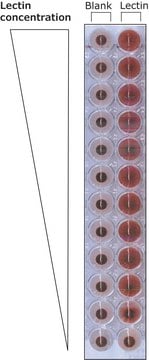
PNA verklumpt keine normalen humanen Erythrozyten, bewirkt aber eine starke Verklumpung (Agglutination) von mit Neuraminidase behandelten Erythrozyten. PNA weist eine potente Anti-T-Aktivität auf, ähnlich der Anti-T-Aktivität in Humanseren. Das Lektin kann für die Unterscheidung zwischen humanen Lymphozyten-Untergruppen verwendet werden.
Physical form
Contains phosphate buffer salts and NaCl
1 of 1
Dieser Artikel | |||
|---|---|---|---|
| form lyophilized powder | form lyophilized powder | form lyophilized powder | form lyophilized powder |
| storage temp. −20°C | storage temp. −20°C | storage temp. −20°C | storage temp. 2-8°C |
| conjugate FITC conjugate | conjugate peroxidase conjugate | conjugate - | conjugate biotin conjugate |
| Quality Level 200 | Quality Level 200 | Quality Level 200 | Quality Level 200 |
| extent of labeling 4-8 mol FITC per mol protein | extent of labeling - | extent of labeling - | extent of labeling ~3 mol biotin per mol protein |
| composition Protein, ~10% Lowry | composition - | composition - | composition Protein, ≥80% Lowry |
Still not finding the right product?
Explore all of our products under Lektin aus Arachis hypogaea (Erdnuss)
Lagerklasse
11 - Combustible Solids
wgk
WGK 3
flash_point_f
Not applicable
flash_point_c
Not applicable
ppe
Eyeshields, Gloves, type N95 (US)
Hier finden Sie alle aktuellen Versionen:
Besitzen Sie dieses Produkt bereits?
In der Dokumentenbibliothek finden Sie die Dokumentation zu den Produkten, die Sie kürzlich erworben haben.
Verwandter Inhalt
Instructions
Global Trade Item Number
| SKU | GTIN |
|---|---|
| L7381-5MG | 04061833965504 |
| L7381-1MG | 04061833965481 |
| L7381-2MG | 04061833965498 |
-
The product information document specifies -20C storage of the lyophilized product. Once resuspended in PBS, should it be stored at 4C instead?
1 answer-
Helpful?
-
-
If samples are stored in 100% ethanol, it there an issue for the actual binding of the lectin to surface sugars?
1 answer-
Fixation generally influences subsequent staining procedures. A recommended approach would be to fix identical tissue sections in alcohol and 10% Neutral Buffered Formalin and then determine which method yields the best staining outcome.
Helpful?
-
-
What is the Department of Transportation shipping information for this product?
1 answer-
Transportation information can be found in Section 14 of the product's (M)SDS.To access the shipping information for this material, use the link on the product detail page for the product.
Helpful?
-
-
How does the storage temperature relate to shipping conditions?
1 answer-
The storage conditions that a Sigma-Aldrich catalog and label recommend for products are deliberately conservative. For many products, long-term storage at low temperatures will increase the time during which they are expected to remain in specification and therefore are labeled accordingly. Where short-term storage, shipping time frame, or exposure to conditions other than those recommended for long-term storage will not affect product quality, Sigma-Aldrich will ship at ambient temperature. The products sensitive to short-term exposure to conditions other than their recommended long-term storage are shipped on wet or dry ice. Ambient temperature shipping helps to control shipping costs for our customers. At any time, our customers can request wet- or dry-ice shipment, but the special handling is at customer expense if our product history indicates that the product is stable for regular shipment.
Helpful?
-
-
Is the peanut lectin (Lectin from Arachis hypogaea) a glycoprotein? If so, what is the carbohydrate content?
1 answer-
Peanut lectin is not a glycoprotein. Although peanut lectin binds specifically to a particular carbohydrate (beta-gal(1-->3)galNac) in other molecules, the lectin itself does not contain any carbohydrate. Please see page 231 of the following paper: R. Banerjee, et al., "Crystal structure of peanut lectin, a protein with an unusual quaternary structure". Proc. Nat. Acad. Sci., USA, 91, 227-231 (1994).
Helpful?
-