
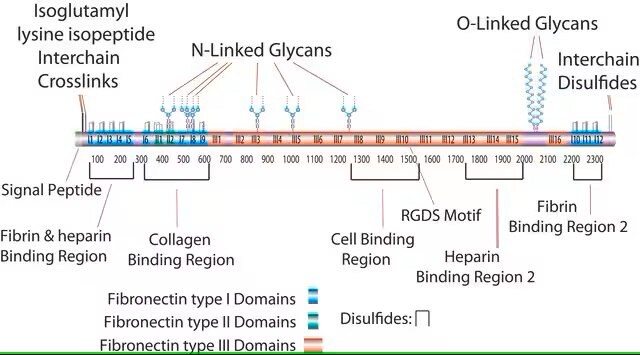

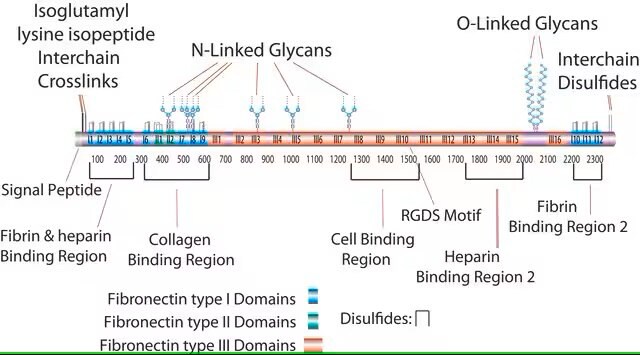
Human fibronectin is composed of two nearly identical disulfide bound peptides. Each has a molecular weight of 220 kDa for a combined total of 440 kDa.
Fortfahren mit
F1056

Human Fibronectin
from human plasma, powder, suitable for cell culture
Synonym(e):
Fibronectin
Anmelden zur Ansicht der Organisations- und Vertragspreise.
Größe auswählen
Ansicht ändern
| Packungsgröße | SKU | Verfügbarkeit | Preis |
|---|---|---|---|
| 1 mg | Warenkorb auf Verfügbarkeit prüfen | € 351,00 | |
| 2 mg | Warenkorb auf Verfügbarkeit prüfen | € 667,00 | |
| 5 mg | Warenkorb auf Verfügbarkeit prüfen | € 1.050,00 |
Über diesen Artikel
Biological source:
human plasma
Form:
lyophilized powder
Technique(s):
cell culture | mammalian: suitable
Assay:
≥95% (SDS-PAGE)
Technischer Dienst
Benötigen Sie Hilfe? Unser Team von erfahrenen Wissenschaftlern ist für Sie da.
Unterstützung erhaltenProduktname
Fibronektin-Humanplasma, lyophilized powder, BioReagent, suitable for cell culture, ≥95% (SDS-PAGE)
biological source
human plasma
Quality Segment
sterility
sterile
product line
BioReagent
assay
≥95% (SDS-PAGE)
form
lyophilized powder
packaging
pkg of 1 mg, pkg of 2 mg, pkg of 5 mg
technique(s)
cell culture | mammalian: suitable
surface coverage
1‑5 μg/cm2
solubility
H2O: 1 mg/mL at 37 °C
UniProt accession no.
binding specificity
Peptide Source: Collagen
shipped in
dry ice
storage temp.
−20°C
Gene Information
human ... FN1(2335)
General description
Fibronektin ist ein hochmolekulares selbsthaftendes Glykoprotein, das vorwiegend in der extrazellulären Matrix (EZM) vorkommt und überall im Gewebe und Blut vorhanden ist. Aus dem hoch konservierten FN-Gen gehen beim Menschen durch alternatives Spleißen mindestens 20 Isoformen hervor, darunter Varianten wie zelluläres FN und Plasma-FN. Plasma-FN wird hauptsächlich in der Leber synthetisiert, wohingegen zelluläres FN, das nur 5 % der zirkulierenden Fibronektine ausmacht, lokal von verschiedenen Zelltypen produziert wird.
Application
Fibronektin-Humanplasma wurde in folgenden Anwendungen eingesetzt:
Biochem/physiol Actions
Fibronektin spielt eine wichtige Rolle in biologischen Prozessen. Es interagiert mit Oberflächenrezeptoren und anderen wichtigen EZM-Proteinen wie Kollagen, um zelluläre Signale zu vermitteln. Fibronektin ist an einer Vielzahl von Zellfunktionen wie etwa der Adhäsion, Zytoskelettorganisation, onkogenen Transformation, Zellmigration, Phagozytose, Hämostase und embryonalen Differenzierung beteiligt. Dieses Glykoprotein kann an Integrine, Kollagene, Fibrine und Glykosaminoglykane (GAG) binden. FN spielt eine entscheidende Rolle bei der Förderung des Ablaufs des Zellzyklus und der Zellproliferation. Diese Interaktion beeinflusst Cycline und Immediate-Early-Response-Gene und trägt so zu zellulären Prozessen im Zusammenhang mit Zellteilung und Zellwachstum bei. FN spielt außerdem eine Rolle beim Zellüberleben und beim Schutz vor Apoptose verschiedener Zelltypen, darunter Epithelzellen und Endothelzellen sowie Leukozyten. Bei diesen Zellen ist FN ausschlaggebend für das Überleben und die Verhinderung des programmierten Zelltods. Mutationen im FN-Gen sind mit FN-Glomerulopathie und spondylometaphysärer Dysplasie assoziiert. Fibronektin hat wichtige Funktionen bei der Wundheilung und in der extrazellulären Matrix (EZM) und ist daher für Anwendungen zur Gewebezüchtung (Tissue Engineering) geeignet.
Preparation Note
Dieses Produkt wird aus 0,05 M Tris-gepufferter Kochsalzlösung bei einem pH-Wert von 7,5 lyophilisiert. Es ist bei 1 mg/mL wasserlöslich und sollte mindestens 30 Minuten lang bei 37 °C gelöst werden. Eine kleine Menge ungelöstes Material kann dabei zurückbleiben. Die Leistung wird dadurch nicht beeinflusst. Die Proteinhomogenität wird mittels Immunelektrophorese beurteilt, das Protein wird auf Endotoxine getestet und das Ausgangsmaterial wurde im Test auf HIV, Hepatitis B und Hepatitis C als negativ befunden.
Bei der Beschichtung von Kulturoberflächen sollte Fibronektin in ausgeglichener steriler Kochsalzlösung verdünnt und möglichst dünn aufgetragen werden. Die behandelte Oberfläche sollte dann 45 Minuten bei Raumtemperatur luftgetrocknet werden und ist 2–4 Wochen bei 2–8 °C haltbar.
Bei der Beschichtung von Kulturoberflächen sollte Fibronektin in ausgeglichener steriler Kochsalzlösung verdünnt und möglichst dünn aufgetragen werden. Die behandelte Oberfläche sollte dann 45 Minuten bei Raumtemperatur luftgetrocknet werden und ist 2–4 Wochen bei 2–8 °C haltbar.
Disclaimer
Die rekonstituierte Lösung sollte in Arbeitsaliquoten bei maximal -20 °C aufbewahrt werden. Vortexmischen, übermäßiges Rühren oder zusätzliches Einfrieren/Auftauen des rekonstituierten Fibronektins werden nicht empfohlen.
NUR FÜR FORSCHUNGSZWECKE. Dieses Produkt unterliegt in Frankreich den Vorschriften für den Gebrauch zu wissenschaftlichen Zwecken, auch bei der Ein- und Ausfuhr (Artikel L 1211-1 Absatz 2 des französischen Gesundheitsgesetzes). Der Käufer (d. h. der Endverbraucher) ist verpflichtet, eine Einfuhrgenehmigung des französischen Forschungsministeriums gemäß Artikel 1245-5-1 II. des französischen Gesundheitsgesetzes einzuholen. Mit der Bestellung dieses Produkts bestätigen Sie, dass Sie über die entsprechende Einfuhrgenehmigung verfügen.
1 of 1
Dieser Artikel | |||
|---|---|---|---|
| sterility sterile | sterility sterile | sterility - | sterility - |
| biological source human plasma | biological source human plasma | biological source human | biological source human |
| technique(s) cell culture | mammalian: suitable | technique(s) cell culture | mammalian: suitable | technique(s) cell culture | mammalian: suitable | technique(s) cell culture | mammalian: suitable |
| assay ≥95% (SDS-PAGE) | assay ≥85% (SDS-PAGE) | assay ~95% (SDS-PAGE) | assay - |
| Quality Level 200 | Quality Level 200 | Quality Level 100 | Quality Level 100 |
| form lyophilized powder | form lyophilized powder | form (liquid: 1MG, 5MG, 10MG pack size | form lyophilized |
Still not finding the right product?
Explore all of our products under Fibronektin-Humanplasma
Lagerklasse
11 - Combustible Solids
wgk
WGK 3
flash_point_f
Not applicable
flash_point_c
Not applicable
ppe
Eyeshields, Gloves, type N95 (US)
Hier finden Sie alle aktuellen Versionen:
Besitzen Sie dieses Produkt bereits?
In der Dokumentenbibliothek finden Sie die Dokumentation zu den Produkten, die Sie kürzlich erworben haben.
Protokolle
Fibronectin auf die gewünschte Konzentration verdünnen. Die optimalen Anhaftungsbedingungen sind vom Zelltyp und der Anwendung abhängig. Die typische Beschichtungskonzentration beträgt 1–5 ug/cm2. Protokoll, Produkte und häufig gestellte Fragen zur Fibronectin-Beschichtung.
Dilute fibronectin for cell attachment, varying per cell type. Coating protocol, products, and FAQs provided.
Artikel
Extracellular matrix proteins such as laminin, collagen, and fibronectin can be used as cell attachment substrates in cell culture.
Global Trade Item Number
| SKU | GTIN |
|---|---|
| F1056-5MG | 04061833611623 |
| F1056-2MG | 04061833611616 |
| F1056-1MG | 04061833611609 |
-
What is the molecular weight of this product?
1 answer-
Helpful?
-
-
This is to ask a question regarding coating flasks with the human freeze-dried fibronectin (F1056). After dissolving it in sterile water and diluting to the desired concentration should I incubate the flasks at 4 or 37 degrees overnight? Many thanks!
1 answer-
As noted in the DESCRIPTION section of the Product Detail Page, fibronectin should be diluted in a sterile balanced sterile salt solution and coated with minimal volume. The surface should then be air dried for 45 minutes at room temp and can be stored for 2-4 weeks at 2-8°C. See the information below for a brief protocol:
To coat culture surfaces:
1. Dilute fibronectin in a sterile balanced salt solution
and coat the culture surface (1-5 mg/cm2) with a
minimal volume.
2. Allow to air dry for at least 45 minutes at room
temperature, Excess fibronectin may be removed
by aspiration, but this is not necessary.
3. Fibronectin coated cultureware can be stored for
2-4 weeks at 2-8 °C in a closed sterile container or
sterile sealable bags.Helpful?
-
-
How long can I store fibronectin coated plates, etc?
1 answer-
Fibronectin coated cultureware can be stored for 2-4 weeks at 2-8 °C in a closed sterile container, or in sterile sealable bags.
Helpful?
-
-
What is the procedure for coating culture surfaces with fibronectin?
1 answer-
To coat culture surfaces: 1. Dilute fibronectin in sterile balanced salt solution and coat the culture surface (1-5 μg/cm2) with a minimal volume. 2. Allow to air dry for at least 45 minutes at room temperature. Excess fibronectin may be removed by aspiration, but this is not necessary.
Helpful?
-
-
How do I choose which fibronectin product to use to coat culture surfaces for cell growth?
1 answer-
The species source for the fibronectin used when coating culture surfaces is not important. It is the presence of the RGD binding site that is present in all fibronectins that promotes binding.
Helpful?
-
-
How long can I store the fibronectin solution?
1 answer-
The product is good for at least a year at 2-8 °C if kept sterile.
Helpful?
-
-
How do I test the wells/flasks that have been coated with fibronectin?
1 answer-
We test the coated culture surface by culturing cells. We compare the adherence of the cells to wells that have been coated with media containing BSA (negative) and media containing 10% FBS (positive). The cell growth should be not less than 50% of the positive control and greater than 50% of the negative control.
Helpful?
-
-
How do I solubilized Fibronectin?
1 answer-
Dissolve at 1 mg/mL in water. Allow to dissolve for at least 30 minutes at 37 °C. A small amount of undissolved material may remain. This will not affect product performance.
Helpful?
-
-
What is the difference between Fibronectin Products F2006 and F1056?
1 answer-
The difference between Product Nos. F2006 and F1056 is in the purity specifications and endotoxin testing. Product No. F2006 has a purity specification of ≥90% and is not tested for endotoxin contamination. Product No. F1056 has a purity specification of ≥95% and is tested for endotoxin contamination with a specification of ≤100 EU/mg.
Helpful?
-
-
What is the Department of Transportation shipping information for this product?
1 answer-
Transportation information can be found in Section 14 of the product's (M)SDS.To access the shipping information for this material, use the link on the product detail page for the product.
Helpful?
-