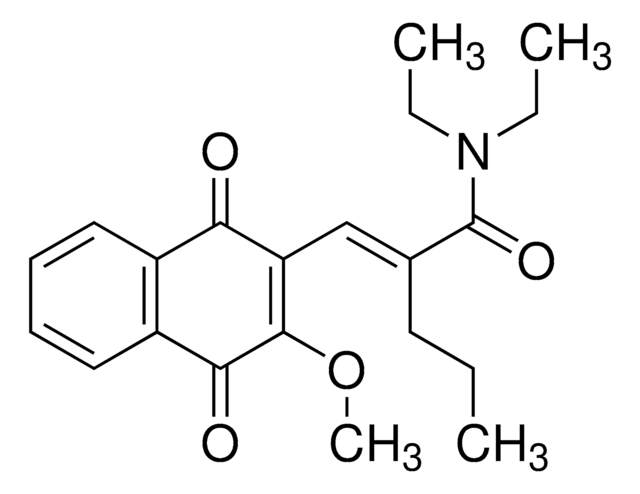
E3330 has been used in the inhibition of endothelial cancer cells and apurinic/apyrimidinic endodeoxyribonuclease 1 (APEX1).
Biochem/physiol Actions
E3330 is a specific inhibitor of AP endonuclease 1 redox domain. E3330 inhibits APE-1 regulation of transcription factors, but does not affect Ape1 DNA repair activity. AP endonuclease 1 (APE1; also known as REF-1) is a multifunctional protein with dual functions in DNA repair and redox regulation of transcription factors. It is involved in apurinic/apyrimidinic endonuclease DNA base excision repair activity, in proofreading exonuclease activity, and in modulating DNA binding activity of several transcription factors including NF-κB, Egr-1, p53, AP-1, CREB, HIF-α, and members of the Pax family. APE1 is overexpressed in several human cancers, and disruption of APE1 function has detrimental effects on cancer cell viability. E3330 significantly reduces the growth of human pancreatic cancer cells in vitro and inhibits pancreatic cancer cell migration.
E3330 is a specific inhibitor of AP endonuclease 1 redox domain; inhibits APE-1 regulation of transcription factors, but does not affect Ape1 DNA repair activity.
We have developed a method using novel latex beads for rapid identification of drug receptors using affinity purification. Composed of a glycidylmethacrylate (GMA) and styrene copolymer core with a GMA polymer surface, the beads minimize nonspecific protein binding and maximize
World journal of gastroenterology, 11(40), 6258-6261 (2006-01-19)
To investigate the reduction of cell viability in human hepatocellular carcinoma (HCC) cell lines induced by inhibition of nuclear factor kappa B (NF kappa B). HLE, SKHep1, and HepG2 were incubated and E3330 was used to compare the stimulation of
The multi-functional apyrimidinic endonuclease 1/redox factor-1 (APE1/Ref-1) DNA repair and redox signaling protein has been shown to have a role in cancer growth and survival, however, little has been investigated concerning its role in inflammation. In this study, an APE1