Direkt zum Inhalt
Merck

C8221

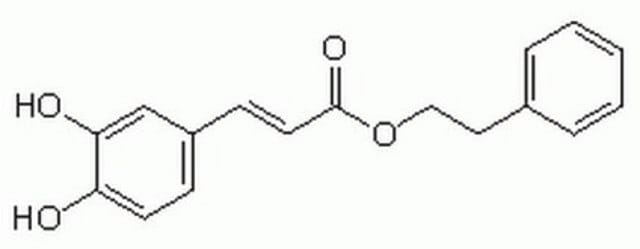
Caffeic acid phenethyl ester

synthetic, ≥97% (HPLC), Nuclear transcription factor NF-κB inhibitor, powder

Caffeic acid phenethyl ester

Synonym(e):

CAPE

Anmelden zur Ansicht der Organisations- und Vertragspreise.

Größe auswählen

C8221-1G

€ 627,00

€ 627,00


Warenkorb auf Verfügbarkeit prüfen

Großbestellung anfragen

Über diesen Artikel

Empirische Formel (Hill-System):
C17H16O4
CAS-Nummer:
Molekulargewicht:
284.31
UNSPSC Code:
12352108
PubChem Substance ID:
NACRES:
NA.77
MDL number:
Assay:
≥97% (HPLC)
Form:
powder
Quality level:
Storage condition:
protect from light

Fortfahren mit

Technischer Dienst
Benötigen Sie Hilfe? Unser Team von erfahrenen Wissenschaftlern ist für Sie da.
Unterstützung erhalten

Produktname

Caffeic acid phenethyl ester, ≥97% (HPLC), powder

biological source

synthetic

Quality Level

assay

≥97% (HPLC)

form

powder

storage condition

protect from light

color

off-white

solubility

ethyl acetate: 50 mg/mL, DMSO: soluble, ethanol: soluble

storage temp.

−20°C

SMILES string

Oc1ccc(\C=C\C(=O)OCCc2ccccc2)cc1O

InChI

1S/C17H16O4/c18-15-8-6-14(12-16(15)19)7-9-17(20)21-11-10-13-4-2-1-3-5-13/h1-9,12,18-19H,10-11H2/b9-7+

InChI key

SWUARLUWKZWEBQ-VQHVLOKHSA-N

Gene Information

human ... NFKB2(4791)

Ähnliche Artikel vergleichen

Vollständigen Vergleich anzeigen

Unterschiede anzeigen

1 of 4

Dieser Artikel
211200C9623D5794
form

powder

form

solid

form

powder

form

solid

assay

≥97% (HPLC)

assay

≥97% (HPLC)

assay

≥98% (HPLC)

assay

≥97% (HPLC)

Quality Level

200

Quality Level

100

Quality Level

200

Quality Level

200

storage temp.

−20°C

storage temp.

−20°C

storage temp.

−20°C

storage temp.

−20°C

storage condition

protect from light

storage condition

OK to freeze, protect from light

storage condition

-

storage condition

-

solubility

ethyl acetate: 50 mg/mL, ethanol: soluble, DMSO: soluble

solubility

DMSO: 200 mg/mL, ethanol: 50 mg/mL

solubility

DMSO: soluble, acetone: soluble, ethyl acetate: soluble

solubility

0.1 M HCl: slightly soluble, 0.1 M NaOH: slightly soluble, DMSO: soluble, H2O: insoluble, ethanol: soluble, ethyl acetate: soluble

Application

Caffeic acid phenethyl ester (CAPE) has been used to determine the effect of CAPE in hyperthyroidism, as a component of culture media to measure the cytotoxicity of breast cancer cell line MDA-MB-231, to study its effects on amiodarone-induced pulmonary fibrosis in rats.

Biochem/physiol Actions

Caffeic acid phenethyl ester is a specific inhibitor of the nuclear transcription factor NF-κB.
CAPE exhibits several properties such as anticarcinogenic, immunomodulatory activities, antioxidant, antiviral, anti-inflammatory, hypoglycaemic effect, cardioprotective and inhibits gastric secretion. It also has an inhibitory effect on fibroblasts growth factor type 2 (FGF-2), a tumor growth factor in breast cancer.

Features and Benefits

This compound is a featured product for Gene Regulation research. Click here to discover more featured Gene Regulation products. Learn more about bioactive small molecules for other areas of research at sigma.com/discover-bsm.

Lagerklasse

11 - Combustible Solids

wgk

WGK 3

flash_point_f

Not applicable

flash_point_c

Not applicable

ppe

dust mask type N95 (US), Eyeshields, Gloves


Hier finden Sie alle aktuellen Versionen:

Analysenzertifikate (COA)

Lot/Batch Number

Die passende Version wird nicht angezeigt?

Wenn Sie eine bestimmte Version benötigen, können Sie anhand der Lot- oder Chargennummer nach einem spezifischen Zertifikat suchen.

Besitzen Sie dieses Produkt bereits?

In der Dokumentenbibliothek finden Sie die Dokumentation zu den Produkten, die Sie kürzlich erworben haben.

Die Dokumentenbibliothek aufrufen

Attenuation of oxidative stress in plasma and tissues of rats with experimentally induced hyperthyroidism by caffeic acid phenylethyl ester
Mohamadin AM, et al.
Basic and Clinical Pharmacology and Toxicology, 100(2), 84-90 (2007)
K Natarajan et al.
Proceedings of the National Academy of Sciences of the United States of America, 93(17), 9090-9095 (1996-08-20)
Caffeic acid phenethyl ester (CAPE), an active component of propolis from honeybee hives, is known to have antimitogenic, anticarcinogenic, antiinflammatory, and immunomodulatory properties. The molecular basis for these diverse properties is not known. Since the role of the nuclear factor
M T Hansen et al.
Oncogene, 34(4), 424-435 (2014-01-29)
S100A4 is implicated in metastasis and chronic inflammation, but its function remains uncertain. Here we establish an S100A4-dependent link between inflammation and metastatic tumor progression. We found that the acute-phase response proteins serum amyloid A (SAA) 1 and SAA3 are
M R Fesen et al.
Proceedings of the National Academy of Sciences of the United States of America, 90(6), 2399-2403 (1993-03-15)
In an effort to further extend the number of targets for development of antiretroviral agents, we have used an in vitro integrase assay to investigate a variety of chemicals, including topoisomerase inhibitors, antimalarial agents, DNA binders, naphthoquinones, the flavone quercetin
O K Mirzoeva et al.
Prostaglandins, leukotrienes, and essential fatty acids, 55(6), 441-449 (1996-12-01)
To investigate the possible mechanism of the therapeutic action of propolis, we studied: (a) the effect of propolis, its components, caffeic acid phenethyl ester (CAPE), caffeic acid (CA), quercetin and naringenin, as well as the synthetic compounds indomethacin (IM) and

Artikel

Chronic inflammation is an underlying factor in the development and progression of many of the chronic diseases of aging, such as arthritis, atherosclerosis, diabetes, and cancer.

We offer a variety of small molecule research tools, such as transcription factor modulators, inhibitors of chromatin modifying enzymes, and agonists/antagonists for target identification and validation in gene regulation research; a selection of these research tools is shown below.

Questions

Reviews

Active Filters

  1. 1 Ratings-only review

Unser Team von Wissenschaftlern verfügt über Erfahrung in allen Forschungsbereichen einschließlich Life Science, Materialwissenschaften, chemischer Synthese, Chromatographie, Analytik und vielen mehr..

Setzen Sie sich mit dem technischen Dienst in Verbindung