Direkt zum Inhalt
Merck

B4813

BGP-15

≥98% (HPLC)

Anmelden zur Ansicht der Organisations- und Vertragspreise.

Größe auswählen

5 MG

€ 142,80

25 MG

€ 664,00

€ 142,80

Listenpreis€ 168,00Sparen Sie 15%
Aktion nur im Web

Warenkorb auf Verfügbarkeit prüfen

Großbestellung anfragen

Über diesen Artikel

Empirische Formel (Hill-System):
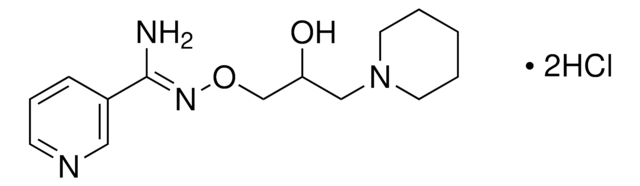
C14H22N4O2· 2HCl
CAS-Nummer:
Molekulargewicht:
351.27
NACRES:
NA.77
PubChem Substance ID:
UNSPSC Code:
12352200
MDL number:
Assay:
≥98% (HPLC)
Form:
solid
Quality level:

Fortfahren mit

Technischer Dienst
Benötigen Sie Hilfe? Unser Team von erfahrenen Wissenschaftlern ist für Sie da.
Unterstützung erhalten

Quality Level

assay

≥98% (HPLC)

form

solid

solubility

deionized water: 28 mg/mL

storage temp.

−20°C

SMILES string

Cl.Cl.N\C(=N/OCC(O)CN1CCCCC1)c2cccnc2

InChI

1S/C14H22N4O2.2ClH/c15-14(12-5-4-6-16-9-12)17-20-11-13(19)10-18-7-2-1-3-8-18;;/h4-6,9,13,19H,1-3,7-8,10-11H2,(H2,15,17);2*1H

InChI key

ISGGVCWFTPTHIX-UHFFFAOYSA-N

Ähnliche Artikel vergleichen

Vollständigen Vergleich anzeigen

Unterschiede anzeigen

1 of 4

Dieser Artikel
C8874565840S5451
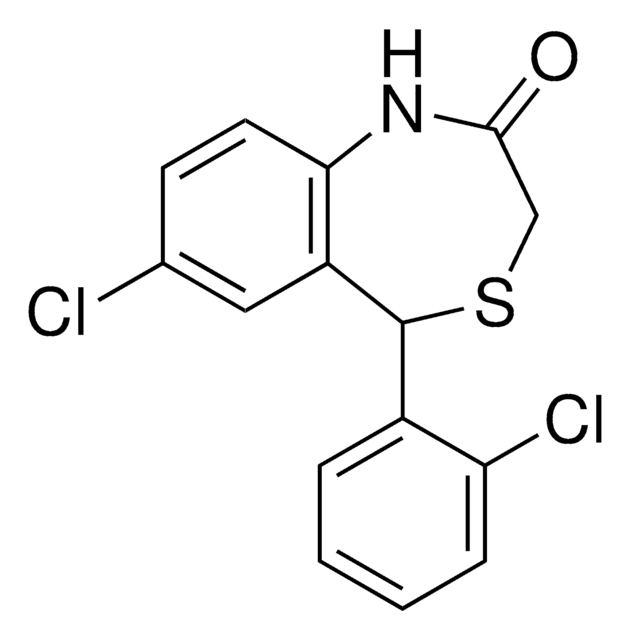
CGP-37157 ≥98% (HPLC), powder

C8874

CGP-37157

form

solid

form

powder

form

solid

form

solid

assay

≥98% (HPLC)

assay

≥98% (HPLC)

assay

≥95% (HPLC)

assay

≥98% (HPLC)

Quality Level

100

Quality Level

100

Quality Level

100

Quality Level

100

storage temp.

−20°C

storage temp.

2-8°C

storage temp.

2-8°C

storage temp.

room temp

solubility

deionized water: 28 mg/mL

solubility

DMSO: ≥20 mg/mL

solubility

DMSO: 50 mg/mL

solubility

deionized water: ≥5 mg/mL

General description

BGP-15 is a hydroxylamine derivative, which has cytoprotective and neuroprotective properties. It reduces phospho- c-Jun N-terminal kinase (pJNK) and p38 stress signalling. BGP-15 also stimulates non-specific serine/threonine protein kinase (AKT) and insulin-like growth factor 1 receptor (IGFR1) protective signalling. BGP-15 functions as an insulin sensitizer in an olanzapine-induced metabolic disorder. It protects cells against cell death and enhances the expression of heat shock protein (HSP). BGP-15 might be used to treat heart failure (HF) and atrial fibrillation (AF).[1]

Application

BGP-15 has been used to study its influence on proteasomal degradation of missense dystrophins.

Biochem/physiol Actions

BGP-15 is PARP inhibitor, HSP72 activator.

pictograms

Skull and crossbones

signalword

Danger

hcodes

Hazard Classifications

Acute Tox. 3 Oral

Lagerklasse

6.1C - Combustible acute toxic Cat.3 / toxic compounds or compounds which causing chronic effects

wgk

WGK 3

flash_point_f

Not applicable

flash_point_c

Not applicable


Hier finden Sie alle aktuellen Versionen:

Analysenzertifikate (COA)

Lot/Batch Number

Die passende Version wird nicht angezeigt?

Wenn Sie eine bestimmte Version benötigen, können Sie anhand der Lot- oder Chargennummer nach einem spezifischen Zertifikat suchen.

Besitzen Sie dieses Produkt bereits?

In der Dokumentenbibliothek finden Sie die Dokumentation zu den Produkten, die Sie kürzlich erworben haben.

Die Dokumentenbibliothek aufrufen

Disease-proportional proteasomal degradation of missense dystrophins
Talsness DM, et al.
Proceedings of the National Academy of Sciences of the USA, 112(40), 12414-12419 (2015)
BGP-15 prevents the death of neurons in a mouse model of familial dysautonomia
Ohlen SB, et al.
Proceedings of the National Academy of Sciences of the USA, 114(19), 5035-5040 (2017)
BGP-15 protects against oxidative stress-or lipopolysaccharide-induced mitochondrial destabilization and reduces mitochondrial production of reactive oxygen species
Sumegi K, et al.
PLoS ONE, 12(1), e0169372-e0169372 (2017)
Urszula Brykczynska et al.
Cell reports, 30(5), 1627-1643 (2020-02-06)
The innate immune system safeguards the organism from both pathogenic and environmental stressors. Also, physiologic levels of nutrients affect organismal and intra-cellular metabolism and challenge the immune system. In the long term, over-nutrition leads to low-grade systemic inflammation. Here, we
Matthew S Elitt et al.
Nature, 585(7825), 397-403 (2020-07-02)
Mutations in PLP1, the gene that encodes proteolipid protein (PLP), result in failure of myelination and neurological dysfunction in the X-chromosome-linked leukodystrophy Pelizaeus-Merzbacher disease (PMD)1,2. Most PLP1 mutations, including point mutations and supernumerary copy variants, lead to severe and fatal disease.

Global Trade Item Number

SKUGTIN
B4813-25MG04061833217580
B4813-5MG04061833217597

Questions

Reviews

No rating value

Active Filters

Unser Team von Wissenschaftlern verfügt über Erfahrung in allen Forschungsbereichen einschließlich Life Science, Materialwissenschaften, chemischer Synthese, Chromatographie, Analytik und vielen mehr..

Setzen Sie sich mit dem technischen Dienst in Verbindung