


If this product has an expiration or retest date, it will be shown on the Certificate of Analysis (COA, CofA). If there is no retest or expiration date listed on the product's COA, we do not have suitable stability data to determine a shelf life. For these products, the only date on the COA will be the release date; a retest, expiration, or use-by-date will not be displayed.
For all products, we recommend handling per defined conditions as printed in our product literature and website product descriptions. We recommend that products should be routinely inspected by customers to ensure they perform as expected.
For products without retest or expiration dates, our standard warranty of 1 year from the date of shipment is applicable.
For more information, please refer to the Product Dating Information document: https://www.sigmaaldrich.com/deepweb/assets/sigmaaldrich/marketing/global/documents/418/501/product-dating-information-06-25-mk.pdf
Fortfahren mit
A2388

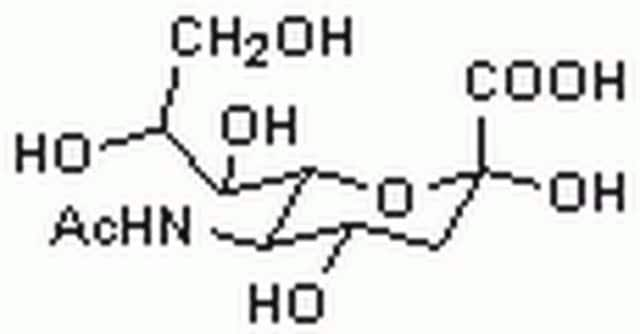
N-Acetylneuraminsäure
≥98% (HPLC), from Escherichia coli
Synonym(e):
5-Acetamido-3,5-dideoxy-D-glycero-D-galactononulosonsäure, Lactaminsäure, NAN, NANA, Sialinsäure
Größe auswählen
| Ihnen/SKU | Verfügbarkeit | Preis |
|---|---|---|
10 mg | Warenkorb auf Verfügbarkeit prüfen | € 70,20 |
25 mg | Warenkorb auf Verfügbarkeit prüfen | € 113,00 |
100 mg | Warenkorb auf Verfügbarkeit prüfen | € 363,00 |
250 mg | Warenkorb auf Verfügbarkeit prüfen | € 753,00 |
1 g | Warenkorb auf Verfügbarkeit prüfen | € 2.000,00 |
Über diesen Artikel
biological source
Escherichia coli
Quality Segment
type
Type VI
assay
≥98% (HPLC)
form
powder
optical activity
[α]20/D -34.0 to -30.0 °, c = 1% in water
technique(s)
HPLC: suitable
color
white to off-white
mp
184-186 °C
solubility
water: 50 mg/mL, clear, colorless
application(s)
advanced drug delivery
storage temp.
−20°C
SMILES string
O[C@@]1(O[C@@]([C@@H]([C@H](C1)O)NC(C)=O)([H])[C@@H]([C@@H](CO)O)O)C(O)=O
InChI
1S/C11H19NO9/c1-4(14)12-7-5(15)2-11(20,10(18)19)21-9(7)8(17)6(16)3-13/h5-9,13,15-17,20H,2-3H2,1H3,(H,12,14)(H,18,19)/t5-,6+,7+,8+,9+,11-/m0/s1
InChI key
SQVRNKJHWKZAKO-PFQGKNLYSA-N
Application
Biochem/physiol Actions
Other Notes
1 of 1
Dieser Artikel | |||
|---|---|---|---|
| biological source Escherichia coli | biological source synthetic | biological source - | biological source - |
| technique(s) HPLC: suitable | technique(s) - | technique(s) HPLC: suitable, gas chromatography (GC): suitable | technique(s) - |
| assay ≥98% (HPLC) | assay ≥95% anhydrous basis | assay ≥97.0% (HPLC) | assay ≥98% (HPLC) |
| solubility water: 50 mg/mL, clear, colorless | solubility H2O: ~50 mg/mL | solubility - | solubility water: ≥10 mg/mL |
| Quality Level 300 | Quality Level 200 | Quality Level 100 | Quality Level 100 |
| form powder | form powder | form powder or crystals | form solid |
Still not finding the right product?
Explore all of our products under N-Acetylneuraminsäure
signalword
Warning
hcodes
Hazard Classifications
Eye Irrit. 2
Lagerklasse
11 - Combustible Solids
wgk
WGK 2
flash_point_f
Not applicable
flash_point_c
Not applicable
ppe
Eyeshields, Gloves, type N95 (US)
Hier finden Sie alle aktuellen Versionen:
Besitzen Sie dieses Produkt bereits?
In der Dokumentenbibliothek finden Sie die Dokumentation zu den Produkten, die Sie kürzlich erworben haben.
-
How can I determine the shelf life / expiration / retest date of this product?
1 answer-
Helpful?
-
-
How is shipping temperature determined? And how is it related to the product storage temperature?
1 answer-
Products may be shipped at a different temperature than the recommended long-term storage temperature. If the product quality is sensitive to short-term exposure to conditions other than the recommended long-term storage, it will be shipped on wet or dry-ice. If the product quality is NOT affected by short-term exposure to conditions other than the recommended long-term storage, it will be shipped at ambient temperature. As shipping routes are configured for minimum transit times, shipping at ambient temperature helps control shipping costs for our customers. For more information, please refer to the Storage and Transport Conditions document: https://www.sigmaaldrich.com/deepweb/assets/sigmaaldrich/marketing/global/documents/316/622/storage-transport-conditions-mk.pdf
Helpful?
-
-
I was wondering if the Sigma-Aldrich (A2388) N-Acetylneuraminic acid from Escherichia coli, ≥98%, is suitable to use in vitro on oligodendrocytes. In other words, is it sterile? Thank you in advance.
1 answer-
This product has not been tested for in vivo or in vitro applications. Suitability for in vitro use will need to be validated by the end-user. The material is purified from Escherichia coli and has not tested for endotoxin. Solutions would require sterile filtration prior to adding to cultures. Alternatively, product 110138 is a synthetically produced product option. While not tested for in vitro use, it may be a better option for sensitive cell lines. It is not sterile and solutions would also required filter sterilization. See the link below to review this product:
https://www.sigmaaldrich.com/product/mm/110138Helpful?
-