


Traditional DNA/RNA isolation kits can be used to prepare genomic material for sequencing (RNA-seq, scRNA-seq, WGS, CHIP-seq etc). For some applications with large organoids, tissue specific DNA/RNA extraction kits are recommended. TRI Reagent (T9424) can be added to the dissociated organoids before RNA extraction and can be stored at -80 °C until future use.
SCM304

3dGRO® humanes Darmorganoid-Expansionsmedium
Complete serum-free organoid media for the expansion and long-term 3D culture of human intestinal colon organoids.
Synonym(e):
Colon Organoid Culture Media, Intestinal Organoid Culture Media
Anmelden zur Ansicht der Organisations- und Vertragspreise.
Größe auswählen
Ansicht ändern
| Packungsgröße | SKU | Verfügbarkeit | Preis |
|---|
Über diesen Artikel
NACRES:
NA.71
UNSPSC Code:
12352207
Preise und Verfügbarkeit sind derzeit nicht verfügbar.
Technischer Dienst
Benötigen Sie Hilfe? Unser Team von erfahrenen Wissenschaftlern ist für Sie da.
Unterstützung erhaltenform
liquid
packaging
pkg of 50 mL
technique(s)
cell culture | stem cell: suitable
osmolality
350-375 mOsm
application(s)
cell analysis
General description
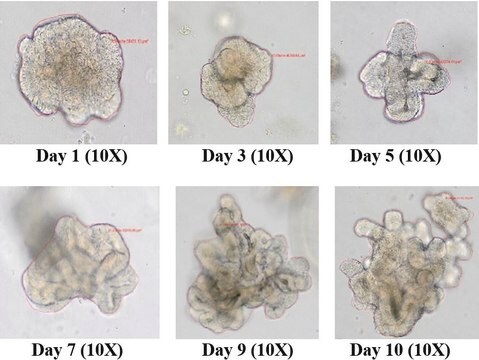
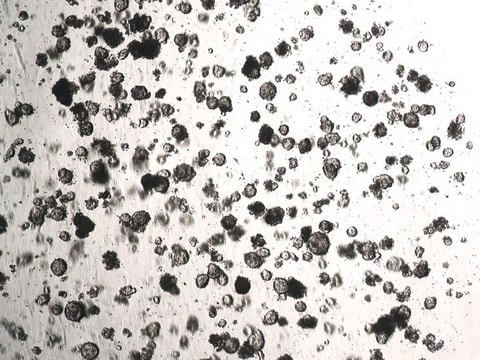
3dGRO® humanes Darmorganoid-Expansionsmedium ist ein gebrauchsfertiges, serumfreies Komplettmedium für die Expansion und Langzeitkultivierung von humanen Darmorganoiden. Das Medium wurde zur Verwendung mit 3dGRO® humanen Darmorganoiden aus iPSC (Katalognr. SCC300) validiert. Darmorganoide, die in dem Medium propagiert wurden, exprimieren darmspezifische Marker, einschließlich Hinterdarmmarker CFX2, α-Carbonanhydrase II (CA-II), α-Carbonanhydrase IV (CA-IV) und Becherzellmarker Mucin-2 und Mucin-5B.
Application
Serumfreie Organoidkomplettmedien für die Expansion und Langzeit-3D-Kultur von humanen Darmorganoiden.
Forschungskategorie:
Forschungskategorie:
- Zellkultur
- Stammzellenforschung
Preparation Note
Ab Empfang bei −20 °C lagern. Wenn Sie für den Gebrauch bereit sind, tauen Sie es über Nacht bei 2–8 °C auf. Nach dem Auftauen gründlich mischen. Sofort verwenden und bei 2–8 °C bis zu 1 Woche aufbewahren. Nicht wieder einfrieren. Nicht verwendete Aliquote können bis zum Verfallsdatum bei −20 °C gelagert werden.
Analysis Note
Aussehen (Farbe): klar/keine Partikel (rote Flüssigkeit)
Osmolalität: 350–375 mOsm
pH-Wert: 7,0–7,4
Sterilitätsgeprüft: kein Wachstum/entspricht
Endotoxin: <2 EU/ml
Mycoplasma: Negativ
Funktionsassay: Auftauen und Kultivieren von humanen Darmorganoiden für 2 Passagen.
Osmolalität: 350–375 mOsm
pH-Wert: 7,0–7,4
Sterilitätsgeprüft: kein Wachstum/entspricht
Endotoxin: <2 EU/ml
Mycoplasma: Negativ
Funktionsassay: Auftauen und Kultivieren von humanen Darmorganoiden für 2 Passagen.
Legal Information
3dGRO is a registered trademark of Merck KGaA, Darmstadt, Germany
Disclaimer
Sofern in unserem Katalog oder anderen Begleitdokumenten unserer Produkte nicht anders angegeben, sind unsere Produkte nur für Forschungszwecke vorgesehen und nicht für andere Zwecke zu verwenden, einschließlich, jedoch nicht beschränkt auf unautorisierte kommerzielle Verwendung, zur In-vitro-Diagnostik, für Ex-vivo- oder In-vivo-Therapiezwecke oder jegliche Art der Einnahme oder Anwendung bei Menschen oder Tieren.
1 of 1
Dieser Artikel | |||
|---|---|---|---|
| application(s) cell analysis | application(s) 3D cell culture | application(s) 3D cell culture | application(s) 3D cell culture |
| form liquid | form liquid | form - | form - |
| technique(s) cell culture | stem cell: suitable | technique(s) cell culture | stem cell: suitable | technique(s) cell culture | mammalian: suitable, cell culture | stem cell: suitable | technique(s) cell culture | mammalian: suitable, cell culture | stem cell: suitable |
| packaging pkg of 50 mL | packaging vial of >1500 viable organoids | packaging vial of ≥1500 organoids/vial vials | packaging vial of ≥1500 organoids/vial vials |
| osmolality 350-375 mOsm | osmolality - | osmolality - | osmolality - |
Lagerklasse
12 - Non Combustible Liquids
wgk
WGK 1
flash_point_f
Not applicable
flash_point_c
Not applicable
Analysenzertifikate (COA)
Suchen Sie nach Analysenzertifikate (COA), indem Sie die Lot-/Chargennummer des Produkts eingeben. Lot- und Chargennummern sind auf dem Produktetikett hinter den Wörtern ‘Lot’ oder ‘Batch’ (Lot oder Charge) zu finden.
Besitzen Sie dieses Produkt bereits?
In der Dokumentenbibliothek finden Sie die Dokumentation zu den Produkten, die Sie kürzlich erworben haben.
Protokolle
Learn how to cultivate similar-sized iPSC-derived colon organoids using Millicell® Microwell plates and perform a forskolin-induced swelling assay.
A rapid in vitro assay for CFTR function, the forskolin-induced swelling protocol uses human colon organoids, which can be derived from cystic fibrosis patient tissue.
Artikel
Organoid culture products to generate tissue and stem cell derived 3D brain, intestinal, gut, lung and cancer tumor organoid models.
Human epithelial intestinal colonic organoids can be used as an alternative to Caco-2 drug permeability assays for drug screening and compound toxicity testing.
Organoid culture FAQs. Learn how to culture and analyze organoids following established 3D cell culture protocols. Tips and tricks.
Verwandter Inhalt
Explore our portfolio of 3D cell culture tools and technologies for any 3D cell line or application and discover organoids, hydrogels, ULA, microwell, or hydrogel plates, and more.
Monitor barrier formation using colon PDOs, iPSC-derived colon organoids, Millicell® cell culture inserts, and the Millicell® ERS. 3.0.
Highly characterized cryopreserved human colonic organoids and a step-by-step organoid culture protocol for epithelial intestinal organoid differentiation from iPS cells.
Global Trade Item Number
| SKU | GTIN |
|---|---|
| SCM304 | 04054839986451 |
-
How Do you Extract RNA/DNA from Organoids in Cultured in Matrigel?
1 answer-
Helpful?
-
-
How do you stain organoids with antibodies?
1 answer-
Organoids can be stained with antibodies for immunocytochemical (ICC)/Immunohistochemical (IHC) analysis using either whole-mount or paraffin embedding/sectioning techniques. It is critical to use antibodies prequalified for organoid analysis.
Helpful?
-
-
How are organoids cultured?
1 answer-
Once isolated, organoids are cultured in specialized media embedded in a rich extracellular matrix (ECM) basement membrane extract hydrogel such as Growth Factor Reduced Matrigel. Media is replenished every other day and cells are passaged once per week (7-12 days) before cells become too large or necrotic. Cells can be passaged in either small clump fragments or as single cells using mechanical dissociation/enzyme-free passaging reagents. Depending on organoid type and confluency, split ratios of roughly 1:3-1:4 can be used when passaging organoids. For sensitive organoid types, ROCKi (Y27632) (SCM075) can be added during passaging to help in promoting cell viability.
Helpful?
-