Direkt zum Inhalt
Merck

MABE351

Anti-acetyl-Histone H3 (Lys14) Antibody, clone 13HH3-1A5

ascites fluid, clone 13HH3-1A5, from mouse

Synonym(e):

Histone H3.1t, H3/t, H3t, H3/g

Anmelden zur Ansicht der Organisations- und Vertragspreise.

Größe auswählen

100 μL

€ 580,00

€ 580,00


Warenkorb auf Verfügbarkeit prüfen
Für Ihr Target ist ein rekombinanter, konservierungsmittelfreier Antikörper verfügbar. Probieren Sie ZRB06599

Großbestellung anfragen

Über diesen Artikel

UNSPSC Code:
12352203
NACRES:
NA.41
eCl@ss:
32160702
Clone:
13HH3-1A5, monoclonal
Species reactivity:
human, mouse
Application:
ChIP, ICC, IP, WB
Citations:
4

Fortfahren mit

Technischer Dienst
Benötigen Sie Hilfe? Unser Team von erfahrenen Wissenschaftlern ist für Sie da.
Unterstützung erhalten

biological source

mouse

Quality Level

antibody form

ascites fluid

antibody product type

primary antibodies

clone

13HH3-1A5, monoclonal

species reactivity

human, mouse

technique(s)

ChIP: suitable (ChIP-seq), immunocytochemistry: suitable, immunoprecipitation (IP): suitable, western blot: suitable

isotype

IgG1

NCBI accession no.

UniProt accession no.

shipped in

dry ice

target post-translational modification

acetylation (Lys14)

Gene Information

human ... H3C1(8350)
mouse ... H3C1(360198)

Ähnliche Artikel vergleichen

Vollständigen Vergleich anzeigen

Unterschiede anzeigen

1 of 4

Dieser Artikel
MABE241ABE435ABE1304
Gene Information

human ... H3C1(8350)
mouse ... H3C1(360198)

Gene Information

human ... HIST1H3F(8968)

Gene Information

human ... HIST1H3F(8968)

Gene Information

human ... HIST1H3F(8968)

species reactivity

human, mouse

species reactivity

human

species reactivity

human, mouse

species reactivity

rat, human

clone

13HH3-1A5, monoclonal

clone

51TA-2H1, monoclonal

clone

polyclonal

clone

polyclonal

biological source

mouse

biological source

mouse

biological source

rabbit

biological source

rabbit

antibody form

ascites fluid

antibody form

ascites fluid

antibody form

affinity isolated antibody

antibody form

affinity isolated antibody

technique(s)

ChIP: suitable (ChIP-seq), immunoprecipitation (IP): suitable, immunocytochemistry: suitable, western blot: suitable

technique(s)

dot blot: suitable, immunocytochemistry: suitable, immunohistochemistry: suitable, immunoprecipitation (IP): suitable, western blot: suitable

technique(s)

ChIP: suitable (ChIP-seq), dot blot: suitable, immunocytochemistry: suitable, western blot: suitable

technique(s)

dot blot: suitable, immunohistochemistry: suitable, immunoprecipitation (IP): suitable, western blot: suitable

General description

Histones are nuclear proteins that form octameric structures which bind DNA to form units of chromatin called nucleosomes. The family of histones—H2A, H2B, H3, and H4—are key players in gene regulation. They undergo a number of post-translational modifications (PTM) in response to various stimuli. Acetylation is a reversible PTM that involves the transfer of acetyl groups to N-terminal lysine (K) residues by a family of histone acetyltransferase enzymes, including GNAT, Gcn5, and p300/CBP. Histone acetylation reduces the electrostatic attractions between DNA and histones, which destabilizes chromatin structure and provide chromatin remodeling and transcriptional complexes, with access to DNA, potentially resulting in increased gene transcription. In fission yeast, acetylation of H3K4 is regulated by Gcn5 and the Mst2 complex, and is crucial to the activation of DNA damage checkpoint.
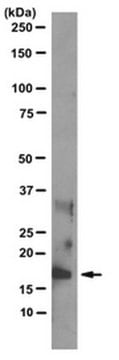
~17 kDa observed. Uncharacterized bands may be observed at ~23 kDa and ~35 kDa in some cell lysates.

Immunogen

Ovalbumin-conjugated linear peptide corresponding to human Histone H3 acetylated at Lys14.

Application

Anti-acetyl-Histone H3 (Lys14) Antibody, clone 13HH3-1A5 is a mouse monoclonal antibody for detection of acetyl-Histone H3 (Lys14) also known as Histone H3.1t, H3/t, H3t, H3/g & has been validated in WB, IP, ICC.
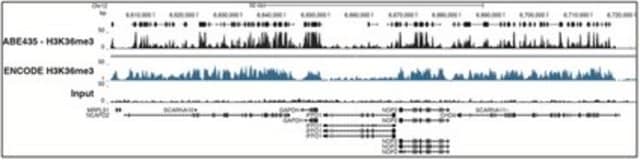
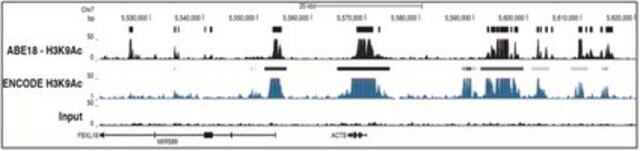
Demonstrated to react in Mouse ESCs in ChIP-seq in Karmodiya et al. BMC Genomics 2012, 13:424.
Immunoprecipitation Analysis: A representative lot was used to immunoprecipitate acetyl-Histone H3 (Lys4) in IP.

Immunocytochemistry Analysis: A representative lot was used to detect acetyl-Histone H3 (Lys4) in ICC.

Chromatin Immunoprecipitation Analysis: A representative lot was used to detect acetyl-Histone H3 (Lys4) in ChIP.

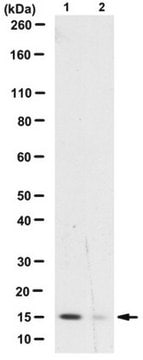
Western Blot Analysis: A representative lot was used to detect acetyl-Histone H3 (Lys4) in WB.

Physical form

Mouse monoclonal IgG1 in ascites containing 0.05% sodium azide.

Analysis Note

Evaluated by Western Blot in HeLa acid extract.

Western Blot Analysis: A 1:2,000 dilution of this antibody detected acetyl-Histone H3 (Lys4) in 10 µg of HeLa acid extract.

Sie haben nicht das passende Produkt gefunden?  

Probieren Sie unser Produkt-Auswahlhilfe. aus.

Lagerklasse

12 - Non Combustible Liquids

wgk

nwg

flash_point_f

Not applicable

flash_point_c

Not applicable


Analysenzertifikate (COA)

Suchen Sie nach Analysenzertifikate (COA), indem Sie die Lot-/Chargennummer des Produkts eingeben. Lot- und Chargennummern sind auf dem Produktetikett hinter den Wörtern ‘Lot’ oder ‘Batch’ (Lot oder Charge) zu finden.

Besitzen Sie dieses Produkt bereits?

In der Dokumentenbibliothek finden Sie die Dokumentation zu den Produkten, die Sie kürzlich erworben haben.

Die Dokumentenbibliothek aufrufen

Renata Z Jurkowska et al.
Nature communications, 8(1), 2057-2057 (2017-12-14)
SETDB1 is an essential H3K9 methyltransferase involved in silencing of retroviruses and gene regulation. We show here that its triple Tudor domain (3TD) specifically binds to doubly modified histone H3 containing K14 acetylation and K9 methylation. Crystal structures of 3TD
Na Li et al.
Molecular cell, 63(3), 470-484 (2016-08-02)
Histone acetylation, including acetylated H3K14 (H3K14ac), is generally linked to gene activation. Monomethylated histone H3 lysine 4 (H3K4me1), together with other gene-activating marks, denotes active genes. In contrast to usual gene-activating functions of H3K14ac and H3K4me1, we here show that
Zhendong Cao et al.
Molecular cell, 81(17), 3604-3622 (2021-08-07)
The transformed state in acute leukemia requires gene regulatory programs involving transcription factors and chromatin modulators. Here, we uncover an IRF8-MEF2D transcriptional circuit as an acute myeloid leukemia (AML)-biased dependency. We discover and characterize the mechanism by which the chromatin
Kyong-Rim Kieffer-Kwon et al.
Molecular cell, 67(4), 566-578 (2017-08-15)
50 years ago, Vincent Allfrey and colleagues discovered that lymphocyte activation triggers massive acetylation of chromatin. However, the molecular mechanisms driving epigenetic accessibility are still unknown. We here show that stimulated lymphocytes decondense chromatin by three differentially regulated steps. First

Global Trade Item Number

SKUGTIN
MABE35104053252697760

Questions

Reviews

No rating value

Active Filters

Unser Team von Wissenschaftlern verfügt über Erfahrung in allen Forschungsbereichen einschließlich Life Science, Materialwissenschaften, chemischer Synthese, Chromatographie, Analytik und vielen mehr..

Setzen Sie sich mit dem technischen Dienst in Verbindung