Direkt zum Inhalt
Merck

Fortfahren mit

512533

MKLP-2 Inhibitor, Paprotrain

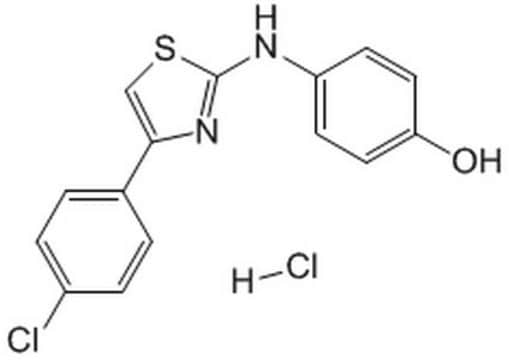
The MKLP-2 Inhibitor, Paprotrain controls the biological activity of MKLP-2. This small molecule/inhibitor is primarily used for Cell Signaling applications.

Synonym(e):

MKLP-2 Inhibitor, Paprotrain, (Z)-2-(1H-Indol-3-yl)-3-(pyridin-3-yl)acrylonitrile, PAssenger PROteins TRAnsport INhibitor, Mitotic Kinesin-Like Protein 2 Inhibitor

Anmelden zur Ansicht der Organisations- und Vertragspreise.

Größe auswählen

Ansicht ändern
PackungsgrößeSKUVerfügbarkeitPreis
25 mg
Warenkorb auf Verfügbarkeit prüfen
€ 194,00

Über diesen Artikel

Empirische Formel (Hill-System):
C16H11N3
Molekulargewicht:
245.28
NACRES:
NA.77
UNSPSC Code:
12352200
Assay:
≥98% (HPLC)
Form:
powder
Quality level:
Storage condition:
OK to freeze, protect from light

€ 194,00


Warenkorb auf Verfügbarkeit prüfen

Technischer Dienst
Benötigen Sie Hilfe? Unser Team von erfahrenen Wissenschaftlern ist für Sie da.
Unterstützung erhalten


Quality Level

assay

≥98% (HPLC)

form

powder

manufacturer/tradename

Calbiochem®

storage condition

OK to freeze, protect from light

color

yellow

solubility

DMSO: 100 mg/mL

shipped in

ambient

storage temp.

2-8°C

General description

A cell-permeable acrylonitrile compound that inhibits the kinesin-6 family member MKLP-2 (Mitotic kinesin-like protein 2; IC50 against basal and microtubule-/MT-stimulated ATPase activity = 1.35 and 0.83 µM, respectively) in a reversible, ATP-uncompetitive (Ki = 3.36 µM), and MT-noncompetitive (Ki = 1.6 µM) manner, with little effect against the ATPase activity of 12 other kinesins (≤20% inhibition at 50 µM), including the close related MKLP-1 and MPP1 (M-phase phosphoprotein 1). Shown to inhibit cellular Aurora B and Survivin anaphase centromere-to-spindle midzone relocation in HeLa cultures (50 µM for 8 h), but not MKLP-1- or Kif4-mediated PRC1 relocation, resulting in misaligned chromosomes (70% of total metaphase cells), multipolar spindles (14% of total metaphase cells), and eventual apoptosis.

Packaging

Packaged under inert gas

Preparation Note

Following reconstitution, aliquot and freeze (-20°C). Stock solutions are stable for up to 3 months at -20°C.

Other Notes

Tcherniuk, S., et al. 2010. Angew. Chem. Int. Ed.49, 8228.

Legal Information

CALBIOCHEM is a registered trademark of Merck KGaA, Darmstadt, Germany

Disclaimer

Toxicity: Regulatory Review (Z)

Ähnliche Artikel vergleichen

Vollständigen Vergleich anzeigen

Unterschiede anzeigen

1 of 1

Dieser Artikel
567731480073616452
assay

≥98% (HPLC)

assay

≥98% (HPLC)

assay

≥95% (HPLC)

assay

≥95% (HPLC)

form

powder

form

solid

form

solid

form

solid

manufacturer/tradename

Calbiochem®

manufacturer/tradename

Calbiochem®

manufacturer/tradename

Calbiochem®

manufacturer/tradename

Calbiochem®

Quality Level

100

Quality Level

100

Quality Level

100

Quality Level

100

storage temp.

2-8°C

storage temp.

2-8°C

storage temp.

2-8°C

storage temp.

2-8°C

storage condition

OK to freeze, protect from light

storage condition

OK to freeze, desiccated (hygroscopic), protect from light

storage condition

OK to freeze, protect from light

storage condition

OK to freeze, protect from light


Lagerklasse

11 - Combustible Solids

wgk

WGK 3

flash_point_f

Not applicable

flash_point_c

Not applicable


Analysenzertifikate (COA)

Suchen Sie nach Analysenzertifikate (COA), indem Sie die Lot-/Chargennummer des Produkts eingeben. Lot- und Chargennummern sind auf dem Produktetikett hinter den Wörtern ‘Lot’ oder ‘Batch’ (Lot oder Charge) zu finden.

Besitzen Sie dieses Produkt bereits?

In der Dokumentenbibliothek finden Sie die Dokumentation zu den Produkten, die Sie kürzlich erworben haben.

Die Dokumentenbibliothek aufrufen


Federico Gulluni et al.
Science (New York, N.Y.), 374(6573), eabk0410-eabk0410 (2021-12-10)
Cytokinetic membrane abscission is a spatially and temporally regulated process that requires ESCRT (endosomal sorting complexes required for transport)–dependent control of membrane remodeling at the midbody, a subcellular organelle that defines the cleavage site. Alteration of ESCRT function can lead
Onur Sen et al.
Developmental cell, 56(22), 3082-3099 (2021-11-11)
Chromosome mis-segregation during mitosis leads to aneuploidy, which is a hallmark of cancer and linked to cancer genome evolution. Errors can manifest as "lagging chromosomes" in anaphase, although their mechanistic origins and likelihood of correction are incompletely understood. Here, we


Global Trade Item Number

SKUGTIN
512533-25MG04055977272031

Questions

Reviews

No rating value

Active Filters