
5.00511

Histone Acetyltransferase Inhibitor VIII, NU9056
Synonym(e):
Histone Acetyltransferase Inhibitor VIII, NU9056, HAT Inhibitor VIII, p300/CBP Inhibitor VII, PCAF Inhibitor V, 1,2-Bis(isothiazol-5-yl)disulfane, 1,2-di(isothiazol-5-yl)disulfane, KAT5 Inhibitor I, Tip60 Inhibitor I
Größe auswählen
| Packungsgröße | SKU | Verfügbarkeit | Preis |
|---|---|---|---|
| 10 mg | Warenkorb auf Verfügbarkeit prüfen | € 243,00 |
Über diesen Artikel
assay
≥97% (HPLC)
Quality Segment
form
oil
manufacturer/tradename
Calbiochem®
storage condition
OK to freeze, protect from light
color
yellow-brown
solubility
DMSO: 50 mg/mL
storage temp.
2-8°C
SMILES string
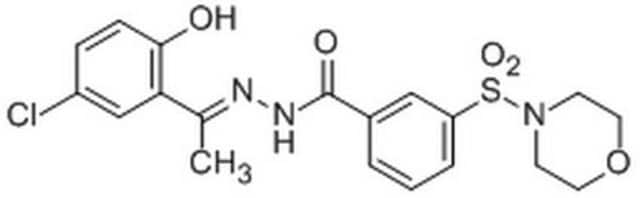
[s]1nccc1SSc2[s]ncc2
InChI
1S/C6H4N2S4/c1-3-7-9-5(1)11-12-6-2-4-8-10-6/h1-4H
InChI key
MLRAMCAHIWHWRM-UHFFFAOYSA-N
General description
Biochem/physiol Actions
KAT5
Preparation Note
Other Notes
Legal Information
Disclaimer
1 of 1
Dieser Artikel | |||
|---|---|---|---|
| form oil | form solid | form solid | form solid |
| assay ≥97% (HPLC) | assay ≥95% (HPLC) | assay ≥98% (HPLC) | assay ≥99% (HPLC) |
| Quality Level 100 | Quality Level 100 | Quality Level 100 | Quality Level 100 |
| manufacturer/tradename Calbiochem® | manufacturer/tradename Calbiochem® | manufacturer/tradename Calbiochem® | manufacturer/tradename Calbiochem® |
| storage temp. 2-8°C | storage temp. 2-8°C | storage temp. 2-8°C | storage temp. 2-8°C |
| storage condition OK to freeze, protect from light | storage condition OK to freeze, protect from light | storage condition OK to freeze, protect from light | storage condition OK to freeze, protect from light |


Lagerklasse
10 - Combustible liquids
wgk
WGK 2
flash_point_f
Not applicable
flash_point_c
Not applicable
Analysenzertifikate (COA)
Suchen Sie nach Analysenzertifikate (COA), indem Sie die Lot-/Chargennummer des Produkts eingeben. Lot- und Chargennummern sind auf dem Produktetikett hinter den Wörtern ‘Lot’ oder ‘Batch’ (Lot oder Charge) zu finden.
Besitzen Sie dieses Produkt bereits?
In der Dokumentenbibliothek finden Sie die Dokumentation zu den Produkten, die Sie kürzlich erworben haben.
Verwandter Inhalt
Cancer is a complex disease manifestation. At its core, it remains a disease of abnormal cellular proliferation and inappropriate gene expression. In the early days, carcinogenesis was viewed simply as resulting from a collection of genetic mutations that altered the gene expression of key oncogenic genes or tumor suppressor genes leading to uncontrolled growth and disease (Virani, S et al 2012). Today, however, research is showing that carcinogenesis results from the successive accumulation of heritable genetic and epigenetic changes. Moreover, the success in how we predict, treat and overcome cancer will likely involve not only understanding the consequences of direct genetic changes that can cause cancer, but also how the epigenetic and environmental changes cause cancer (Johnson C et al 2015; Waldmann T et al 2013). Epigenetics is the study of heritable gene expression as it relates to changes in DNA structure that are not tied to changes in DNA sequence but, instead, are tied to how the nucleic acid material is read or processed via the myriad of protein-protein, protein-nucleic acid, and nucleic acid-nucleic acid interactions that ultimately manifest themselves into a specific expression phenotype (Ngai SC et al 2012, Johnson C et al 2015). This review will discuss some of the principal aspects of epigenetic research and how they relate to our current understanding of carcinogenesis. Because epigenetics affects phenotype and changes in epigenetics are thought to be key to environmental adaptability and thus may in fact be reversed or manipulated, understanding the integration of experimental and epidemiologic science surrounding cancer and its many manifestations should lead to more effective cancer prognostics as well as treatments (Virani S et al 2012).
Global Trade Item Number
| SKU | GTIN |
|---|---|
| 5005110001 | 04055977245738 |