
17-10131

ChIPAb+ Phospho-CREB (Ser133) - ChIP Validated Antibody and Primer Set
from rabbit
Synonym(e):
active transcription factor CREB, cAMP responsive element binding protein 1, cAMP-response element-binding protein-1, transactivator protein
Größe auswählen
| Packungsgröße | SKU | Verfügbarkeit | Preis |
|---|
Über diesen Artikel
biological source
rabbit
Quality Segment
clone
polyclonal
species reactivity
rat, mouse, human, hamster
manufacturer/tradename
ChIPAb+, Upstate®
technique(s)
ChIP: suitable, electrophoretic mobility shift assay: suitable, immunohistochemistry: suitable, immunoprecipitation (IP): suitable, western blot: suitable
isotype
IgG
NCBI accession no.
UniProt accession no.
shipped in
dry ice
Gene Information
human ... CREB1(1385)
General description
The ChIPAb+ Phospho-CREB (Ser133) set includes the Phospho-CREB (Ser133) antibody, a negative control normal rabbit IgG, and qPCR primers which amplify a 64 bp region of human cFos CRE. The Phospho-CREB (Ser133) and negative controls are supplied in a scalable "per ChIP" reaction size and can be used to functionally validate the precipitation of Phospho-CREB (Ser133)-associated chromatin.
Immunogen
Application
Representative lot data.
Sonicated chromatin prepared from 293T cells (5 X 10E6 cell equivalents per IP) were subjected to chromatin immunoprecipitation using either 4 µg of Normal Rabbit IgG, (Part No. P64B), or 4 µg of Anti-Phospho-CREB (Ser133) antibody (Part No. CS204400) and the Magna ChIP® A Kit (Cat. # 17-610).
Successful immunoprecipitation of Phospho-CREB (Ser133) antibody associated DNA fragments was verified by qPCR using ChIP Primers cFos CRE (Part No. CS203203) as a positive locus, and cFos downstream 4Kb as a negative locus (Figure 2). Data is presented as percent input of each IP sample relative to input chromatin for each amplicon and ChIP sample as indicated.
Please refer to the EZ-Magna ChIP A (Cat. # 17-408) or EZ-ChIP (Cat. # 17-371) protocol for experimental details.
Western Blot Analysis:
Representative lot data.
Untreated (lane 1) and Forskolin-treated (Lane 2) NIH/3T3 lysates were resolved by SDS-PAGE, transferred to PVDF, and probed with anti-phospho-CREB (Ser133) (1:1,000 dilution).
Proteins were visualized using a donkey anti-rabbit secondary antibody conjugated to HRP and a chemiluminescence detection system.
Arrow indicates phosphorylated CREB (Figure 3).
Immunoprecipitation:
10 µL from a representative lot of this antibody was shown to immunoprecipitate phosphorylated CREB from 500 µg of cells treated with 50 mM forskolin.
Immunohistochemistry: A 1:1000 dilution of a representative lot detected phosphorylated CREB in formalin-fixed paraffin-embedded normal and ischemic rat brain sections.
Electrophoretic Mobility Shift:
A representative lot of this antibody has been shown to gel shift by an independent laboratory.
Signaling
Epigenetics & Nuclear Function
Transcription Factors
Biochem/physiol Actions
Packaging
Physical form
Normal Rabbit IgG, Part No. PP64B. One vial containing 125 µg Rabbit IgG in 125 µL storage buffer containing 0.05% sodium azide.
Store at -20°C.
ChIP Primers cFos CRE, Part No. CS203203. One vial containing 75 μL of 5 μM of each primer specific for the cFos CRE. Store at -20°C.
FOR: GGC CCA CGA GAC CTC TGA GAC A
REV: GCC TTG GCG CGT GTC CTA ATC T
Preparation Note
Analysis Note
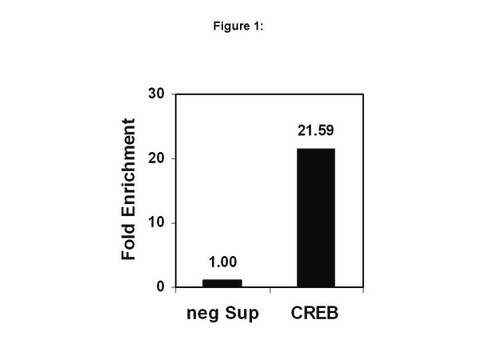
Sonicated chromatin prepared from 293T cells (5 X 10E6 cell equivalents per IP) was subjected to chromatin immunoprecipitation using either 4 μg of a Normal Rabbit IgG , or 4 μg of Anti-Phospho-CREB antibody and the Magna ChIP® A Kit (Cat. # 17-610). Successful immunoprecipitation of Phospho-CREB (Ser133) associated DNA fragments was verified by qPCR using ChIP Primers cFos CRE (Figure 1).
Please refer to the EZ-Magna ChIP A (Cat. # 17-408) or EZ-ChIP (Cat. # 17-371) protocol for experimental details.
Includes negative control normal rabbit IgG and primers specific for human cFOS CRE.
Other Notes
Legal Information
Disclaimer
1 of 1
Dieser Artikel | |||
|---|---|---|---|
| species reactivity rat, mouse, human, hamster | species reactivity mouse, rat, human | species reactivity rat, mouse | species reactivity mouse, rat, hamster, human |
| clone polyclonal | clone NL904, monoclonal | clone 634-2, monoclonal | clone polyclonal |
| biological source rabbit | biological source rabbit | biological source mouse | biological source rabbit |
| shipped in dry ice | shipped in dry ice | shipped in dry ice | shipped in wet ice |
| UniProt accession no. | UniProt accession no. | UniProt accession no. | UniProt accession no. |
| Gene Information human ... CREB1(1385) | Gene Information human ... CREB1(1385) | Gene Information human ... CREB1(1385) | Gene Information human ... CREB1(1385) |


Lagerklasse
12 - Non Combustible Liquids
flash_point_f
Not applicable
flash_point_c
Not applicable
wgk
WGK 2
Analysenzertifikate (COA)
Suchen Sie nach Analysenzertifikate (COA), indem Sie die Lot-/Chargennummer des Produkts eingeben. Lot- und Chargennummern sind auf dem Produktetikett hinter den Wörtern ‘Lot’ oder ‘Batch’ (Lot oder Charge) zu finden.
Besitzen Sie dieses Produkt bereits?
In der Dokumentenbibliothek finden Sie die Dokumentation zu den Produkten, die Sie kürzlich erworben haben.
Verwandter Inhalt
Epigenetics describes heritable changes in gene expression caused by non-genetic mechanisms. Epigenetic regulation allows a cell to vary its response based on its biological and environmental contexts. Epigenetic changes can effect transcriptional and post-transcriptional regulation via mechanisms such as histone modification, chromatin and nucleosome remodeling, DNA methylation, and small and non-coding RNA-mediated regulation. These mechanisms, in cooperation with transcription factors and other nucleic acid-binding proteins, regulate gene expression. Epigenetic mechanisms of gene regulation impacts diverse areas of research—from agriculture to human health. Common epigenetic assays such as chromatin immunoprecipitation (ChIP) and RNA immunoprecipitation (RIP) rely on high quality antibodies that recognize specific epigenetic modifications for accurate results. EMD Millipore offers over 100 ChIPAb+™ and RIPAb+™ validated antibody kits that are quality tested on ChIP/RIP assays and are conveniently provided with control qPCR primers and negative control antibodies to ensure first time ChIP/RIP success.
Signaling Product Guide: Antibodies, small molecule inhibitors, kits, assays and proteins for signaling research.
Global Trade Item Number
| SKU | GTIN |
|---|---|
| 17-10131 | 04053252748387 |