Direkt zum Inhalt
Merck

Fortfahren mit

07-373

Anti-Acetyl-Histon H2B-Antikörper

Upstate®, from rabbit

Anmelden zur Ansicht der Organisations- und Vertragspreise.

Größe auswählen

Ansicht ändern
PackungsgrößeSKUVerfügbarkeitPreis
100 μg
Warenkorb auf Verfügbarkeit prüfen
€ 545,00

Über diesen Artikel

UNSPSC Code:
12352203
NACRES:
NA.41
eCl@ss:
32160702
Clone:
polyclonal
Species reactivity:
human
Application:
WB
Citations:
13

€ 545,00


Warenkorb auf Verfügbarkeit prüfen

Großbestellung anfragen
Technischer Dienst
Benötigen Sie Hilfe? Unser Team von erfahrenen Wissenschaftlern ist für Sie da.
Unterstützung erhalten


biological source

rabbit

Quality Level

antibody form

purified antibody

antibody product type

primary antibodies

clone

polyclonal

species reactivity

human

manufacturer/tradename

Upstate®

technique(s)

western blot: suitable

isotype

IgG

NCBI accession no.

UniProt accession no.

shipped in

dry ice

target post-translational modification

acetylation (Lys5,Lys12,Lys15,Lys20)

Gene Information

human ... H2BC1(255626)

General description

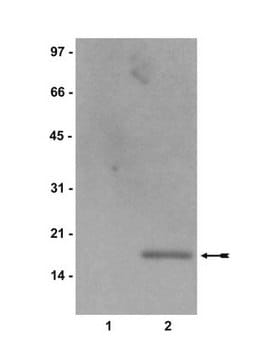
15 kDa

Immunogen

Synthetisches Peptid mit einem Acetyl-Lysin an Resten 5, 12, 15 und 20 von humanem Histon H2B.

Application

Forschungs-Unterkategorie
Histone
Forschungskategorie
Epigenetik und Zellkernfunktion
Weisen Sie Acetyl-Histon H2B, auch als Histon H2B bekannt, mit diesem Anti-Acetyl-Histon H2B-Antikörper (polyklonaler Kaninchen-Antikörper) nach, der in WB funktioniert.

Biochem/physiol Actions

Acetyliertes Histon H2B

Physical form

0,1 mol/l Tris-Glycin, pH-Wert 7,4, 0,15 mol/l NaCl, 0,05 % Natriumazid vor der Zugabe von Glycerin zu 30 %.
Format: Aufgereinigt
Protein-A-Chromatografie

Preparation Note

2 Jahre bei -20 °C

Analysis Note

Regelmäßig mittels Immunblot an mit Natriumbutyrat behandelten, säureextrahierten Proteinen aus HeLa-Zellen beurteilt.

Legal Information

UPSTATE is a registered trademark of Merck KGaA, Darmstadt, Germany

Disclaimer

Sofern in unserem Katalog oder anderen Begleitdokumenten unserer Produkte nicht anders angegeben, sind unsere Produkte nur für Forschungszwecke vorgesehen und nicht für andere Zwecke zu verwenden, einschließlich, jedoch nicht beschränkt auf unautorisierte kommerzielle Verwendung, zur In-vitro-Diagnostik, für Ex-vivo- oder In-vivo-Therapiezwecke oder jegliche Art der Einnahme oder Anwendung bei Menschen oder Tieren.

Ähnliche Artikel vergleichen

Vollständigen Vergleich anzeigen

Unterschiede anzeigen

1 of 1

Dieser Artikel
07-28907-371ABE327
biological source

rabbit

biological source

rabbit

biological source

rabbit

biological source

rabbit

species reactivity

human

species reactivity

vertebrates, human

species reactivity

human, chicken

species reactivity

rat, mouse, human

antibody form

purified antibody

antibody form

serum

antibody form

purified antibody

antibody form

affinity isolated antibody

clone

polyclonal

clone

polyclonal

clone

polyclonal

clone

polyclonal

UniProt accession no.

Q8N257

UniProt accession no.

P16104

UniProt accession no.

Q8N257

UniProt accession no.

P0C0S8

Gene Information

human ... H2BC1(255626)

Gene Information

-

Gene Information

Saccharomyces cerevisiae ... Htb2(852284)
human ... H2BC1(255626)

Gene Information

human ... HIST1H2AG(8969)


Still not finding the right product?

Probieren Sie unser Produkt-Auswahlhilfe, um Ihre Auswahl einzugrenzen


Lagerklasse

10 - Combustible liquids

wgk

WGK 1


Analysenzertifikate (COA)

Suchen Sie nach Analysenzertifikate (COA), indem Sie die Lot-/Chargennummer des Produkts eingeben. Lot- und Chargennummern sind auf dem Produktetikett hinter den Wörtern ‘Lot’ oder ‘Batch’ (Lot oder Charge) zu finden.

Besitzen Sie dieses Produkt bereits?

In der Dokumentenbibliothek finden Sie die Dokumentation zu den Produkten, die Sie kürzlich erworben haben.

Die Dokumentenbibliothek aufrufen


Verwandter Inhalt

Histone Modifications Poster


Snehajyoti Chatterjee et al.
EMBO molecular medicine, 10(11) (2018-10-03)
Chromatin acetylation, a critical regulator of synaptic plasticity and memory processes, is thought to be altered in neurodegenerative diseases. Here, we demonstrate that spatial memory and plasticity (LTD, dendritic spine formation) deficits can be restored in a mouse model of
Spatial memory consolidation is associated with induction of several lysine-acetyltransferase (histone acetyltransferase) expression levels and H2B/H4 acetylation-dependent transcriptional events in the rat hippocampus.
Bousiges, O; Vasconcelos, AP; Neidl, R; Cosquer, B; Herbeaux, K; Panteleeva, I; Loeffler et al.
Neuropsychopharmacology null
Estelle Schueller et al.
European neuropsychopharmacology : the journal of the European College of Neuropsychopharmacology, 33, 101-116 (2020-02-15)
Memory impairment is the main feature of Alzheimer's disease (AD). Initial impairments originate in the temporal lobe area and propagate throughout the brain in a sequential manner. Epigenetic mechanisms, especially histone acetylation, regulate plasticity and memory processes. These may be


Questions

Reviews

No rating value

Active Filters