Direkt zum Inhalt
Merck

Fortfahren mit

04-889

Anti-Src Antibody, clone N6L, rabbit monoclonal

culture supernatant, clone N6L, from rabbit

Synonym(e):

proto-oncogene tyrosine-protein kinase SRC, protooncogene SRC, Rous sarcoma, tyrosine kinase pp60c-src, tyrosine-protein kinase SRC-1, v-src avian sarcoma (Schmidt-Ruppin A-2) viral oncogene

homolog, v-src sarcoma (Schmidt-Ruppin A-2) viral onco

Anmelden zur Ansicht der Organisations- und Vertragspreise.

Größe auswählen

Ansicht ändern
PackungsgrößeSKUVerfügbarkeitPreis
100 μL
Warenkorb auf Verfügbarkeit prüfen
€ 406,00

Über diesen Artikel

UNSPSC Code:
12352203
NACRES:
NA.41
eCl@ss:
32160702
Conjugate:
unconjugated
Clone:
N6L, monoclonal
Application:
WB
Citations:
3

€ 406,00


Warenkorb auf Verfügbarkeit prüfen

Großbestellung anfragen
Technischer Dienst
Benötigen Sie Hilfe? Unser Team von erfahrenen Wissenschaftlern ist für Sie da.
Unterstützung erhalten


biological source

rabbit

Quality Level

conjugate

unconjugated

antibody form

culture supernatant

antibody product type

primary antibodies

clone

N6L, monoclonal

species reactivity

human

technique(s)

western blot: suitable

isotype

IgG

NCBI accession no.

UniProt accession no.

shipped in

dry ice

target post-translational modification

unmodified

Gene Information

human ... SRC(6714)

General description

pp60c-Src is the prototype non-receptor tyrosine kinase. Homology to Src in three regions is shared by a number of proteins: SH1 being the catalytic domain, SH2 being a phospho-tyrosine binding domain, and SH3 being a proline-binding domain. The Src SH2 domain binds to phospho-Tyr527 (phosphorylated by Csk) within the Src molecule, causing Src to adopt an inactive conformation. Mutation of Tyr527 to phenylalanine removes the SH2-binding target and results in a constitutively active kinase. A second mutation at the conserved lysine residue at the ATP-binding site abolishes kinase activity, but without Tyr527, the conformation of the protein is open, allowing interaction with endogenous activators. Consequently, this double-mutant exhibits a dominant-negative phenotype
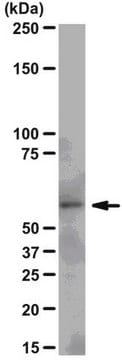
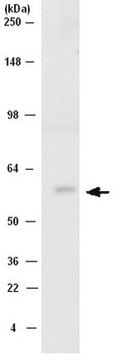
~ 60 kDa

Immunogen

N-terminal 6His-tagged recombinant full-length human Src expressed by baculovirus in Sf21 insect cells. Purified using Ni2+/NTA agarose.

Application

Research Category
Cell Structure
Research Sub Category
Cytoskeletal Signaling
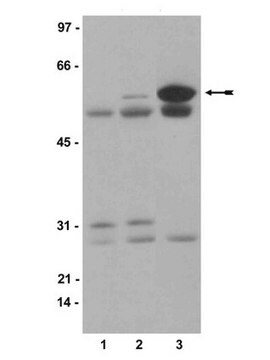
This Anti-Src Antibody, clone N6L is validated for use in WB for the detection of Src.

Biochem/physiol Actions

Recognizes Src. Crossreacts with Yes and weakly with Fyn. No crossreactivity observed with Lck or Lyn.

Physical form

Cultured supernantant containing 0.05% sodium azide.

Preparation Note

Stable for 1 year at -20ºC from date of receipt.
Handling Recommendations: Upon receipt, and prior to removing the cap, centrifuge the vial and gently mix the solution. Aliquot into microcentrifuge tubes and store at -20°C. Avoid repeated freeze/thaw cycles, which may damage IgG and affect product performance.

Analysis Note

Control
Included positive antigen control of non-stimulated A431 lysate (Cat. No. 12-301). Add 2.5 μL of 2-mercaptoethanol/100 μL of lysate and boil for 5 minutes to reduce the preparation. Load 20 μg of reduced lysate per lane for minigels.
Western Blot Analysis: A 1:500 to 1:1000 dilution of this antibody detected Src in RIPA lysates from A431 cells.

Other Notes

Concentration: Please refer to the Certificate of Analysis for the lot-specific concentration.
Replaces: 05-889

Disclaimer

Unless otherwise stated in our catalog or other company documentation accompanying the product(s), our products are intended for research use only and are not to be used for any other purpose, which includes but is not limited to, unauthorized commercial uses, in vitro diagnostic uses, ex vivo or in vivo therapeutic uses or any type of consumption or application to humans or animals.

Ähnliche Artikel vergleichen

Vollständigen Vergleich anzeigen

Unterschiede anzeigen

1 of 1

Dieser Artikel
04-77205-67705-184-AF488
biological source

rabbit

biological source

rabbit

biological source

mouse

biological source

mouse

clone

N6L, monoclonal

clone

NL19, monoclonal

clone

9A6, monoclonal

clone

GD11, monoclonal

antibody form

culture supernatant

antibody form

culture supernatant

antibody form

purified immunoglobulin

antibody form

purified immunoglobulin

Gene Information

human ... SRC(6714)

Gene Information

human ... SRC(6714)

Gene Information

human ... SRC(6714)

Gene Information

human ... SRC(6714)

species reactivity

human

species reactivity

mouse, human, rat

species reactivity

mouse, human

species reactivity

rat, human, mink, mouse, avian

conjugate

unconjugated

conjugate

unconjugated

conjugate

-

conjugate

ALEXA FLUOR 488


Still not finding the right product?

Probieren Sie unser Produkt-Auswahlhilfe, um Ihre Auswahl einzugrenzen


Lagerklasse

12 - Non Combustible Liquids

wgk

WGK 1

flash_point_f

Not applicable

flash_point_c

Not applicable


Analysenzertifikate (COA)

Suchen Sie nach Analysenzertifikate (COA), indem Sie die Lot-/Chargennummer des Produkts eingeben. Lot- und Chargennummern sind auf dem Produktetikett hinter den Wörtern ‘Lot’ oder ‘Batch’ (Lot oder Charge) zu finden.

Besitzen Sie dieses Produkt bereits?

In der Dokumentenbibliothek finden Sie die Dokumentation zu den Produkten, die Sie kürzlich erworben haben.

Die Dokumentenbibliothek aufrufen


Cheng-Zhe Wu et al.
The Korean journal of physiology & pharmacology : official journal of the Korean Physiological Society and the Korean Society of Pharmacology, 25(2), 159-166 (2021-02-20)
Nicotinamide adenine dinucleotide phosphate oxidases (NOXs) are the major enzymatic source of reactive oxygen species (ROS). NOX2 and NOX4 are expressed in the heart but its role in hypoxia-induced atrial natriuretic peptide (ANP) secretion is unclear. This study investigated the
Xiang Li et al.
Kardiologia polska, 79(9), 972-979 (2021-06-28)
Interleukin (IL)-18 is produced mainly in the heart and can be associated with the development of cardiac hypertrophy that leads to cardiac dysfunction. However, the effects of hypoxia on IL-18 expression and atrial natriuretic factor (ANF) secretion remain largely unknown.
Mariya S Liyasova et al.
PloS one, 14(5), e0216967-e0216967 (2019-05-24)
Many receptor tyrosine kinases (RTKs, such as EGFR, MET) are negatively regulated by ubiquitination and degradation mediated by Cbl proteins, a family of RING finger (RF) ubiquitin ligases (E3s). Loss of Cbl protein function is associated with malignant transformation driven


Global Trade Item Number

SKUGTIN
04-88904053252623479

Questions

Reviews

No rating value

Active Filters