Direkt zum Inhalt
Merck

Fortfahren mit

R5403

Monoclonal Anti-Rhodopsin antibody produced in mouse

clone 1D4, purified immunoglobulin, buffered aqueous solution

Synonym(e):

Anti-CSNBAD1, Anti-OPN2, Anti-RP4

Anmelden zur Ansicht der Organisations- und Vertragspreise.

Größe auswählen

Ansicht ändern
PackungsgrößeSKUVerfügbarkeitPreis
100 μL
Warenkorb auf Verfügbarkeit prüfen
€ 609,00

Über diesen Artikel

UNSPSC Code:
12352203
NACRES:
NA.41
MDL number:
Conjugate:
unconjugated
Clone:
1D4, monoclonal
Application:
ICC, WB
Citations:
18

€ 609,00


Warenkorb auf Verfügbarkeit prüfen
Für Ihr Target ist ein rekombinanter, konservierungsmittelfreier Antikörper verfügbar. Probieren Sie ZMS1069

Technischer Dienst
Benötigen Sie Hilfe? Unser Team von erfahrenen Wissenschaftlern ist für Sie da.
Unterstützung erhalten


biological source

mouse

Quality Level

conjugate

unconjugated

antibody form

purified immunoglobulin

antibody product type

primary antibodies

clone

1D4, monoclonal

form

buffered aqueous solution

species reactivity

human, rat, bovine

technique(s)

immunocytochemistry: 1:1,000 using human retinal samples, western blot: 1:1,000 using Sf9 cells expressing the bovine gene

isotype

IgG1

UniProt accession no.

shipped in

wet ice

storage temp.

−20°C

target post-translational modification

unmodified

Gene Information

human ... RHO(6010)
rat ... Rho(24717)

General description

Vision involves the conversion of light into electrochemical signals that are processed by the retina and subsequently sent to and interpreted by the brain. The process of converting light to an electrochemical signal begins when the membrane-bound protein, rhodopsin, absorbs light within the retina. Photoexcitation of rhodopsin causes the cytoplasmic surface of the protein to become catalytically active. In the active state, rhodopsin activates transducin, a GTP binding protein. Once activated, transducin promotes the hydrolysis of cGMP by phosphodiesterase (PDE). The decrease of intracellular cGMP concentrations causes the ion channels within the outer segment of the rod or cone to close, thus causing membrane hyperpolarization and, eventually, signal transmission. Rhodopsin′s activity is believed to be shut off by its phosphorylation followed by binding of the soluble protein arrestin.

Immunogen

bovine rhodopsin.

Application

Applications in which this antibody has been used successfully, and the associated peer-reviewed papers, are given below.
Immunohistochemistry (1 paper)
Mouse monoclonal clone 1D4 anti-Rhodopsin antibody has been successfully used in Western blot, immunocytochemistry, and immunoprecipitation. It is used as a probe to determine the presence and roles of rhodopsin in the conversion of light into electrochemical signals.

Biochem/physiol Actions

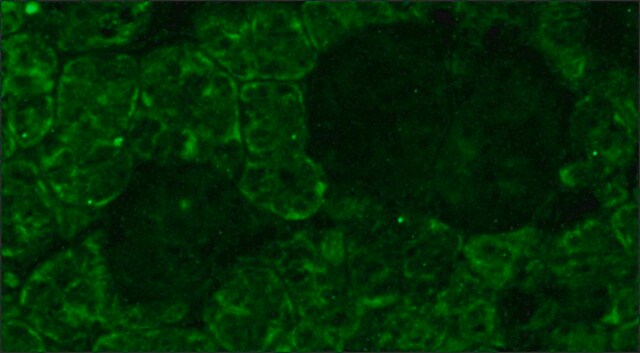
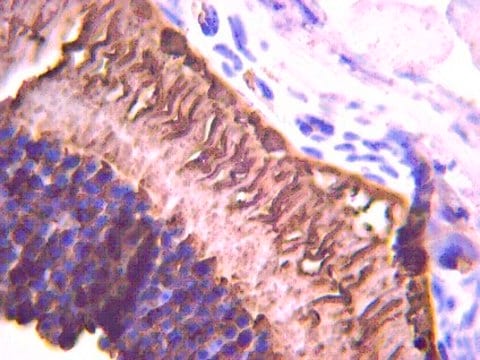
By Western blot, mouse monoclonal clone 1D4 anti-Rhodopsin antibody detects an ~40 kDa protein representing rhodopsin from Sf 9 cells expressing the bovine gene. Immunocytochemical staining of rhodopsin in human retinal samples results in staining of both rod and cone outer segments.
The epitope for this antibody has been localized to the C-terminal nine amino acids of bovine rhodopsin known as the 1D4 epitope, and detects rhodopsin from human and bovine retinal samples.

Physical form

Solution in phosphate buffered saline containing 1 mg/mL BSA and 0.05% sodium azide.

Disclaimer

Unless otherwise stated in our catalog or other company documentation accompanying the product(s), our products are intended for research use only and are not to be used for any other purpose, which includes but is not limited to, unauthorized commercial uses, in vitro diagnostic uses, ex vivo or in vivo therapeutic uses or any type of consumption or application to humans or animals.

Ähnliche Artikel vergleichen

Vollständigen Vergleich anzeigen

Unterschiede anzeigen

1 of 1

Dieser Artikel
O4886MABN15R3151
conjugate

unconjugated

conjugate

unconjugated

conjugate

unconjugated

conjugate

unconjugated

biological source

mouse

biological source

mouse

biological source

mouse

biological source

mouse

Gene Information

human ... RHO(6010)
rat ... Rho(24717)

Gene Information

human ... RHO(6010)
mouse ... Rho(212541)
rat ... Rho(24717)

Gene Information

human ... RHO(6010)
rat ... Rho(24717)

Gene Information

human ... GRK1(6011)
mouse ... Grk1(24013)
rat ... Grk1(81760)

clone

1D4, monoclonal

clone

RET-P1, monoclonal

clone

4D2, monoclonal

clone

G8, monoclonal

antibody form

purified immunoglobulin

antibody form

ascites fluid

antibody form

purified immunoglobulin

antibody form

purified immunoglobulin

species reactivity

human, rat, bovine

species reactivity

goldfish, mouse, tiger salamander, rat, amphibian, quail, dove, duck, rabbit, bovine, human, turtle

species reactivity

rat, human, fish

species reactivity

rat, bovine, chicken, human, mouse


Still not finding the right product?

Probieren Sie unser Produkt-Auswahlhilfe, um Ihre Auswahl einzugrenzen


Lagerklasse

10 - Combustible liquids

wgk

nwg

flash_point_f

Not applicable

flash_point_c

Not applicable


Hier finden Sie alle aktuellen Versionen:

Analysenzertifikate (COA)

Lot/Batch Number

Die passende Version wird nicht angezeigt?

Wenn Sie eine bestimmte Version benötigen, können Sie anhand der Lot- oder Chargennummer nach einem spezifischen Zertifikat suchen.

Besitzen Sie dieses Produkt bereits?

In der Dokumentenbibliothek finden Sie die Dokumentation zu den Produkten, die Sie kürzlich erworben haben.

Die Dokumentenbibliothek aufrufen


Verwandter Inhalt

Instructions


Angelo Felline et al.
Computational and structural biotechnology journal, 19, 6020-6038 (2021-12-02)
Failure of a protein to achieve its functional structural state and normal cellular location contributes to the etiology and pathology of heritable human conformational diseases. The autosomal dominant form of retinitis pigmentosa (adRP) is an incurable blindness largely linked to
Kirk Haltaufderhyde et al.
Photochemistry and photobiology, 91(1), 117-123 (2014-10-01)
Human skin is constantly exposed to solar light containing visible and ultraviolet radiation (UVR), a powerful skin carcinogen. UVR elicits cellular responses in epidermal cells via several mechanisms: direct absorption of short-wavelength UVR photons by DNA, oxidative damage caused by
Silvia Ravera et al.
Cells, 12(17) (2023-09-08)
Dysfunction of the retinal pigment epithelium (RPE) is associated with several diseases characterized by retinal degeneration, such as diabetic retinopathy (DR). However, it has recently been proposed that outer retinal neurons also participate in the damage triggering. Therefore, we have


Global Trade Item Number

SKUGTIN
R5403-100UL04061837724206

Questions

Reviews

No rating value

Active Filters