


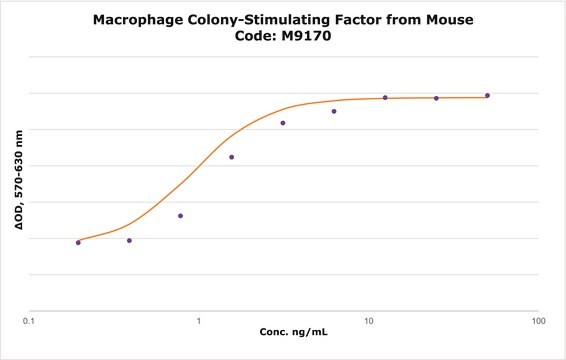
While this is not an application that's part of the specifications, the GM-CSF has been used by independent laboratories in monocyte cell culture to induce differentiation into monocyte-derived macrophages.
For example:
https://pmc.ncbi.nlm.nih.gov/articles/PMC12258040/
Other articles may be found through the following search:
https://scholar.google.com/scholar?hl=en&as_sdt=0%2C22&q=g5035+monocyte&btnG=
Fortfahren mit
G5035

Granulozyten-Makrophagen-Kolonie-stimulierender Faktor human
≥98% (SDS-PAGE), recombinant, expressed in E. coli, lyophilized powder, suitable for cell culture
Synonym(e):
GM-CSF
Anmelden zur Ansicht der Organisations- und Vertragspreise.
Größe auswählen
Ansicht ändern
| Packungsgröße | SKU | Verfügbarkeit | Preis |
|---|---|---|---|
| 5 μg | Warenkorb auf Verfügbarkeit prüfen | € 230,00 | |
| 4 x 5 μg | Warenkorb auf Verfügbarkeit prüfen | € 476,00 |
Über diesen Artikel
Biological source:
human
Recombinant:
expressed in E. coli
Assay:
≥98% (SDS-PAGE)
Form:
lyophilized powder
Mol wt:
14.6 kDa
Impurities:
≤1.000 EU/μg
Technischer Dienst
Benötigen Sie Hilfe? Unser Team von erfahrenen Wissenschaftlern ist für Sie da.
Unterstützung erhaltenProduktname
Granulozyten-Makrophagen-Kolonie-stimulierender Faktor human, GM-CSF, recombinant, expressed in E. coli, suitable for cell culture
biological source
human
Quality Segment
recombinant
expressed in E. coli
assay
≥98% (SDS-PAGE)
form
lyophilized powder
potency
≤0.1 ng/mL EC50
mol wt
14.6 kDa
packaging
pkg of 4X5 μg, pkg of 5 μg
storage condition
avoid repeated freeze/thaw cycles
technique(s)
cell culture | mammalian: suitable
impurities
≤1.000 EU/μg
color
white
solubility
water: soluble 0.010 mL, clear, colorless
UniProt accession no.
storage temp.
−20°C
General description
Packungsgröße basiert auf dem Proteingehalt
Biochem/physiol Actions
Der Granulozyten-Makrophagen-Kolonie-stimulierende Faktor (GM-CSF) ist ein Wachstums- und Differenzierungsfaktor für Zellen der Granulozyten-, Makrophagen- und Eosinophilen-Linie. GM-CSF stimuliert bei extrem niedrigen Konzentrationen die Koloniebildung aus pluripotenten Vorläuferzellen und ist ein essenzieller Faktor für Überleben und Proliferation von hämatopoietischen Vorläuferzellen in allen Stadien bis hin zur Reife. Ebenso stimuliert er das Wachstum mancher Epithelzellen und Osteoplasten. GM-CSF wird von Zellen verschiedener Typen produziert (Monozyten, Endothelzellen, T-Zellen, Fibroblasten, Mitogen-stimulierte B-Zellen und LPS-stimulierte Makrophagen). GM-CSF wird als einkettiges Glycoprotein mit 128 Aminosäuren (beim Menschen) und einer konservierten Disulfidbindung sezerniert. GM-CSF von Mensch und Maus weisen eine Sequenzhomologie von ca. 54 % auf, eine Kreuzreaktivität bei Bioaktivität liegt nicht vor.
Physical form
Lyophilisiert aus 0,2 μm filtrierter 10-mM-Natriumcitratlösung, pH 3,5.
Analysis Note
Die proliferative Aktivität von menschlichem GM-CSF wird mittels humanen TF-1-Zellen in der Kultur getestet.[1]
1 of 1
Dieser Artikel | |||
|---|---|---|---|
| assay ≥98% (SDS-PAGE) | assay ≥97% (SDS-PAGE) | assay ≥98% (SDS-PAGE and HPLC) | assay ≥98% (SDS-PAGE) |
| biological source human | biological source mouse | biological source human | biological source mouse |
| recombinant expressed in E. coli | recombinant expressed in E. coli | recombinant expressed in E. coli | recombinant expressed in E. coli |
| technique(s) cell culture | mammalian: suitable | technique(s) cell culture | mammalian: suitable | technique(s) cell culture | mammalian: suitable | technique(s) cell culture | mammalian: suitable |
| Quality Level 200 | Quality Level 200 | Quality Level 200 | Quality Level 200 |
| form lyophilized powder | form lyophilized powder | form lyophilized powder | form lyophilized powder |
Still not finding the right product?
Explore all of our products under Granulozyten-Makrophagen-Kolonie-stimulierender Faktor human
Lagerklasse
11 - Combustible Solids
wgk
WGK 3
flash_point_f
Not applicable
flash_point_c
Not applicable
ppe
Eyeshields, Gloves, type N95 (US)
Hier finden Sie alle aktuellen Versionen:
Besitzen Sie dieses Produkt bereits?
In der Dokumentenbibliothek finden Sie die Dokumentation zu den Produkten, die Sie kürzlich erworben haben.
Artikel
Discover validated bioactivity and proliferation data for our portfolio of animal component-free cell culture growth factors.
Read article on hematopoietic cytokines and hematopoiesis
Verwandter Inhalt
Instructions
Global Trade Item Number
| SKU | GTIN |
|---|---|
| G5035-5UG | 04061833632895 |
| G5035-4X5UG | 04061833632888 |
-
CAN I USE G5035 GM-CSF ON MY PLASTIC ADHERED MONOCYTES TO DIFFERENTIATE THEM TO MACROPHAGES?
1 answer-
Helpful?
-
-
How to dilute Granulocyte-Macrophage Colony-Stimulating Factor human GMCSF (G5035-4X5UG) for tissue culture. Can we use sterile PBS or human albumin? Diluted to what suggested concentration is suitable to free in -80? Thank you
1 answer-
The data sheet, found at the link below, includes instructions for reconstitution and storage:
https://www.sigmaaldrich.com/deepweb/assets/sigmaaldrich/product/documents/399/841/g5035dat.pdf
Preparation Instructions
It is advisable to centrifuge the vial prior to reconstitution. Reconstitute the contents of the vial using water to a concentration of 0.1 mg/ml. This solution can then be diluted into other aqueous buffers and stored frozen in working aliquots. Storage/Stability
Prior to reconstitution, store the lyophilized protein at –20 °C. It is stable for up to a few weeks at room temperature, but is best stored at –20 °C. For extended storage, after reconstitution, store in working aliquots at –20 °C. Avoid repeated freeze-thaw cycles.Helpful?
-
-
What is reconstitution procedure for GM-CSF?
1 answer-
This product may be reconstituted in sterile water at 0.1 - 1.0 mg/mL, following centrifugation of the vial to collect the contents. Please see the link below to review the product datasheet which includes complete preparation and storage instructions:
https://www.sigmaaldrich.com/deepweb/assets/sigmaaldrich/product/documents/399/841/g5035dat.pdfHelpful?
-
-
Can I use Product G5035, Granulocyte-Macrophage Colony-Stimulating Factor human, on mouse cells?
1 answer-
There is only about 56% homology between human and mouse GM-CSF, and no cross-species activity. We would recommend to use mouse GM-CSF, Product No. G0282.
Helpful?
-
-
There is no visible powder in the vial of Product G5035, Granulocyte-Macrophage Colony-Stimulating Factor human. Is the vial empty?
1 answer-
This product only contains 5 micrograms of protein without any carrier protein. The product is lyophilized from a small amount of solution so the product may not be visible in the vial.
Helpful?
-
-
How many units are present in the vial of Product G5035, Granulocyte-Macrophage Colony-Stimulating Factor human?
1 answer-
The ED50 was determined by the dose-dependent stimulation of the proliferation of human TF-1 cells is less than or equal to 0.1 ng/ml, corresponding to a specific activity of greater than or equal to 1 x 10⁷ units/mg. So the 5 microgram package size (G5035-5UG) should have at least 50,000 units per vial.
Helpful?
-
-
What is the Department of Transportation shipping information for this product?
1 answer-
Transportation information can be found in Section 14 of the product's (M)SDS.To access the shipping information for this material, use the link on the product detail page for the product.
Helpful?
-
-
What is the isoelectric point (pI) for Product G5035, Granulocyte-Macrophage Colony-Stimulating Factor human?
1 answer-
The pI is 4.8.
Helpful?
-
-
How does the storage temperature relate to shipping conditions?
1 answer-
The storage conditions that a Sigma-Aldrich catalog and label recommend for products are deliberately conservative. For many products, long-term storage at low temperatures will increase the time during which they are expected to remain in specification and therefore are labeled accordingly. Where short-term storage, shipping time frame, or exposure to conditions other than those recommended for long-term storage will not affect product quality, Sigma-Aldrich will ship at ambient temperature. The products sensitive to short-term exposure to conditions other than their recommended long-term storage are shipped on wet or dry ice. Ambient temperature shipping helps to control shipping costs for our customers. At any time, our customers can request wet- or dry-ice shipment, but the special handling is at customer expense if our product history indicates that the product is stable for regular shipment.
Helpful?
-