Direkt zum Inhalt
Merck

Fortfahren mit

F6928

Monoclonal Anti-FKHR (FOXO1a) antibody produced in mouse

clone FKH 117, purified immunoglobulin, buffered aqueous solution

Anmelden zur Ansicht der Organisations- und Vertragspreise.

Größe auswählen

Ansicht ändern
PackungsgrößeSKUVerfügbarkeitPreis

Über diesen Artikel

UNSPSC Code:
12352203
NACRES:
NA.41
MDL number:
Conjugate:
unconjugated
Clone:
FKH 117, monoclonal
Application:
ARR, ELISA (i), IP, WB
Citations:
22
Preise und Verfügbarkeit sind derzeit nicht verfügbar.
Technischer Dienst
Benötigen Sie Hilfe? Unser Team von erfahrenen Wissenschaftlern ist für Sie da.
Unterstützung erhalten

biological source

mouse

Quality Level

conjugate

unconjugated

antibody form

purified immunoglobulin

antibody product type

primary antibodies

clone

FKH 117, monoclonal

form

buffered aqueous solution

mol wt

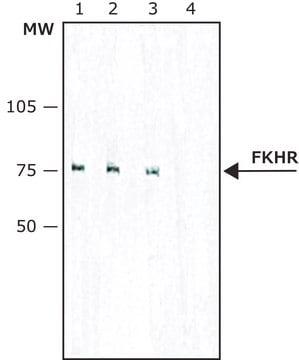
antigen 70-75 kDa

species reactivity

human

technique(s)

immunoprecipitation (IP): suitable, indirect ELISA: suitable, microarray: suitable, western blot: 0.5-1 μg/mL using total extract of COS-7 cells transfected with FKHR expression plasmid

Ähnliche Artikel vergleichen

Vollständigen Vergleich anzeigen

Unterschiede anzeigen

1 of 1

Dieser Artikel
SAB4500939WH0002309M3SAB1411861
Gene Information

human ... FOXO1(2308)

Gene Information

human ... FOXO1(2308)

Gene Information

human ... FOXO3(2309)

Gene Information

human ... FOXO1A(2308)

species reactivity

human

species reactivity

human, mouse

species reactivity

human

species reactivity

human

conjugate

unconjugated

conjugate

unconjugated

conjugate

unconjugated

conjugate

unconjugated

biological source

mouse

biological source

rabbit

biological source

mouse

biological source

mouse

antibody form

purified immunoglobulin

antibody form

affinity isolated antibody

antibody form

purified immunoglobulin

antibody form

purified immunoglobulin

clone

FKH 117, monoclonal

clone

polyclonal

clone

1F6, monoclonal

clone

1F6, monoclonal

General description

FKHR belongs to the superfamily of forkhead transcription factors (FOX). It is characterized by a common Forkhead (or winged helix) domain, a variant of the helix-turn-helix motif. FKHR contains three residues, Thr24, Ser256, and Ser319 that lie within consensus sequences for phosphorylation by protein kinase B (PKB).
Monoclonal Anti-FKHR (FOXO1a) (mouse IgG1 isotype) is derived from the FKH117 hybridoma produced by the fusion of mouse myeloma cells and splenocytes from BALB/c mice immunized with a synthetic peptide corresponding to human FKHR, conjugated to KLH.

Immunogen

synthetic peptide corresponding to human FKHR (amino acids 636-651), conjugated to KLH.

Application

Monoclonal Anti-FKHR (FOXO1a) antibody is suitable for immunoblot assay to study the down-regulation of both p16INK4A and p14ARF expression, and immunoblot of SKMCs and HSMM cells in a study of stable ectopic expression of PAX3-FKHR in low passage primary human skeletal muscle cells. It is also suitable for microarray and indirect ELISA.
Monoclonal Anti-FKHR antibody has been used in:
  • immunoblotting
  • enzyme linked immunosorbent assay (ELISA)
  • immunoprecipitation

Biochem/physiol Actions

FKHR plays a key regulatory roles in embryonic development, differentiation, apoptosis, and tumorigenesis. It was first identified at chromosomal breakpoints in human tumors and consequently linked to tumorigenesis. The activity of FKHR is regulated by growth factors via the PKB/PI3K pathway. The expression of FKHR is inhibited through phosphorylation by PKB. Within the nucleus, the dephosphorylated FKHRL1 induces expression of target genes such as Fas ligand, and triggers apoptosis. It is involved in apoptosis, glucose homeostasis, cell cycle regulation and as a nuclear receptor co factor. It has been found that FKHR also play a role in endometrial differentiation via the protein kinase A (PKA) pathway.

Physical form

Solution in 0.01 M phosphate buffered saline, pH 7.4, containing 15 mM sodium azide.

Disclaimer

Unless otherwise stated in our catalog or other company documentation accompanying the product(s), our products are intended for research use only and are not to be used for any other purpose, which includes but is not limited to, unauthorized commercial uses, in vitro diagnostic uses, ex vivo or in vivo therapeutic uses or any type of consumption or application to humans or animals.

Sie haben nicht das passende Produkt gefunden?  

Probieren Sie unser Produkt-Auswahlhilfe. aus.

Lagerklasse

10 - Combustible liquids

wgk

WGK 2

flash_point_f

Not applicable

flash_point_c

Not applicable

ppe

Eyeshields, Gloves, multi-purpose combination respirator cartridge (US)


Hier finden Sie alle aktuellen Versionen:

Analysenzertifikate (COA)

Lot/Batch Number

Die passende Version wird nicht angezeigt?

Wenn Sie eine bestimmte Version benötigen, können Sie anhand der Lot- oder Chargennummer nach einem spezifischen Zertifikat suchen.

Besitzen Sie dieses Produkt bereits?

In der Dokumentenbibliothek finden Sie die Dokumentation zu den Produkten, die Sie kürzlich erworben haben.

Die Dokumentenbibliothek aufrufen

A Mansouri
Critical reviews in oncogenesis, 9(2), 141-149 (1999-02-11)
Pax genes consist of a family of transcription factors that are essentially required for the genesis of a variety of tissues and organs. Pax3 and Pax7 are specifically expressed in the dorsal neural tube and the developing somite. Loss-of-function mutations
Defining the Cooperative Genetic Changes That Temporally Drive Alveolar Rhabdomyosarcoma
Naini S, et al.
Cancer Research, 68(23), 9583-9588 (2008)
The PAX3-FKHR Fusion Gene of Rhabdomyosarcoma Cooperates with Loss of p16INK4A to Promote Bypass of Cellular Senescence
Linardic CM, et al.
Cancer Research, 67(14), 6691-6699 (2007)
FGFR4 Blockade Exerts Distinct Antitumorigenic Effects in Human Embryonal versus Alveolar Rhabdomyosarcoma
Crose LES, et al.
Clinical Cancer Research, 18(14), 3780-3790 (2012)
J Hillion et al.
Blood, 90(9), 3714-3719 (1997-11-14)
Fusion genes implicating the MLL gene have been recently demonstrated in various 11q23 chromosomal abnormalities in human hematopoietic malignancies. We analyzed a t(6;11)(q21;q23) translocation detected in a secondary acute myeloblastic leukemia. This translocation results in fusion of the MLL gene

Verwandter Inhalt

Global Trade Item Number

SKUGTIN
F6928-200UL04061837771569

Unser Team von Wissenschaftlern verfügt über Erfahrung in allen Forschungsbereichen einschließlich Life Science, Materialwissenschaften, chemischer Synthese, Chromatographie, Analytik und vielen mehr..

Setzen Sie sich mit dem technischen Dienst in Verbindung