Direkt zum Inhalt
Merck

F4262

Anti-Cat IgG (whole molecule)−FITC antibody produced in goat

IgG fraction of antiserum, buffered aqueous solution

Synonym(e):

Goat Anti-Cat IgG (whole molecule)−Fluorescein isothiocyanate

Anmelden zur Ansicht der Organisations- und Vertragspreise.

Größe auswählen

2 ML

€ 306,00

€ 306,00


Warenkorb auf Verfügbarkeit prüfen

Großbestellung anfragen

Über diesen Artikel

UNSPSC Code:
12352203
NACRES:
NA.46
MDL number:
Conjugate:
FITC conjugate
Clone:
polyclonal
Application:
IF (d)
Citations:
11

Fortfahren mit

Technischer Dienst
Benötigen Sie Hilfe? Unser Team von erfahrenen Wissenschaftlern ist für Sie da.
Unterstützung erhalten

biological source

goat

conjugate

FITC conjugate

antibody form

IgG fraction of antiserum

antibody product type

secondary antibodies

clone

polyclonal

form

buffered aqueous solution

storage condition

protect from light

technique(s)

direct immunofluorescence: 1:32

storage temp.

−20°C

target post-translational modification

unmodified

Quality Level

Ähnliche Artikel vergleichen

Vollständigen Vergleich anzeigen

Unterschiede anzeigen

1 of 2

Dieser Artikel
A8667
antibody form

IgG fraction of antiserum

antibody form

IgG fraction of antiserum

technique(s)

direct immunofluorescence: 1:32

technique(s)

direct ELISA: 1:30,000, dot blot: 1:80,000, immunohistochemistry (formalin-fixed, paraffin-embedded sections): 1:200

conjugate

FITC conjugate

conjugate

peroxidase conjugate

biological source

goat

biological source

goat

form

buffered aqueous solution

form

buffered aqueous solution

clone

polyclonal

clone

polyclonal

General description

IgG is present in large quantities in the human serum. It constitutes about 10-20% of the plasma proteins. IgG is composed of glycoproteins, out of which it is 82-96% proteins and 4-18% carbohydrates. It consists of four sub-classes i.e IgG1, IgG2, IgG3, and IgG4. IgG is composed of four polypeptide chains-two heavy chains (γ chains) and two light chains (κ or λ chains) which are linked by inter-chain disulfide bonds. The heavy chains consist of a N-terminal variable domain (VH) and three constant domains (CH1, CH2, CH3). A hinge region exists between the CH1 and CH2 region. The light chains have one N-terminal variable domain (VL) and one constant domain (CL). The heavy and the light chains are linked at VH and CH1 domain to form the Fab arm (Fragment antigen binding). The antigen binds to the V regions of the antibody.

Immunogen

Purified cat IgG
Purified cat IgG.

Application

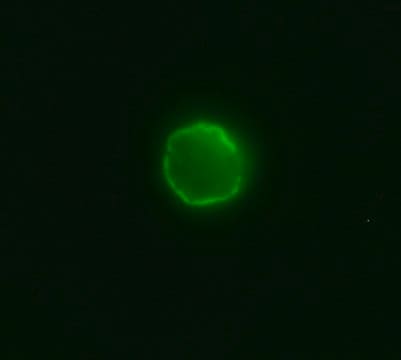
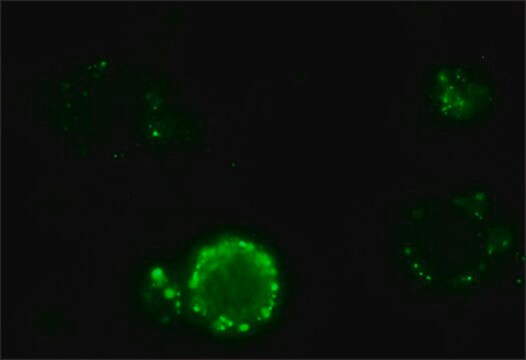
Anti-Cat IgG (whole molecule)-FITC antibody has been used in immunofluorescence antibody test (IFAT), immunofluorescence.
Anti-Cat IgG (whole molecule)-FITC antibody may be used for immunofluorescence at a working antibody dilution of 1:32. The antibody was used in indirect fluorescent antibody test (IFAT) to detect Toxoplasma specific antibodies in cat at a dilution of 1:100.
Anti-cat IgG (whole molecule) −FITC antibody can be used in direct (1:32) and indirect immunofluorescence (dilution 1:64).

Biochem/physiol Actions

Anti-Cat IgG (whole molecule)-FITC antibody specifically recognizes cat IgG. Goat anti-cat IgG is conjugated to Fluorescein Isothiocyanate (FITC) in an alkaline reaction, then further purified to remove unbound FITC.
IgG antibody plays a crucial role in humoral immune responses such as phagocytosis, complement activation, placental transport and cell surface-receptor binding. FITC (fluorescein isothiocyanate), a fluorochrome dye conjugation is useful in localization of antigen-antibody interaction of biological structures like cells or tissues. Anti-cat IgG (whole molecule) -FITC antibody can be used in immunofluorescence study of exfoliative dermatitis in cats. Goat anti-cat IgG antibody is immonospecific for cat IgG.
IgG antibody subtype is the most abundant serum immunoglobulins of the immune system. It is secreted by B cells and is found in blood and extracellular fluids and provides protection from infections caused by bacteria, fungi and viruses. Maternal IgG is transferred to fetus through the placenta that is vital for immune defence of the neonate against infections.

Physical form

Solution in 0.01 M phosphate buffered saline, pH 7.4, containing 15 mM sodium azide.

Disclaimer

Unless otherwise stated in our catalog or other company documentation accompanying the product(s), our products are intended for research use only and are not to be used for any other purpose, which includes but is not limited to, unauthorized commercial uses, in vitro diagnostic uses, ex vivo or in vivo therapeutic uses or any type of consumption or application to humans or animals.

Sie haben nicht das passende Produkt gefunden?  

Probieren Sie unser Produkt-Auswahlhilfe. aus.

Lagerklasse

10 - Combustible liquids

wgk

nwg

flash_point_f

Not applicable

flash_point_c

Not applicable

ppe

Eyeshields, Gloves, multi-purpose combination respirator cartridge (US)


Hier finden Sie alle aktuellen Versionen:

Analysenzertifikate (COA)

Lot/Batch Number

Die passende Version wird nicht angezeigt?

Wenn Sie eine bestimmte Version benötigen, können Sie anhand der Lot- oder Chargennummer nach einem spezifischen Zertifikat suchen.

Besitzen Sie dieses Produkt bereits?

In der Dokumentenbibliothek finden Sie die Dokumentation zu den Produkten, die Sie kürzlich erworben haben.

Die Dokumentenbibliothek aufrufen

Feline Leishmania infection in a canine leishmaniasis endemic region, Portugal
Maia C, et al.
Veterinary Parasitology, 174(3-4), 336-340 (2010)
Exploring the epidemiological role of the Eurasian lynx (Lynx lynx) in the life cycle of Toxoplasma gondii.
Scherrer, et al.
International Journal for Parasitology. Parasites and Wildlife, 21, 10-Jan-10-Jan (2023)
Gabriela Hartmann et al.
Parasitology research, 122(11), 2631-2639 (2023-09-05)
Feline leishmanial infection is reported worldwide, but the epidemiological role of domestic cats in the leishmaniasis cycle remains unclear, and cats might act as cryptic reservoir hosts in endemic areas with no feline leishmaniosis cases. Considering that, a serological screening
S Rottenberg et al.
Veterinary pathology, 41(4), 429-433 (2004-07-03)
Five cases of exfoliative dermatitis in cats were presented from 1996 to 2002 in which a feline thymoma was found by postmortem or postsurgical examination. Besides abundant exfoliation of keratin squames and layers, the histologic picture of the skin revealed
Fernando Izquierdo et al.
Animals : an open access journal from MDPI, 12(19) (2022-10-15)
Lynx pardinus is one of the world's most endangered felines inhabiting the Iberian Peninsula. The present study was performed to identify the presence of microsporidia due to the mortality increase in lynxes. Samples of urine (n = 124), feces (n

Verwandter Inhalt

Questions

Reviews

No rating value

Active Filters

Unser Team von Wissenschaftlern verfügt über Erfahrung in allen Forschungsbereichen einschließlich Life Science, Materialwissenschaften, chemischer Synthese, Chromatographie, Analytik und vielen mehr..

Setzen Sie sich mit dem technischen Dienst in Verbindung