Direkt zum Inhalt
Merck

Fortfahren mit

E9653

Anti-Endothelial Cells antibody, Mouse monoclonal

clone P1H12, purified from hybridoma cell culture

Synonym(e):

Anti-CD146

Anmelden zur Ansicht der Organisations- und Vertragspreise.

Über diesen Artikel

UNSPSC Code:
12352203
NACRES:
NA.41
MDL number:
Conjugate:
unconjugated
Clone:
P1H12, monoclonal
Application:
ARR, ELISA (i), FACS, ICC, IHC, IP
Citations:
7


biological source

mouse

Quality Level

conjugate

unconjugated

antibody form

purified immunoglobulin

antibody product type

primary antibodies

clone

P1H12, monoclonal

form

buffered aqueous solution

mol wt

antigen 130 kDa

species reactivity

human

technique(s)

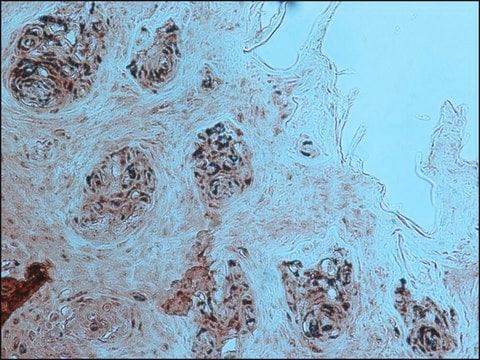
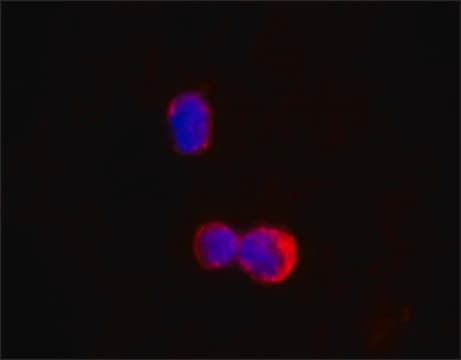
flow cytometry: suitable using 2% paraformaldehyde 9:1 methanol, immunocytochemistry: suitable using 4% paraformaldehyde 0.1-0.5% triton X-100, smears or live cells, immunohistochemistry: suitable using using acetone-fixed sections of human tongue, immunoprecipitation (IP): suitable, indirect ELISA: suitable, microarray: suitable

isotype

IgG1

shipped in

dry ice

storage temp.

−20°C

target post-translational modification

unmodified

General description

Monoclonal Anti-Endothelial cells (CD146) (mouse IgG1 isotype) is derived from the P1H12 hybridoma produced by the fusion of mouse myeloma cells and splenocytes from mice immunized with human umbilical cord cells (HUVEC). CD146 (cluster of differentiation 146) is also known as the melanoma cell adhesion molecule (MCAM), cell surface glycoprotein MUC18, A32, Mel-CAM and S-Endo-1. It is encoded by the MCAM gene. It belongs to the immunoglobulin supergene family with five immunoglobulin-like domains (V-V-C2-C2-C2), a transmembrane region and a 63 residue cytoplasmic tail. It is located on human chromosome11q23.

Immunogen

human umbilical cord cells (HUVEC).

Application

Anti-Endothelial Cells antibody, Mouse monoclonal has been used in:
  • immunocytochemistry
  • immunohistochemistry
  • flow cytometry
  • immunoprecipitation
  • enzyme-linked immunosorbent assay (ELISA)
  • western blotting

Biochem/physiol Actions

CD146 (cluster of differentiation 146) expression can stimulate tumor development in human melanoma, through enhanced interaction between melanoma cells and endothelial cells. However, in breast carcinoma, CD146 may act as a tumor suppressor. CD146 is expressed by the intermediate trophoblast in the placental site and binds to its putative receptor in uterine smooth muscle cells during implantation and placentation, thus limiting trophoblastic invasion in the myometrium.
Recognizes cultured microvascular and large-vessel endothelial cells (MVEC and HUVEC, respectively) and endothelial cells in tissues and in circulation.
Soluble CD146 (cluster of differentiation 146) is associated with the activation of angiogenesis. Circulating endothelial cells (CECs) may help in predicting clinical outcome in cancer patients. Tumor endothelial markers are expressed in a wide range of tumor types and in normal vessels associated with wound healing and corpus luteum formation. It may have significant implications for the development of anti-angiogenic therapies as well.

Physical form

Solution in 0.01 M phosphate buffered saline, pH 7.4, containing 15 mM sodium azide

Disclaimer

Unless otherwise stated in our catalog or other company documentation accompanying the product(s), our products are intended for research use only and are not to be used for any other purpose, which includes but is not limited to, unauthorized commercial uses, in vitro diagnostic uses, ex vivo or in vivo therapeutic uses or any type of consumption or application to humans or animals.

Ähnliche Artikel vergleichen

Vollständigen Vergleich anzeigen

Unterschiede anzeigen

1 of 1

Dieser Artikel
R4903SAB4200366SAB4200369
conjugate

unconjugated

conjugate

unconjugated

conjugate

unconjugated

conjugate

unconjugated

biological source

mouse

biological source

mouse

biological source

mouse

biological source

mouse

species reactivity

human

species reactivity

bovine, newt, chicken, human, monkey, mouse

species reactivity

rat, monkey, human, mouse

species reactivity

rat, human, monkey, mouse

antibody form

purified immunoglobulin

antibody form

purified from hybridoma cell culture

antibody form

purified from hybridoma cell culture

antibody form

purified from hybridoma cell culture

clone

P1H12, monoclonal

clone

4D11, monoclonal

clone

E1.14, monoclonal

clone

R2.5254.2, monoclonal

isotype

IgG1

isotype

IgG1

isotype

IgG2b

isotype

-


Still not finding the right product?

Probieren Sie unser Produkt-Auswahlhilfe, um Ihre Auswahl einzugrenzen


Lagerklasse

12 - Non Combustible Liquids

wgk

nwg

flash_point_f

Not applicable

flash_point_c

Not applicable


Hier finden Sie alle aktuellen Versionen:

Analysenzertifikate (COA)

Lot/Batch Number

Die passende Version wird nicht angezeigt?

Wenn Sie eine bestimmte Version benötigen, können Sie anhand der Lot- oder Chargennummer nach einem spezifischen Zertifikat suchen.

Besitzen Sie dieses Produkt bereits?

In der Dokumentenbibliothek finden Sie die Dokumentation zu den Produkten, die Sie kürzlich erworben haben.

Die Dokumentenbibliothek aufrufen


M Ilie et al.
British journal of cancer, 110(5), 1236-1243 (2014-01-30)
Previous studies indicate that endothelial injury, as demonstrated by the presence of circulating endothelial cells (CECs), may predict clinical outcome in cancer patients. In addition, soluble CD146 (sCD146) may reflect activation of angiogenesis. However, no study has investigated their combined
Xianyi Yu et al.
Pediatric research, 55(4), 688-694 (2004-02-07)
Nitric oxide (NO) serves many vasoprotective roles, but the massive release of NO causes arterial wall degeneration. We investigated whether enhanced nitric oxide synthase (iNOS) expression in peripheral blood leukocytes and circulating endothelial cells mirrors the progression of coronary arterial
Targeting CD146 with a 64Cu-labeled antibody enables in vivo immunoPET imaging of high-grade gliomas
Yang Y, et al.
Proceedings of the National Academy of Sciences of the USA, 112(47), E6525-E6534 (2015)


Global Trade Item Number

SKUGTIN
E9653-.2ML04061838105165

Questions

Reviews

No rating value

Active Filters