
Fortfahren mit
C9409

Creatinine Deiminase microbial
lyophilized powder, ≥25 units/mg protein
Synonym(e):
Creatinine Deaminase
Anmelden zur Ansicht der Organisations- und Vertragspreise.
Größe auswählen
Ansicht ändern
| Packungsgröße | SKU | Verfügbarkeit | Preis |
|---|
Über diesen Artikel
CAS-Nummer:
UNSPSC Code:
12352204
NACRES:
NA.54
EC Number:
253-449-1
MDL number:
Specific activity:
≥25 units/mg protein
Preise und Verfügbarkeit sind derzeit nicht verfügbar.
Technischer Dienst
Benötigen Sie Hilfe? Unser Team von erfahrenen Wissenschaftlern ist für Sie da.
Unterstützung erhaltenform
lyophilized powder
Quality Level
specific activity
≥25 units/mg protein
mol wt
~260 kDa
composition
Protein, ≥15% biuret
storage temp.
−20°C
General description
Isoelectric point : 4.4
Michaelis constant : 3.5 x 10‾3M (Creatinine)
Structure : 6 subunits per mol of enzyme
Inhibitors : Ag+,Hg++, o-phenanthroline,monoiodoacetate
Optimum pH : 8.5 – 9.5
Optimum temperature : 65 – 75°C
pH Stability : pH 7.0 – 11.0 (30°C, 20hr)
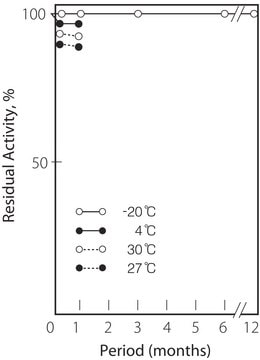
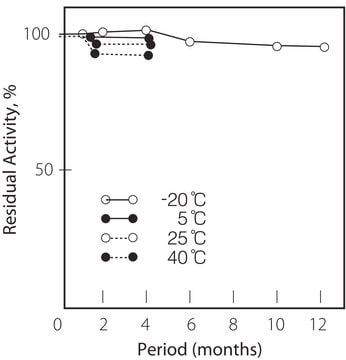
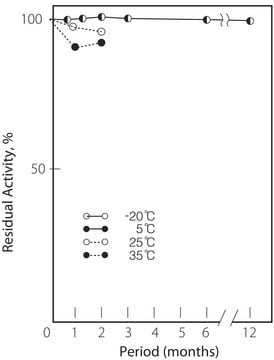
Thermal stability : Below 65°C (pH 7.5, 1hr)
Michaelis constant : 3.5 x 10‾3M (Creatinine)
Structure : 6 subunits per mol of enzyme
Inhibitors : Ag+,Hg++, o-phenanthroline,monoiodoacetate
Optimum pH : 8.5 – 9.5
Optimum temperature : 65 – 75°C
pH Stability : pH 7.0 – 11.0 (30°C, 20hr)
Thermal stability : Below 65°C (pH 7.5, 1hr)
Application
Creatinine Deiminase microbial has been used:
- to immobilize aminosilylated glass beads based biosensor for ammonia/ammonium and creatinine detection in urine[1]
- in creating creatinine-sensing membrane for biophysical studies[2]
- to investigate the bioelectronic tongue for the simultaneous determination of urea, creatinine and alkaline ions in clinical samples[3]
Creatinine deiminase has been used in a study to assess the application of a creatinine-sensitive biosensor for hemodialysis control. Creatinine deiminase has also been used in a study to investigate the bioelectronic tongue for the simultaneous determination of urea, creatinine and alkaline ions in clinical samples.
Biochem/physiol Actions
Creatinine deiminase catalyzes the hydrolysis of creatinine to methylhydantoine and ammonia.[1]
Physical form
Lyophilized powder containing mannitol as stabilizer
Other Notes
One unit will hydrolyze 1.0 μmole of creatinine to N-methylhydantoin and NH3 per min at pH 7.5 at 37 °C in a coupled system with L-glutamic dehydrogenase.
1 of 1
Dieser Artikel | |||
|---|---|---|---|
| specific activity ≥25 units/mg protein | specific activity 100-300 units/mg protein | specific activity ≥4 units/mg solid | specific activity ≥150 units/mg protein |
| form lyophilized powder | form lyophilized powder | form lyophilized powder | form salt-free, lyophilized powder |
| storage temp. −20°C | storage temp. 2-8°C | storage temp. −20°C | storage temp. −20°C |
| mol wt ~260 kDa | mol wt ~175 kDa | mol wt ~100 kDa | mol wt 80-86.2 kDa |
| Quality Level 200 | Quality Level 200 | Quality Level 200 | Quality Level 200 |
| composition Protein, ≥15% biuret | composition Protein, 65-85% | composition - | composition - |

Lagerklasse
11 - Combustible Solids
wgk
WGK 3
flash_point_f
Not applicable
flash_point_c
Not applicable
ppe
Eyeshields, Gloves, type N95 (US)
Hier finden Sie alle aktuellen Versionen:
Besitzen Sie dieses Produkt bereits?
In der Dokumentenbibliothek finden Sie die Dokumentation zu den Produkten, die Sie kürzlich erworben haben.
Anjal C Sharma et al.
Journal of the American Chemical Society, 126(9), 2971-2977 (2004-03-05)
We developed a new sensing motif for the detection and quantification of creatinine, which is an important small molecule marker of renal dysfunction. This novel sensor motif is based on our intelligent polymerized crystalline colloidal array (IPCCA) materials, in which
O A Zinchenko et al.
Biosensors & bioelectronics, 35(1), 466-469 (2012-03-31)
The highly sensitive and selective potentiometric biosensor for creatinine determination has been developed by us earlier. In it, pH-sensitive field effect transistors were used as transducer and immobilized creatinine deiminase (EC 3.5.4.21)--as a biosensitive element. In the work presented, we
L Campanella et al.
The Analyst, 115(6), 827-830 (1990-06-01)
Enzyme sensors for urea and creatinine were developed by coupling an ammonia gas-diffusion electrode with triacetate cellulose membranes entrapping urease or creatinine deiminase enzymes. Satisfactory results were obtained by using these sensors both in standard solutions and in authentic biological
Global Trade Item Number
| SKU | GTIN |
|---|---|
| C9409-250UN | 04061832755403 |