Direkt zum Inhalt
Merck

Fortfahren mit

A3361

Anti-ATP13A2 (C-terminal region) antibody produced in rabbit

~1.5 mg/mL, affinity isolated antibody, buffered aqueous solution

Synonym(e):

Anti-ATPase type 13A2, Anti-PARK9

Anmelden zur Ansicht der Organisations- und Vertragspreise.

Größe auswählen

Ansicht ändern
PackungsgrößeSKUVerfügbarkeitPreis
200 μL
Warenkorb auf Verfügbarkeit prüfen
€ 527,00

Über diesen Artikel

NACRES:
NA.41
UNSPSC Code:
12352203
Conjugate:
unconjugated
Clone:
polyclonal
Application:
WB
Citations:
11

€ 527,00


Warenkorb auf Verfügbarkeit prüfen

Großbestellung anfragen
Technischer Dienst
Benötigen Sie Hilfe? Unser Team von erfahrenen Wissenschaftlern ist für Sie da.
Unterstützung erhalten


biological source

rabbit

Quality Level

conjugate

unconjugated

antibody form

affinity isolated antibody

antibody product type

primary antibodies

clone

polyclonal

form

buffered aqueous solution

mol wt

antigen ~129 kDa

species reactivity

mouse, human

enhanced validation

recombinant expression
Learn more about Antibody Enhanced Validation

concentration

~1.5 mg/mL

technique(s)

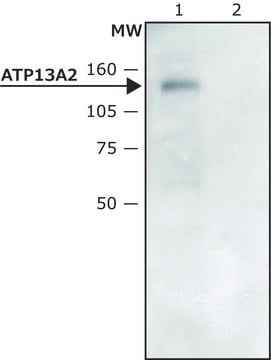
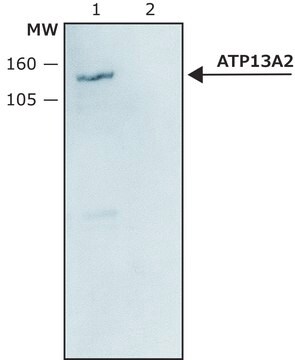
western blot: 1.5-3.0 μg/mL using mouse brain extract (S1 fraction) or HEK-293T cells expressing human ATP13A2

UniProt accession no.

shipped in

dry ice

storage temp.

−20°C

target post-translational modification

unmodified

Gene Information

human ... ATP13A2(23400)

General description

ATP13A2 (ATPase type 13A2, also known as PARK9) is a neuronal P-type ATPase of the P5 subfamily. It is present in the lysosome of transiently transfected cells, whereas the unstable truncated mutants are retained in the endoplasmic reticulum and degraded by the proteasome.
ATP13A2 is a member of the P5 subfamily of P-type transport ATPases which include ATP13A1-ATP13A5. Mutations in ATP3A2 also known as PARK9 are associated with hereditary Parkinson′s disease.
Rabbit anti-ATP13A2 (C-terminal region) antibody is specific for human and mouse ATP13A2. Staining of the ATP13A2 band by immunoblotting is specifically inhibited by the ATP13A2 immunizing peptide.

Application

Applications in which this antibody has been used successfully, and the associated peer-reviewed papers, are given below.
Western Blotting (1 paper)
Rabbit anti-ATP13A2 (C-terminal region) antibody has been used for western blotting applications at a dilution of 1:1000.

Biochem/physiol Actions

ATP13A2 (ATPase type 13A2, also known as PARK9) shows elevated expression levels in the brains of sporadic Parkinson′s disease (PD) patients, suggesting a potential role in the more common forms of PD. It is associated with Kufor-Rakeb syndrome (KRS). KRS is a rare form of hereditary PD with juvenile onset. In addition to typical signs of PD, affected individuals show symptoms of more widespread pyramidal neurodegeneration, including dementia.

Physical form

Solution in 0.01 M phos­phate buffered saline, pH 7.4, containing 15 mM sodium azide.

Disclaimer

Unless otherwise stated in our catalog or other company documentation accompanying the product(s), our products are intended for research use only and are not to be used for any other purpose, which includes but is not limited to, unauthorized commercial uses, in vitro diagnostic uses, ex vivo or in vivo therapeutic uses or any type of consumption or application to humans or animals.

Ähnliche Artikel vergleichen

Vollständigen Vergleich anzeigen

Unterschiede anzeigen

1 of 1

Dieser Artikel
A9607HPA054717P0075
conjugate

unconjugated

conjugate

unconjugated

conjugate

unconjugated

conjugate

unconjugated

antibody form

affinity isolated antibody

antibody form

affinity isolated antibody

antibody form

affinity isolated antibody

antibody form

affinity isolated antibody

biological source

rabbit

biological source

rabbit

biological source

rabbit

biological source

rabbit

Quality Level

200

Quality Level

200

Quality Level

100

Quality Level

200

shipped in

dry ice

shipped in

dry ice

shipped in

wet ice

shipped in

dry ice

UniProt accession no.

Q9NQ11

UniProt accession no.

-

UniProt accession no.

Q9NQ11

UniProt accession no.

Q9BXM7


Still not finding the right product?

Probieren Sie unser Produkt-Auswahlhilfe, um Ihre Auswahl einzugrenzen


Lagerklasse

12 - Non Combustible Liquids

wgk

nwg

flash_point_f

Not applicable

flash_point_c

Not applicable


Hier finden Sie alle aktuellen Versionen:

Analysenzertifikate (COA)

Lot/Batch Number

Die passende Version wird nicht angezeigt?

Wenn Sie eine bestimmte Version benötigen, können Sie anhand der Lot- oder Chargennummer nach einem spezifischen Zertifikat suchen.

Besitzen Sie dieses Produkt bereits?

In der Dokumentenbibliothek finden Sie die Dokumentation zu den Produkten, die Sie kürzlich erworben haben.

Die Dokumentenbibliothek aufrufen


Verwandter Inhalt

Instructions


Alejandro Estrada-Cuzcano et al.
Brain : a journal of neurology, 140(2), 287-305 (2017-02-01)
Hereditary spastic paraplegias are heterogeneous neurodegenerative disorders characterized by progressive spasticity of the lower limbs due to degeneration of the corticospinal motor neurons. In a Bulgarian family with three siblings affected by complicated hereditary spastic paraplegia, we performed whole exome
Mark Ainsley Colijn et al.
Neurogenetics (2024-07-18)
Biallelic (autosomal recessive) pathogenic variants in ATP13A2 cause a form of juvenile-onset parkinsonism, termed Kufor-Rakeb syndrome. In addition to motor symptoms, a variety of other neurological and psychiatric symptoms may occur in affected individuals, including supranuclear gaze palsy and cognitive
David Ramonet et al.
Human molecular genetics, 21(8), 1725-1743 (2011-12-22)
Mutations in the ATP13A2 gene (PARK9, OMIM 610513) cause autosomal recessive, juvenile-onset Kufor-Rakeb syndrome and early-onset parkinsonism. ATP13A2 is an uncharacterized protein belonging to the P(5)-type ATPase subfamily that is predicted to regulate the membrane transport of cations. The physiological


Global Trade Item Number

SKUGTIN
A3361-200UL04061838029638

Questions

Reviews

No rating value

Active Filters