
Fortfahren mit
01673

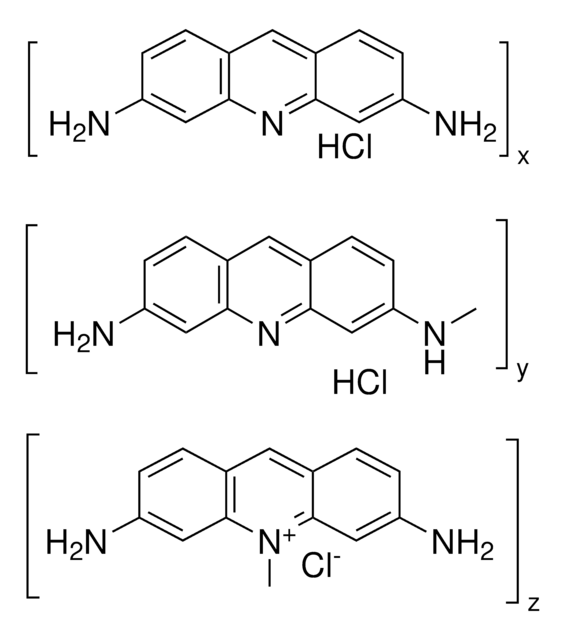
Acriflavin
BioReagent, suitable for fluorescence, ≥90% (AT)
Synonym(e):
3,6-Diamino-10-methylacridiniumchlorid, Gemisch mit 3,6-Diaminoacridin (Proflavin), Euflavin, Trypaflavin Neutral
Größe auswählen
| Packungsgröße | SKU | Verfügbarkeit | Preis |
|---|---|---|---|
| 10 g | Warenkorb auf Verfügbarkeit prüfen | € 70,10 | |
| 50 g | Warenkorb auf Verfügbarkeit prüfen | € 230,00 |
Über diesen Artikel
product line
BioReagent
Quality Segment
assay
≥90% (AT)
form
powder
composition
Sum of components 3,6-diaminoacridinium chloride and 3,6-diamino-10-methylacridinium chloride, ≥70% HPLC
solubility
H2O: 0.33 g/mL (lit.)(lit.)
fluorescence
λex 463 nm; λem 490 nm in ethanol
suitability
suitable for fluorescence
SMILES string
[Cl-].Nc1ccc2cc3ccc(N)cc3nc2c1.C[n+]4c5cc(N)ccc5cc6ccc(N)cc46
InChI
1S/C14H13N3.C13H11N3.ClH/c1-17-13-7-11(15)4-2-9(13)6-10-3-5-12(16)8-14(10)17;14-10-3-1-8-5-9-2-4-11(15)7-13(9)16-12(8)6-10;/h2-8H,1H3,(H3,15,16);1-7H,14-15H2;1H
InChI key
PEJLNXHANOHNSU-UHFFFAOYSA-N
Application
Anregungs- (ex) und Emissionswellenlängen (em) in verschiedenen Lösungsmitteln:
- Methanol: λex = 424 nm; λem = 518 nm
- Ethanol: λex = 426 nm; λem = 524 nm
- Propanol: λex = 430 nm; λem = 512 nm
- Butanol: λex = 430 nm; λem = 526 nm
- Formamid: λex = 434 nm; λem = 524 nm
- Glycerin: λex = 432 nm; λem = 540 nm
- Wasser: λex = 416 nm; λem = 514 nm
Unlöslich in Ether, Chloroform und fetten Ölen. Wird für Fluoreszenzmessungen im stationären Zustand als Donormolekül verwendet (wenn es mit Rhodamin 6G als Akzeptor gepaart ist), um als ein pH-Sensor zu dienen .
Other Notes
1 of 1
Dieser Artikel | |||
|---|---|---|---|
| suitability suitable for fluorescence | suitability - | suitability - | suitability - |
| fluorescence λex 463 nm; λem 490 nm in ethanol | fluorescence - | fluorescence - | fluorescence - |
| solubility H2O: 0.33 g/mL (lit.)(lit.) | solubility H2O: 0.33 g/mL (lit.)(lit.) | solubility H2O: 1 mg/mL | solubility DMSO: 2 mg/mL, clear |
| form powder | form powder | form powder | form powder |
| composition Sum of components 3,6-diaminoacridinium chloride and 3,6-diamino-10-methylacridinium chloride, ≥70% HPLC | composition - | composition Acriflavine HCL content, 10-50% , Proflavine HCL, 25-70% | composition - |
| assay ≥90% (AT) | assay - | assay - | assay ≥95% (HPLC) |


Still not finding the right product?
Explore all of our products under Acriflavin


signalword
Warning
hcodes
Hazard Classifications
Acute Tox. 4 Oral - Aquatic Acute 1 - Eye Irrit. 2 - Skin Irrit. 2 - STOT SE 3
target_organs
Respiratory system
Lagerklasse
11 - Combustible Solids
wgk
WGK 3
flash_point_f
Not applicable
flash_point_c
Not applicable
ppe
dust mask type N95 (US), Eyeshields, Gloves
Hier finden Sie alle aktuellen Versionen:
Besitzen Sie dieses Produkt bereits?
In der Dokumentenbibliothek finden Sie die Dokumentation zu den Produkten, die Sie kürzlich erworben haben.
Global Trade Item Number
| SKU | GTIN |
|---|---|
| PH000036-25MG | 04061831294828 |
| 01673-50G | 04061838609588 |
| 01673-10G | 04061838609571 |