
Fortfahren mit
C1484

7-Diethylamino-3-(4-Maleimidophenyl)-4-Methylcumarin
≥95% purity (HPLC), solid
Synonym(e):
1-{4-[7-(Diethylamino)-4-methyl-2-oxo-2H-1-benzopyran-3-yl]-phenyl}-1H-pyrrol-2,5-dion, CPM
Größe auswählen
| Packungsgröße | SKU | Verfügbarkeit | Preis |
|---|---|---|---|
| 25 mg | Warenkorb auf Verfügbarkeit prüfen | € 549,00 |
Über diesen Artikel
Produktname
7-Diethylamino-3-(4-Maleimidophenyl)-4-Methylcumarin, ≥95% (HPLC), solid
Quality Segment
assay
≥95% (HPLC)
form
solid
technique(s)
titration: suitable
color
yellow
solubility
DMSO: soluble, methanol: soluble
application(s)
diagnostic assay manufacturing
hematology
histology
storage temp.
−20°C
SMILES string
CCN(CC)c1ccc2C(C)=C(C(=O)Oc2c1)c3ccc(cc3)N4C(=O)C=CC4=O
InChI
1S/C24H22N2O4/c1-4-25(5-2)18-10-11-19-15(3)23(24(29)30-20(19)14-18)16-6-8-17(9-7-16)26-21(27)12-13-22(26)28/h6-14H,4-5H2,1-3H3
InChI key
YGIABALXNBVHBX-UHFFFAOYSA-N
General description
Application
- as a nontoxic substitute for conjugation with antibody(93)
- to aid fluorescent detection of Coenzyme A (CoA-SH) in human N-myristoyltransferases assay (94)
- in thermostability shift assay of recombinant protein(95)
Biochem/physiol Actions
1 of 1
Dieser Artikel | |||
|---|---|---|---|
| technique(s) titration: suitable | technique(s) - | technique(s) - | technique(s) - |
| color yellow | color - | color - | color yellow |
| solubility DMSO: soluble, methanol: soluble | solubility - | solubility - | solubility DMSO: 10 mg/mL, acetone: 10 mg/mL, DMF: soluble |
| form solid | form solid | form solid | form solid |
| storage temp. −20°C | storage temp. −20°C | storage temp. - | storage temp. 2-8°C |
| Quality Level 100 | Quality Level 100 | Quality Level 100 | Quality Level 100 |

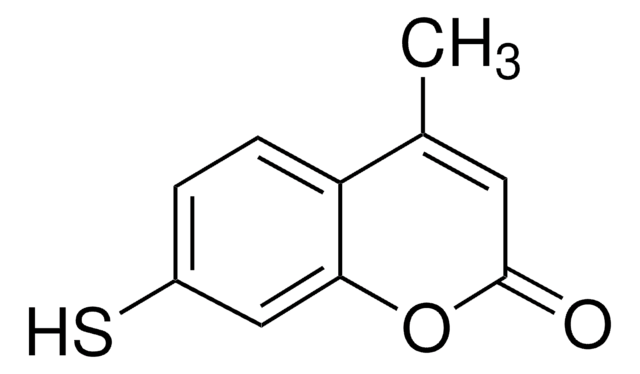
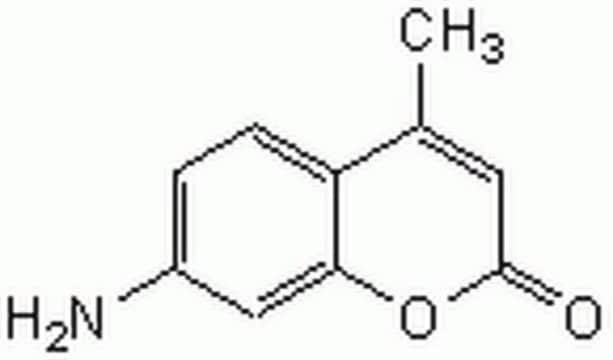
Still not finding the right product?
Explore all of our products under 7-Diethylamino-3-(4-Maleimidophenyl)-4-Methylcumarin
Lagerklasse
11 - Combustible Solids
wgk
WGK 3
flash_point_f
Not applicable
flash_point_c
Not applicable
ppe
Eyeshields, Gloves, type N95 (US)
Hier finden Sie alle aktuellen Versionen:
Besitzen Sie dieses Produkt bereits?
In der Dokumentenbibliothek finden Sie die Dokumentation zu den Produkten, die Sie kürzlich erworben haben.
Global Trade Item Number
| SKU | GTIN |
|---|---|
| C1484-25MG | 04061833467626 |