Direkt zum Inhalt
Merck

Fortfahren mit

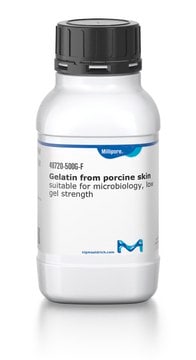
48720

Gelatine aus Schweinehaut

suitable for microbiology, low gel strength

Anmelden zur Ansicht der Organisations- und Vertragspreise.

Größe auswählen

Ansicht ändern
PackungsgrößeSKUVerfügbarkeitPreis
500 g
Warenkorb auf Verfügbarkeit prüfen
€ 116,00

Über diesen Artikel

CAS-Nummer:
UNSPSC Code:
41106212
EC Number:
232-554-6
NACRES:
NA.85

€ 116,00


Warenkorb auf Verfügbarkeit prüfen

Großbestellung anfragen
Technischer Dienst
Benötigen Sie Hilfe? Unser Team von erfahrenen Wissenschaftlern ist für Sie da.
Unterstützung erhalten


biological source

Porcine

Quality Segment

sterility

non-sterile

form

powder

quality

low gel strength

ign. residue

≤2%

loss

≤15% loss on drying

pH

4.0-6.0 (50 °C, 67 mg/mL in H2O)

gel strength

90-110 g Bloom (67 mg/ml water)

solubility

H2O: 67 mg/mL at 50 °C, slightly hazy, light brownish-yellow

anion traces

chloride (Cl-): ≤2000 mg/kg

cation traces

Ca: ≤2000 mg/kg, Cd: ≤5 mg/kg, Co: ≤5 mg/kg, Cr: ≤10 mg/kg, Cu: ≤50 mg/kg, Fe: ≤50 mg/kg, K: ≤500 mg/kg, Mg: ≤500 mg/kg, Mn: ≤5 mg/kg, Na: ≤3000 mg/kg, Ni: ≤5 mg/kg, Pb: ≤5 mg/kg, Zn: ≤10 mg/kg

application(s)

microbiology

Application

60 g Bloom

Other Notes

Gelatine ist ein heterogenes Gemisch aus wasserlöslichen Proteinen mit hoher mittlerer Molekularmasse, das in Kollagen vorhanden ist. Die Proteine werden mittels Sieden der relevanten Haut, Sehnen, Ligamente, Knochen usw. in Wasser extrahiert. Gelatine vom Typ A wird aus mit Säure aufgeschlossenem Gewebe gewonnen. Gelatine vom Typ B wird aus mit Kalklauge geäschertem Gewebe gewonnen.
Kann Verkaufsbeschränkungen unterliegen.

Disclaimer

Dry gelatin, when stored in airtight containers at room temperature, will remain unchanged for many years. When heated at 100°C in the presence of air, it swells becomes soft and disintegrates to a carbonaceous mass with evolution of pyridine bases and ammonia.

Ähnliche Artikel vergleichen

Vollständigen Vergleich anzeigen

Unterschiede anzeigen

1 of 1

Dieser Artikel
48722G6144G9136
form

powder

form

powder

form

-

form

lyophilized powder

application(s)

microbiology

application(s)

microbiology

application(s)

-

application(s)

-

biological source

Porcine

biological source

Porcine

biological source

-

biological source

Porcine skin

sterility

non-sterile

sterility

non-sterile

sterility

-

sterility

γ-irradiated

solubility

H2O: 67 mg/mL at 50 °C, slightly hazy, light brownish-yellow

solubility

H2O: 67 mg/mL at 50 °C, slightly hazy, slightly yellow

solubility

-

solubility

soluble 20 mg/mL, clear, colorless (in warm tissue culture medium)

Quality Level

100

Quality Level

200

Quality Level

200

Quality Level

200


Still not finding the right product?

Explore all of our products under Gelatine aus Schweinehaut


Lagerklasse

11 - Combustible Solids

wgk

nwg

flash_point_f

Not applicable

flash_point_c

Not applicable

ppe

Eyeshields, Gloves, type N95 (US)


Hier finden Sie alle aktuellen Versionen:

Analysenzertifikate (COA)

Lot/Batch Number

Die passende Version wird nicht angezeigt?

Wenn Sie eine bestimmte Version benötigen, können Sie anhand der Lot- oder Chargennummer nach einem spezifischen Zertifikat suchen.

Besitzen Sie dieses Produkt bereits?

In der Dokumentenbibliothek finden Sie die Dokumentation zu den Produkten, die Sie kürzlich erworben haben.

Die Dokumentenbibliothek aufrufen


Anupriya Chatterjee et al.
International journal of molecular sciences, 21(10) (2020-05-30)
Ablation of nucleoside diphosphate kinase B (NDPK-B) in mice causes a breakdown of the neurovascular unit in the retina, mimicking diabetic retinopathy. The NDPK-B deficiency-induced vascular damage is mediated by excessive angiopoietin 2 (Ang2). Herein, the potential involvement of its
Anupriya Chatterjee et al.
Cells, 9(10) (2020-10-23)
Our previous studies identified that retinal endothelial damage caused by hyperglycemia or nucleoside diphosphate kinase-B (NDPK-B) deficiency is linked to elevation of angiopoietin-2 (Ang-2) and the activation of the hexosamine biosynthesis pathway (HBP). Herein, we investigated how NDPK-B is involved
Leslie Crews et al.
The Journal of neuroscience : the official journal of the Society for Neuroscience, 28(16), 4250-4260 (2008-04-18)
Altered expression and mutations in alpha-synuclein (alpha-syn) have been linked to Parkinson's disease (PD) and related disorders. The neurological alterations in PD patients have been associated with degeneration of dopaminergic cells and other neuronal populations. Moreover, recent studies in murine


Global Trade Item Number

SKUGTIN
48720-100G-F04061832392844
48720-500G-F04061833499153

Questions

Reviews

No rating value

Active Filters