Direkt zum Inhalt
Merck

Fortfahren mit

MABS14

Anti-mTOR Antibody, clone F11

clone F11, from mouse

Synonym(e):

FK506 binding protein 12-rapamycin associated protein 1, FK506 binding protein 12-rapamycin associated protein 2, FK506-binding protein 12-rapamycin complex-associated protein 1, FKBP-rapamycin associated protein, FKBP12-rapamycin complex-associated prot

Anmelden zur Ansicht der Organisations- und Vertragspreise.

Größe auswählen

Ansicht ändern
PackungsgrößeSKUVerfügbarkeitPreis
100 μg
Warenkorb auf Verfügbarkeit prüfen
€ 340,00

Über diesen Artikel

UNSPSC Code:
12352203
NACRES:
NA.41
eCl@ss:
32160702
Conjugate:
unconjugated
Clone:
F11, monoclonal
Application:
IP, WB
Citations:
1

€ 340,00


Warenkorb auf Verfügbarkeit prüfen

Großbestellung anfragen
Technischer Dienst
Benötigen Sie Hilfe? Unser Team von erfahrenen Wissenschaftlern ist für Sie da.
Unterstützung erhalten


biological source

mouse

Quality Level

conjugate

unconjugated

antibody form

purified immunoglobulin

antibody product type

primary antibodies

clone

F11, monoclonal

species reactivity

human

species reactivity (predicted by homology)

rat (based on 100% sequence homology)

technique(s)

immunoprecipitation (IP): suitable, western blot: suitable

isotype

IgG1κ

NCBI accession no.

UniProt accession no.

shipped in

wet ice

target post-translational modification

unmodified

Gene Information

human ... MTOR(2475)

General description

mTOR (Mammalian Target of Rapamycin, aka FRAP, RAPT or RAFT) is a large 289 kDa Ser/Thr protein kinase that regulates cell cycle progression, cell growth, protein synthesis, ribosome biogenesis, and autophagy. mTOR is an evolutionarily conserved member of the Phosphoinositol Kinase-related Kinase (PIKK) family whose activity is regulated by phosphorylation on Ser2448 by Akt in response to insulin or muscle activity. mTORC1 (mTOR Complex 1) consists of at least mTOR, Raptor, and G (mLST8). mTORC1 is known to play a central role in insulin signaling, which is crucial in maintaining metabolic homeostasis. mTORC2 affects cell proliferation and survival primarily by phosphorylating the hydrophobic motif of Akt on Ser473, a well-known effecter of the PI3 Kinase pathway. In addition to phosphorylating Akt, the mTORC2 complex is also known to effect cytoskeletal organization and migration by exerting its effects through Rac, Rho, and PKC. Defects in both mTOR complexes are associated with a variety of diseases, including cancer and diabetes.
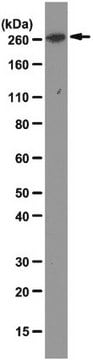
~ 289 kDa observed

Immunogen

GST-tagged recombinant protein corresponding to rat mTOR.

Application

Immunoprecipitation Analysis: A previous lot was used by an independent laboratory in IP. (Nemazanyy, I, et al. (2008). Hybridoma, 27:395-398.)
Research Category
Signaling
Research Sub Category
PI3K, Akt, & mTOR Signaling
This Anti-mTOR Antibody, clone F11 is validated for use in WB, IP for the detection of mTOR.

Physical form

Format: Purified
Protein G
Purified mouse monoclonal IgG1κ in buffer containing 0.1 M Tris-Glycine (pH 7.4), 150 mM NaCl with 0.05% sodium azide.

Preparation Note

Stable for 1 year at 2-8°C from date of receipt.

Analysis Note

Control
HeLa cell lysate
Evaluated by Western Blot in HeLa cell lysate.

Western Blot Analysis: 0.5 µg/mL of this antibody detected mTOR on 10 µg of HeLa cell lysate.

Other Notes

Concentration: Please refer to the Certificate of Analysis for the lot-specific concentration.

Disclaimer

Unless otherwise stated in our catalog or other company documentation accompanying the product(s), our products are intended for research use only and are not to be used for any other purpose, which includes but is not limited to, unauthorized commercial uses, in vitro diagnostic uses, ex vivo or in vivo therapeutic uses or any type of consumption or application to humans or animals.

Ähnliche Artikel vergleichen

Vollständigen Vergleich anzeigen

Unterschiede anzeigen

1 of 1

Dieser Artikel
ABS79ABS88SAB4501038
species reactivity

human

species reactivity

human

species reactivity

human

species reactivity

rat, human, mouse

antibody form

purified immunoglobulin

antibody form

affinity isolated antibody

antibody form

serum

antibody form

affinity isolated antibody

Gene Information

human ... MTOR(2475)

Gene Information

human ... MTOR(2475)

Gene Information

human ... MTOR(2475)

Gene Information

human ... MTOR(2475)

conjugate

unconjugated

conjugate

-

conjugate

-

conjugate

unconjugated

biological source

mouse

biological source

rabbit

biological source

rabbit

biological source

rabbit

clone

F11, monoclonal

clone

polyclonal

clone

polyclonal

clone

polyclonal


Still not finding the right product?

Probieren Sie unser Produkt-Auswahlhilfe, um Ihre Auswahl einzugrenzen


Lagerklasse

12 - Non Combustible Liquids

wgk

WGK 1

flash_point_f

Not applicable

flash_point_c

Not applicable


Analysenzertifikate (COA)

Suchen Sie nach Analysenzertifikate (COA), indem Sie die Lot-/Chargennummer des Produkts eingeben. Lot- und Chargennummern sind auf dem Produktetikett hinter den Wörtern ‘Lot’ oder ‘Batch’ (Lot oder Charge) zu finden.

Besitzen Sie dieses Produkt bereits?

In der Dokumentenbibliothek finden Sie die Dokumentation zu den Produkten, die Sie kürzlich erworben haben.

Die Dokumentenbibliothek aufrufen


Habeebunnisa Begum et al.
Drug development research, 83(4), 910-926 (2022-01-30)
Pancreatic cancer (PC) is among the most lethal cancers and is resistant to existing therapies, which highlights the need for new and alternative therapeutic treatments. Autophagy is emerging as one of the alternative cell death mechanisms and is well known


Global Trade Item Number

SKUGTIN
MABS1404053252290954

Questions

Reviews

No rating value

Active Filters