Direkt zum Inhalt
Merck

ABS79

Anti-phospho-mTOR (Ser2159) Antibody

from rabbit, purified by affinity chromatography

Synonym(e):

Serine/threonine-protein kinase mTOR, FK506-binding protein 12-rapamycin complex-associated protein 1, FKBP12-rapamycin complex-associated protein, Mammalian target of rapamycin, mTOR, Mechanistic target of rapamycin, Rapamycin and FKBP12 target 1, Rapam

Anmelden zur Ansicht der Organisations- und Vertragspreise.

Größe auswählen

100 μL

€ 397,00

€ 397,00


Warenkorb auf Verfügbarkeit prüfen

Großbestellung anfragen

Über diesen Artikel

UNSPSC-Code:
12352203
eCl@ss:
32160702
NACRES:
NA.41

Fortfahren mit

Technischer Dienst
Benötigen Sie Hilfe? Unser Team von erfahrenen Wissenschaftlern ist für Sie da.
Unterstützung erhalten

Biologische Quelle

rabbit

Qualitätsniveau

Antikörperform

affinity isolated antibody

Antikörper-Produkttyp

primary antibodies

Klon

polyclonal

Aufgereinigt durch

affinity chromatography

Speziesreaktivität

human

Speziesreaktivität (Voraussage durch Homologie)

mouse (based on 100% sequence homology), rat (based on 100% sequence homology), zebrafish (based on 100% sequence homology), sheep (based on 100% sequence homology)

Methode(n)

dot blot: suitable
inhibition assay: suitable (peptide)
western blot: suitable

NCBI-Hinterlegungsnummer

UniProt-Hinterlegungsnummer

Versandbedingung

wet ice

Posttranslationale Modifikation Target

phosphorylation (pSer2159)

Angaben zum Gen

human ... MTOR(2475)

Ähnliche Artikel vergleichen

Vollständigen Vergleich anzeigen

Unterschiede anzeigen

1 of 4

Dieser Artikel
ABS88MABS196SAB4501038
biological source

rabbit

biological source

rabbit

biological source

mouse

biological source

rabbit

Quality Level

100

Quality Level

100

Quality Level

100

Quality Level

100

antibody form

affinity isolated antibody

antibody form

serum

antibody form

purified immunoglobulin

antibody form

affinity isolated antibody

species reactivity

human

species reactivity

human

species reactivity

human

species reactivity

rat, human, mouse

UniProt accession no.

P42345

UniProt accession no.

P42345

UniProt accession no.

P42345

UniProt accession no.

P42345

Gene Information

human ... MTOR(2475)

Gene Information

human ... MTOR(2475)

Gene Information

human ... MTOR(2475)

Gene Information

human ... MTOR(2475)

Allgemeine Beschreibung

290 kDa calculated
The mammalian target of rapamycin (mTOR), also known as FRAP, RAFT, or RAPT, is a ubiquitously expressed serine/threonine kinase that belongs to the phosphoinositide 3-kinase–related kinase (PIKK) family. mTOR functions as a downstream effector in the PI3K pathway and is activated by the Akt kinase. mTOR responds to signals from growth factors and promotes protein synthesis underlying cell proliferation, by activation of the S6 kinase and inhibition of the 4E-BP protein involved in protein translation. Several studies have suggested that the proliferative functions of mTOR may contribute to the development of cancer.

Immunogen

Epitope: Phosphorylated at Ser2159
KLH-conjugated linear peptide corresponding to human mTOR phosphorylated at Ser2159.

Anwendung

Research Category
Zelluläre Signaltransduktion
Research Sub Category
Kinasen & Phosphatasen
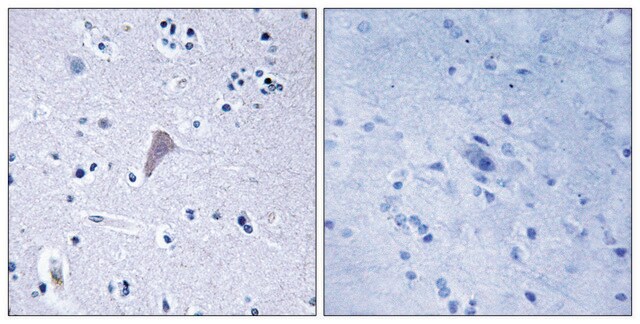
Anti-mTOR Antibody detects level of phospho-mTOR (Ser2159) & has been published & validated for use in Western Blotting, Peptide Inhibition Assay, Dot Blot.
Western Blot Analysis: A representative lot detected phospho-mTOR (Ser2159) in HEK293 cell lysate. Image courtesy from the laboratory of Dr. Diane Fingar, University of Michigan Medical School.

Biochem./physiol. Wirkung

This antibody recognizes mTOR phosphorylated at Ser2159.

Physikalische Form

Affinity purified
Purified rabbit polyclonal in buffer containing 0.1 M Tris-Glycine (pH 7.4), 150 mM NaCl with 0.05% sodium azide.

Angaben zur Herstellung

Stable for 1 year at 2-8°C from date of receipt.

Hinweis zur Analyse

Control
Unmodified and modified mTOR peptides
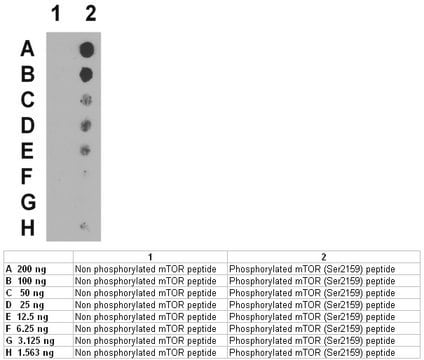
Evaluated by Dot Blot in unmodified and modified mTOR peptides.

Dot Blot Specificity Analysis: Unmodified and modified mTOR peptides (see Table) were probed with Anti-phospho-mTOR (Ser2159) (1:1,000 dilution).

Sonstige Hinweise

Concentration: Please refer to the Certificate of Analysis for the lot-specific concentration.

Haftungsausschluss

Unless otherwise stated in our catalog or other company documentation accompanying the product(s), our products are intended for research use only and are not to be used for any other purpose, which includes but is not limited to, unauthorized commercial uses, in vitro diagnostic uses, ex vivo or in vivo therapeutic uses or any type of consumption or application to humans or animals.

Sie haben nicht das passende Produkt gefunden?  

Probieren Sie unser Produkt-Auswahlhilfe. aus.

Lagerklassenschlüssel

12 - Non Combustible Liquids

WGK

WGK 1

Flammpunkt (°F)

Not applicable

Flammpunkt (°C)

Not applicable


Analysenzertifikate (COA)

Suchen Sie nach Analysenzertifikate (COA), indem Sie die Lot-/Chargennummer des Produkts eingeben. Lot- und Chargennummern sind auf dem Produktetikett hinter den Wörtern ‘Lot’ oder ‘Batch’ (Lot oder Charge) zu finden.

Besitzen Sie dieses Produkt bereits?

In der Dokumentenbibliothek finden Sie die Dokumentation zu den Produkten, die Sie kürzlich erworben haben.

Die Dokumentenbibliothek aufrufen

mTOR kinase domain phosphorylation promotes mTORC1 signaling, cell growth, and cell cycle progression.
Ekim, B; Magnuson, B; Acosta-Jaquez, HA; Keller, JA; Feener, EP; Fingar, DC
Molecular and cellular biology null
Lipotoxicity-induced STING1 activation stimulates MTORC1 and restricts hepatic lipophagy.
Liu, et al.
Autophagy, 18, 860-876 (2022)
Quan-Yu Zhang et al.
Hepatology (Baltimore, Md.), 66(3), 834-854 (2017-05-17)
Cellular repressor of E1A-stimulated genes (CREG), a novel cellular glycoprotein, has been identified as a suppressor of various cardiovascular diseases because of its capacity to reduce hyperplasia, maintain vascular homeostasis, and promote endothelial restoration. However, the effects and mechanism of
Kashif Aziz Khan et al.
PLoS pathogens, 17(1), e1009111-e1009111 (2021-01-08)
Antiviral innate immune response to RNA virus infection is supported by Pattern-Recognition Receptors (PRR) including RIG-I-Like Receptors (RLR), which lead to type I interferons (IFNs) and IFN-stimulated genes (ISG) production. Upon sensing of viral RNA, the E3 ubiquitin ligase TNF
Cagri Bodur et al.
The EMBO journal, 37(1), 19-38 (2017-11-19)
The innate immune kinase TBK1 initiates inflammatory responses to combat infectious pathogens by driving production of type I interferons. TBK1 also controls metabolic processes and promotes oncogene-induced cell proliferation and survival. Here, we demonstrate that TBK1 activates mTOR complex 1

Questions

Reviews

No rating value

Active Filters

Unser Team von Wissenschaftlern verfügt über Erfahrung in allen Forschungsbereichen einschließlich Life Science, Materialwissenschaften, chemischer Synthese, Chromatographie, Analytik und vielen mehr..

Setzen Sie sich mit dem technischen Dienst in Verbindung