
MABF158B

Anti-CD3e (Mouse), PerCP-Cy5.5, clone 145-2C11 Antibody
clone 145-2C11, from hamster(Armenian), PerCP-Cy5.5
Synonym(e):
T-cell surface glycoprotein CD3 epsilon chain, T-cell surface antigen T3/Leu-4 epsilon chain, CD3e, CD3e
Größe auswählen
| Packungsgröße | SKU | Verfügbarkeit | Preis |
|---|---|---|---|
| 25 μg | Warenkorb auf Verfügbarkeit prüfen | € 135,00 |
Über diesen Artikel
biological source
hamster (Armenian)
Quality Segment
conjugate
PerCP-Cy5.5
antibody form
purified antibody
antibody product type
primary antibodies
clone
145-2C11, monoclonal
species reactivity
mouse
packaging
antibody small pack of 25 μg
technique(s)
flow cytometry: suitable
isotype
IgG
UniProt accession no.
target post-translational modification
unmodified
Gene Information
mouse ... Cd3E(12501)
General description
Immunogen
Application
Inflammation & Immunology
Immunoglobulins & Immunology
Physical form
Preparation Note
Note: It is recommended to store the product undiluted at 2-8°C and protected from prolonged exposure to light. Do not freeze.
Analysis Note
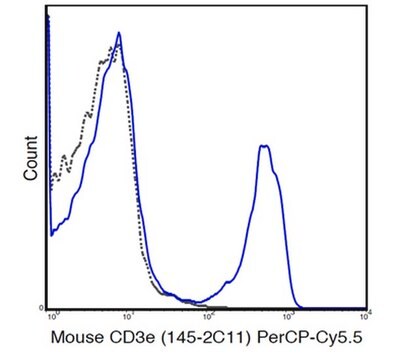
Flow Cytometry Analysis: 0.25 μg from a representative lot detected CD3e in one million C57Bl/6 splenocytes.
Other Notes
Disclaimer
1 of 1
Dieser Artikel | |||
|---|---|---|---|
| biological source hamster (Armenian) | biological source hamster (Armenian) | biological source hamster (Armenian) | biological source rat |
| antibody form purified antibody | antibody form purified antibody | antibody form purified antibody | antibody form purified antibody |
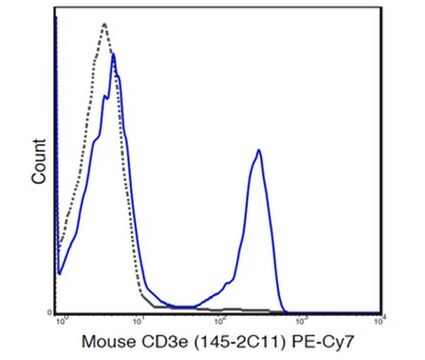
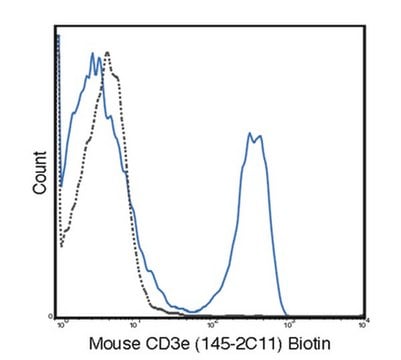
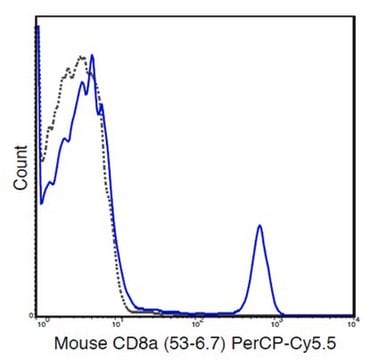
| conjugate PerCP-Cy5.5 | conjugate PE-Cy7 | conjugate biotin conjugate | conjugate PerCP-Cy5.5 |
| Gene Information mouse ... Cd3E(12501) | Gene Information mouse ... Cd3E(12501) | Gene Information mouse ... Cd3E(12501) | Gene Information mouse ... Cd8A(12525) |
| clone 145-2C11, monoclonal | clone 145-2C11, monoclonal | clone 145-2C11, monoclonal | clone 53-6.7, monoclonal |
| species reactivity mouse | species reactivity mouse | species reactivity mouse | species reactivity mouse |
Still not finding the right product?
Probieren Sie unser Produkt-Auswahlhilfe, um Ihre Auswahl einzugrenzen
Lagerklasse
12 - Non Combustible Liquids
wgk
nwg
flash_point_f
Not applicable
flash_point_c
Not applicable
Analysenzertifikate (COA)
Suchen Sie nach Analysenzertifikate (COA), indem Sie die Lot-/Chargennummer des Produkts eingeben. Lot- und Chargennummern sind auf dem Produktetikett hinter den Wörtern ‘Lot’ oder ‘Batch’ (Lot oder Charge) zu finden.
Besitzen Sie dieses Produkt bereits?
In der Dokumentenbibliothek finden Sie die Dokumentation zu den Produkten, die Sie kürzlich erworben haben.
Verwandter Inhalt
"Mods – modifications – small alterations can have a big impact on form and function. In the motorsports world, stock vehicles are modified to enhance their performance. Modifications, or mods, to the engine, drive train, intake and exhaust components add up to provide phenomenal performance gains that can be measured as horsepower and torque increases, which yield a competitive advantage, and result in reduced run times. In biology, proteins undergo modifications that alter their function. Some proteins require the modifications in order to perform their function effectively, whether it’s a pro-protein that is cleaved to produce an active enzyme, or a protein that is phosphorylated to facilitate a signaling process. Other proteins, such as histones, undergo modifications that regulate gene expression and alter cellular function. There are several post translational modifications such as acetylation, methylation, phosphorylation, and ubiquitination that impact protein function and activity. As a result, the analysis of proteins and their post-translational modifications are particularly important for the study of normal and disease-associated processes. New antibodies to detect phospho Histidines are now available from EMD Millipore."
Global Trade Item Number
| SKU | GTIN |
|---|---|
| MABF1584 | 04055977292879 |
| MABF1583 | 04055977292862 |