Direkt zum Inhalt
Merck

Fortfahren mit

MABE1132

Anti-TET2 Antibody, clone 9F7

clone 9F7, from rat

Synonym(e):

Methylcytosine dioxygenase TET2, Protein Ayu17-449

Anmelden zur Ansicht der Organisations- und Vertragspreise.

Größe auswählen

Ansicht ändern
Ihnen/SKUVerfügbarkeitPreis

Über diesen Artikel

UNSPSC Code:
12352203
NACRES:
NA.41
eCl@ss:
32160702
Conjugate:
unconjugated
Clone:
9F7, monoclonal
Application:
ELISA, ICC, IP, WB
Citations:
2
Preise und Verfügbarkeit sind derzeit nicht verfügbar.
Technischer Dienst
Benötigen Sie Hilfe? Unser Team von erfahrenen Wissenschaftlern ist für Sie da.
Unterstützung erhalten


biological source

rat

Quality Segment

conjugate

unconjugated

antibody form

purified immunoglobulin

antibody product type

primary antibodies

clone

9F7, monoclonal

species reactivity

mouse

technique(s)

ELISA: suitable, immunocytochemistry: suitable, immunoprecipitation (IP): suitable, western blot: suitable

isotype

IgG2aκ

NCBI accession no.

UniProt accession no.

target post-translational modification

unmodified

Gene Information

mouse ... Tet2(214133)

General description

212.1 kDa (isoform 1), 68.06 kDa (isoform 2), 64.50 kDa (isoform 3) calculated.
Methylcytosine dioxygenase TET2 (EC 1.14.11.n2; UniProt Q4JK59; also known as Protein Ayu17-449) is encoded by the Tet2 (also known as Kiaa1546) gene (Gene ID 214133) in murine species. TET (ten-eleven translocation) proteins (TET1, TET2, and TET3) oxidize 5-methylcytosine to 5-hydroxymethylcytosine, 5-formylcytosine, and 5-carboxylcytosine, providing a means for active epigenetic DNA demethylation in mammals. TET proteins also modify genomic thymine residues to 5-hydroxyuracil. TET proteins depend on Fe(II) and 2-oxoglutarate as cofactors for activity, and 2-oxoglutarate is known to inhibit their activity, while ascorbate is shown to stimulate TET-mediated cytosine oxidation. In addition, post-translational modifications (PTMs), such as phosphorylation and O-GlcNAcylation, also play a role in regulating the activity of TET proteins. TET1 and TET2 are found highly expressed in mouse embryonic stem cells (mESCs) and TET3 is known to be upregulated in oocytes and oxidize the silenced paternal pronuclear DNA. High levels of TET proteins and genomic 5-hydroxymethylcytosine in neuronal tissues are also reported.

Immunogen

Epitope: Region between DNA-binding and 2-oxoglutarate-binding domains.
His-tagged recombinant fragment from the region between DNA-binding and 2-oxoglutarate-binding domains of mouse TET2.

Application

Anti-TET2 Antibody, clone 9F7 is an antibody against TET2 for use in Immunocytochemistry, Western Blotting, Immunoprecipitation, ELISA.
Research Category
Epigenetics & Nuclear Function
Research Sub Category
Chromatin Biology
Western Blotting Analysis: A representative lot detected exogenously expressed TET2, but not TET1 or TET3, GST fusion in lysates from respective HEK293T transfectants (Bauer, C., et al. (2015). J. Biol. Chem. 290(8):4801-4812).
Immunoprecipitation Analysis: A representative lot immunoprecipitated endogenous TET2 from murine embryonic stem cell (mESC) lysate. Subsequent LC-MS/MS analysis detected the presence of co-immunoprecipitated glycosyltransferase OGT (Bauer, C., et al. (2015). J. Biol. Chem. 290(8):4801-4812).
ELISA Analysis: Clone 9F7 hybridoma culture supernatant was confirmed for its immunoreactivity against His-tagged murine TET2 by ELISA (Bauer, C., et al. (2015). J. Biol. Chem. 290(8):4801-4812).

Biochem/physiol Actions

Clone 9F7 detected exogenously expressed TET2, but not TET1 or TET3, GST fusion (Bauer, C., et al. (2015). J. Biol. Chem. 290(8):4801-4812). Epitope region is present in all three murine TET2 spliced isoforms reported by UniProt (Q4JK59).

Physical form

Format: Purified
Protein G purified.
Purified rat monoclonal IgG2aκ antibody in buffer containing 0.1 M Tris-Glycine (pH 7.4), 150 mM NaCl with 0.05% sodium azide.

Preparation Note

Stable for 1 year at 2-8°C from date of receipt.

Analysis Note

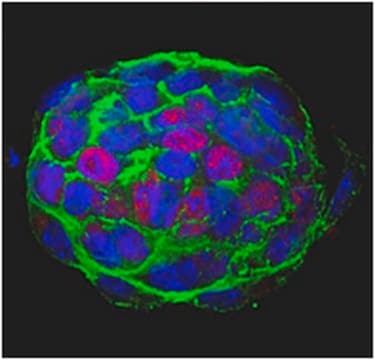
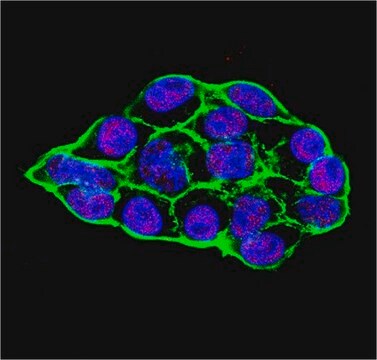
Evaluated by Immunocytochemistry in mouse mouse ESCs.

Immunocytochemistry Analysis: A 1:100 dilution of this antibody detected TET2 in mouse embryonic stem cells (ESCs).

Other Notes

Concentration: Please refer to lot specific datasheet.

Disclaimer

Unless otherwise stated in our catalog or other company documentation accompanying the product(s), our products are intended for research use only and are not to be used for any other purpose, which includes but is not limited to, unauthorized commercial uses, in vitro diagnostic uses, ex vivo or in vivo therapeutic uses or any type of consumption or application to humans or animals.

Ähnliche Artikel vergleichen

Vollständigen Vergleich anzeigen

Unterschiede anzeigen

1 of 1

Dieser Artikel
MABE1144SAB1304574SAB3500711
Gene Information

mouse ... Tet2(214133)

Gene Information

mouse ... Tet1(52463)

Gene Information

human ... TET2(54790)

Gene Information

human ... TET2(54790)

species reactivity

mouse

species reactivity

mouse

species reactivity

human

species reactivity

human

antibody form

purified immunoglobulin

antibody form

purified immunoglobulin

antibody form

IgG fraction of antiserum

antibody form

affinity isolated antibody

conjugate

unconjugated

conjugate

unconjugated

conjugate

unconjugated

conjugate

unconjugated

clone

9F7, monoclonal

clone

5D6, monoclonal

clone

polyclonal

clone

polyclonal

biological source

rat

biological source

rat

biological source

rabbit

biological source

rabbit


Still not finding the right product?

Probieren Sie unser Produkt-Auswahlhilfe, um Ihre Auswahl einzugrenzen


Lagerklasse

12 - Non Combustible Liquids

wgk

WGK 1

flash_point_f

Not applicable

flash_point_c

Not applicable


Analysenzertifikate (COA)

Suchen Sie nach Analysenzertifikate (COA), indem Sie die Lot-/Chargennummer des Produkts eingeben. Lot- und Chargennummern sind auf dem Produktetikett hinter den Wörtern ‘Lot’ oder ‘Batch’ (Lot oder Charge) zu finden.

Besitzen Sie dieses Produkt bereits?

In der Dokumentenbibliothek finden Sie die Dokumentation zu den Produkten, die Sie kürzlich erworben haben.

Die Dokumentenbibliothek aufrufen


Questions

Reviews

No rating value

Active Filters