Direkt zum Inhalt
Merck

Fortfahren mit

MAB5414

Anti-Notch 1 Antibody, extracellular, clone 8G10

culture supernatant, clone 8G10, Chemicon®

Synonym(e):

Motch A, mT14, p300

Anmelden zur Ansicht der Organisations- und Vertragspreise.

Größe auswählen

Ansicht ändern
PackungsgrößeSKUVerfügbarkeitPreis
100 μL
Warenkorb auf Verfügbarkeit prüfen
€ 493,00

Über diesen Artikel

UNSPSC Code:
12352203
NACRES:
NA.41
eCl@ss:
32160702
Conjugate:
unconjugated
Clone:
8G10, monoclonal
Application:
FACS, IHC, WB
Citations:
6

€ 493,00


Warenkorb auf Verfügbarkeit prüfen

Großbestellung anfragen
Technischer Dienst
Benötigen Sie Hilfe? Unser Team von erfahrenen Wissenschaftlern ist für Sie da.
Unterstützung erhalten


biological source

hamster (Syrian)

Quality Level

conjugate

unconjugated

antibody form

culture supernatant

antibody product type

primary antibodies

clone

8G10, monoclonal

species reactivity

mouse, rat

manufacturer/tradename

Chemicon®

technique(s)

flow cytometry: suitable, immunohistochemistry: suitable, western blot: suitable

isotype

IgG1

NCBI accession no.

UniProt accession no.

shipped in

wet ice

target post-translational modification

unmodified

Gene Information

human ... NOTCH1(4851)

General description

Notch 1 is a type 1 membrane protein that serves as a receptor for the membrane bound ligands jagged-1 and -2 and delta-1 to regulate cell fate determination through the implementation of differentiation, proliferation and apoptotic programs. Upon ligand binding, the Notch intracellular domain (NICD) is released by proteolytic processing and subsequently translocates to the nucleus where it forms a transcriptionally active complex with RBP-J kappa to activate genes of the enhancer of split locus. Notch-1 may also be involved in cell specification and/or differentiation and body segment determination in the postimplantation embryo. In the adult animal, Notch-1 is highly expressed in the brain, lung, and thymus with lower expression levels in the spleen, bone-marrow, spinal cord, eyes, mammary gland, liver, intestine, skeletal muscle, kidney and heart.

Immunogen

A GST fusion protein comprising amino acids 1299-1492 of mouse Notch 1
Epitope: extracellular

Application

Research Category
Epigenetics & Nuclear Function
Research Sub Category
Transcription Factors
Use Anti-Notch 1 Antibody, extracellular, clone 8G10 (Syrian Hamster Monoclonal Antibody) validated in FC, WB, IHC to detect Notch 1 also known as Motch A, mT14, p300.
Western blot

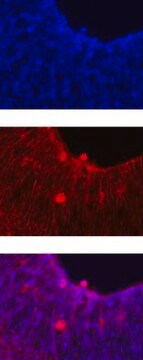
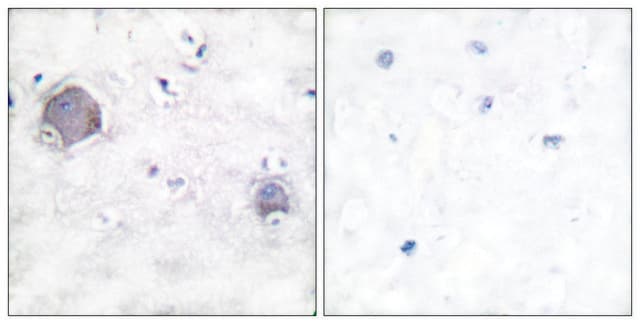
Immunohistochemistry on paraformaldehyde fixed frozen tissue sections.

Flow Cytometry

Optimal working dilutions must be determined by end user.

Biochem/physiol Actions

Reacts with natural and recombinant Notch1. Recognizes a band migrating at approximately 300 kDa on Western blots of rat and mouse protein extracts. A cross reactive band migrating at approximately 230 kDa is observed in some samples and is believed to correspond to the processed extracellular fragment of Notch 1.

Physical form

Unpurified tissue culture supernatant from a perfusion system, filtered through a 0.2 micron membrane prior to vialing. Product contains 20% FBS and Ciprofloxacin at final concentration of 10 μg/mL.

Preparation Note

Maintain at -20°C in undiluted aliquots for up to 6 months from date of receipt. Avoid repeated freeze/thaw cycles.

Analysis Note

Control
POSITIVE CONTROL: brain, lung, thymus.

Other Notes

Replaces: 04-1046

Legal Information

CHEMICON is a registered trademark of Merck KGaA, Darmstadt, Germany

Disclaimer

Unless otherwise stated in our catalog or other company documentation accompanying the product(s), our products are intended for research use only and are not to be used for any other purpose, which includes but is not limited to, unauthorized commercial uses, in vitro diagnostic uses, ex vivo or in vivo therapeutic uses or any type of consumption or application to humans or animals.

Ähnliche Artikel vergleichen

Vollständigen Vergleich anzeigen

Unterschiede anzeigen

1 of 1

Dieser Artikel
MAB5352SAB4502019SAB4200024
conjugate

unconjugated

conjugate

unconjugated

conjugate

unconjugated

conjugate

unconjugated

Gene Information

human ... NOTCH1(4851)

Gene Information

human ... NOTCH1(4851)

Gene Information

human ... NOTCH1(4851)

Gene Information

human ... NOTCH1(4851)

species reactivity

mouse, rat

species reactivity

rat, mouse, feline

species reactivity

rat, mouse, human

species reactivity

human

clone

8G10, monoclonal

clone

mN1A, monoclonal

clone

polyclonal

clone

ICN 5B5, monoclonal

biological source

hamster (Syrian)

biological source

mouse

biological source

rabbit

biological source

rat

antibody form

culture supernatant

antibody form

purified immunoglobulin

antibody form

affinity isolated antibody

antibody form

purified from hybridoma cell culture


Still not finding the right product?

Probieren Sie unser Produkt-Auswahlhilfe, um Ihre Auswahl einzugrenzen


Lagerklasse

10 - Combustible liquids


Analysenzertifikate (COA)

Suchen Sie nach Analysenzertifikate (COA), indem Sie die Lot-/Chargennummer des Produkts eingeben. Lot- und Chargennummern sind auf dem Produktetikett hinter den Wörtern ‘Lot’ oder ‘Batch’ (Lot oder Charge) zu finden.

Besitzen Sie dieses Produkt bereits?

In der Dokumentenbibliothek finden Sie die Dokumentation zu den Produkten, die Sie kürzlich erworben haben.

Die Dokumentenbibliothek aufrufen


Distinct TCR signaling pathways drive proliferation and cytokine production in T cells.
Guy, CS; Vignali, KM; Temirov, J; Bettini, ML; Overacre, AE; Smeltzer, M; Zhang, H; Huppa et al.
Nature Immunology null
Paschalis Kratsios et al.
Circulation research, 106(3), 559-572 (2009-12-17)
The Notch signaling pathway is important for cell-cell communication that controls tissue formation and homeostasis during embryonic and adult life, but the precise cell targets of Notch signaling in the mammalian heart remain poorly defined. To investigate the functional role
Donna Nichol et al.
Blood, 116(26), 6133-6143 (2010-10-16)
Epidermal growth factor-like domain 7 (Egfl7) is important for regulating tubulogenesis in zebrafish, but its role in mammals remains unresolved. We show here that endothelial overexpression of Egfl7 in transgenic mice leads to partial lethality, hemorrhaging, and altered cardiac morphogenesis.


Global Trade Item Number

SKUGTIN
MAB541404053252666957

Questions

Reviews

No rating value

Active Filters