Direkt zum Inhalt
Merck

Fortfahren mit

EZHS100B

Human S100B ELISA Kit

quantifies S100B in 50 μL cerebrospinal fluid, serum or plasma

Synonym(e):

Protein S100B, S-100 protein beta chain, S100 calcium-binding protein B

Anmelden zur Ansicht der Organisations- und Vertragspreise.

Größe auswählen

Ansicht ändern
PackungsgrößeSKUVerfügbarkeitPreis
96 wells
Warenkorb auf Verfügbarkeit prüfen
€ 1.050,00

Über diesen Artikel

UNSPSC Code:
12161503
eCl@ss:
32161000
NACRES:
NA.84
Input:
sample type cerebrospinal fluid (CSF)
sample type plasma (K2 EDTA)
sample type serum
Species reactivity:
human
Storage temp.:
2-8°C
Shipped in:
wet ice

€ 1.050,00


Warenkorb auf Verfügbarkeit prüfen

Großbestellung anfragen
Technischer Dienst
Benötigen Sie Hilfe? Unser Team von erfahrenen Wissenschaftlern ist für Sie da.
Unterstützung erhalten


Produktname

Humanes S100B ELISA, EZHS100B-33K, This Human S100B ELISA kit is to be used for the quantification of human S100B in cerebrospinal fluid, serum & plasma.

Quality Segment

species reactivity

human

packaging

kit of 1 × 96 wells

parameter

50 μL sample volume (4hr assay)

technique(s)

ELISA: suitable

input

sample type cerebrospinal fluid (CSF)
sample type plasma (K2 EDTA)
sample type serum

UniProt accession no.

application(s)

research use

assay range

accuracy: 93%
(CSF), accuracy: 94%
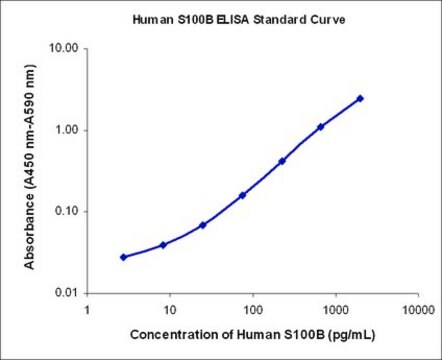
(serum), sensitivity: 2.7 pg/mL, standard curve range: 2.7-2000 pg/mL, inter-assay cv: <4%
intra-assay cv: <4%

detection method

colorimetric (450nm)

shipped in

wet ice

storage temp.

2-8°C

General description

Das Human S100B ELISA-Kit von EMD Millipore wird zur Quantifizierung von humanem S100B in Gehirn-Rückenmark-Flüssigkeit, Serum und Plasma verwendet. Dieses Kit wurde nicht auf Zellkulturüberstände geprüft.
S100B ist ein kalziumbindendes Protein, das hauptsächlich von Astrozyten im zentralen Nervensystem gebildet wird und an der Entwicklung und Erhaltung des Nervensystems beteiligt ist. Zwar ist der Mechanismus der S100B-Sekretion unbekannt, er scheint jedoch durch oxidativen Stress beeinflusst zu werden. In nanomolaren Konzentrationen (normalen Werten) kann S100B Neuronen vor Glutamattoxizität schützen. Gliaschäden oder Astrozytenreaktionen auf Nervenverletzungen (reaktive Astrogliose) führen zu einem Anstieg von S100B auf Konzentrationen im Mikromolarbereich. Hohe S100B-Werte führen zu weiteren neuronalen Schäden. Hohe S100B-Werte gelten als Biomarker, die auf eine Schädigung oder Störung des ZNS hinweisen könnten.

Application

Dies ist ein 1-Tages-Assay
Forschungskategorie
Neurowissenschaft
Zur Entdeckung/Quantifizierung von: S100B

Biochem/physiol Actions

Das in diesem Assay verwendete Antikörperpaar misst humanes S100B und weist keine Kreuzreaktivität mit S100A1, S100A6 and S100A13 auf.

Dieses Assay weist S100B bei zahlreichen Spezies nach, darunter: Rind, Hamster, Pferd, Esel, Maus, Schwein, Kaninchen und Ratte.

Other Notes

Bitte kontaktieren Sie den Technischen Service wegen der Verdünnungslinearität.

Disclaimer

Nur für Forschungszwecke. Nicht zur Verwendung in diagnostischen Verfahren vorgesehen.

Ähnliche Artikel vergleichen

Vollständigen Vergleich anzeigen

Unterschiede anzeigen

1 of 1

Dieser Artikel
ABN59S2532SAB5700647
species reactivity

human

species reactivity

human

species reactivity

feline, pig, bovine, sheep, goat, rabbit, canine, human, rat

species reactivity

rat, mouse, human

input

sample type cerebrospinal fluid (CSF)
sample type plasma (K2 EDTA)
sample type serum

input

-

input

-

input

-

assay range

accuracy: 93%
(CSF), sensitivity: 2.7 pg/mL, inter-assay cv: <4%
intra-assay cv: <4%, accuracy: 94%
(serum), standard curve range: 2.7-2000 pg/mL

assay range

-

assay range

-

assay range

-

Quality Level

200

Quality Level

100, 300

Quality Level

200

Quality Level

100

detection method

colorimetric (450nm)

detection method

-

detection method

-

detection method

-

technique(s)

ELISA: suitable

technique(s)

immunohistochemistry: suitable (paraffin), western blot: suitable

technique(s)

dot blot: suitable using denatured-reduced preparations, immunohistochemistry (formalin-fixed, paraffin-embedded sections): 1:1000 using protease-digested sections of human tongue, indirect ELISA: suitable, microarray: suitable, radioimmunoassay: suitable

technique(s)

immunofluorescence: 1:50-1:200, immunohistochemistry: 1:50-1:200, western blot: 1:500-1:2000


signalword

Danger

Hazard Classifications

Acute Tox. 3 Dermal - Acute Tox. 4 Inhalation - Acute Tox. 4 Oral - Aquatic Chronic 2 - Met. Corr. 1 - Skin Sens. 1

Lagerklasse

6.1C - Combustible acute toxic Cat.3 / toxic compounds or compounds which causing chronic effects

wgk

WGK 3


Analysenzertifikate (COA)

Suchen Sie nach Analysenzertifikate (COA), indem Sie die Lot-/Chargennummer des Produkts eingeben. Lot- und Chargennummern sind auf dem Produktetikett hinter den Wörtern ‘Lot’ oder ‘Batch’ (Lot oder Charge) zu finden.

Besitzen Sie dieses Produkt bereits?

In der Dokumentenbibliothek finden Sie die Dokumentation zu den Produkten, die Sie kürzlich erworben haben.

Die Dokumentenbibliothek aufrufen


Verwandter Inhalt

S100B is a recognized biomarker for traumatic brain injury (TBI) and several chronic neurological disorders (SCZ, bipolar disorder, Alzheimer’s disease). In addition, it may have utility as a biomarker in other disease states, such as cerebral palsy, Down’s syndrome, multiple sclerosis and metastatic melanoma. S100B is the most abundant member of the S100 family expressed in the brain, and is predominantly synthesized and secreted by astrocytes. Increased extracellular levels of S100B in the brain can result in neurodegeneration, are indicative of neuronal injury or underlying chronic inflammation and can subsequently be measured in the peripheral circulation, after passing through the blood-brain barrier. Measurement of S100B in blood is more convenient than measuring cerebrospinal fluid (CSF), since routine blood tests are almost invariably conducted on admission to hospital in psychiatric patients whereas lumbar punctures for CSF analysis are extremely rare in these settings.

Alle verwandten Inhalte anzeigen


Global Trade Item Number

SKUGTIN
EZHS100B-33K04053252417313

Questions

1–2 of 2 Questions  
  1. Is the EZHS100B-33K ELISA assay compatible with human saliva samples?

    1 answer
    1. The kits have not been validated for use with saliva; however, some guidelines are available for processing saliva samples:


      1. Add protease inhibitor cocktail (Product P2714) at a 1:500 ratio to the saliva.
      2. Centrifuge the mixture at 10,000 rpm for 10 minutes.
      3. Dilute the supernatant in a 1:2 ratio with Assay Buffer before to setting up the assay.
      4. Run assay with Assay Buffer as the matrix for the standard curve.
      5. Multiply by 2 for the final result.


      It should be noted that there are no references available for the S100B ELISA kit being used with saliva samples.

      Helpful?

  2. Which antibodies have been used for the Human S100B ELISA kit (EZHS100B-33K)?

    1 answer
    1. The origins of the antibodies utilized in the kit are considered proprietary. Nevertheless, some information about the antibodies can be shared. The capture antibody is a monoclonal mouse anti-S100B, with bovine brain S100B used as the immunogen. The detection antibody is a polyclonal rabbit anti-S100, and the immunogen for this is also sourced from bovine brain S100.

      Helpful?

Reviews

No rating value

Active Filters