Direkt zum Inhalt
Merck

Fortfahren mit

CBL162

Anti-CD9-Antikörper, Klon MM2/57

clone MM2/57, Chemicon®, from mouse

Synonym(e):

MRP-1, DRAP-27

Anmelden zur Ansicht der Organisations- und Vertragspreise.

Größe auswählen

Ansicht ändern
PackungsgrößeSKUVerfügbarkeitPreis

Über diesen Artikel

UNSPSC Code:
12352203
NACRES:
NA.41
eCl@ss:
32160702
Conjugate:
unconjugated
Clone:
MM2/57, monoclonal
Application:
FACS, IHC, IP, WB
Citations:
41
Preise und Verfügbarkeit sind derzeit nicht verfügbar.
Technischer Dienst
Benötigen Sie Hilfe? Unser Team von erfahrenen Wissenschaftlern ist für Sie da.
Unterstützung erhalten


biological source

mouse

Quality Level

conjugate

unconjugated

antibody form

purified antibody

antibody product type

primary antibodies

clone

MM2/57, monoclonal

species reactivity

human, rabbit, mouse

manufacturer/tradename

Chemicon®

technique(s)

flow cytometry: suitable, immunohistochemistry: suitable, immunoprecipitation (IP): suitable, western blot: suitable

isotype

IgG2bκ

NCBI accession no.

UniProt accession no.

shipped in

wet ice

target post-translational modification

unmodified

Gene Information

human ... CD9(928)

Immunogen

Humanes Thrombozyten-Glykoprotein

Application

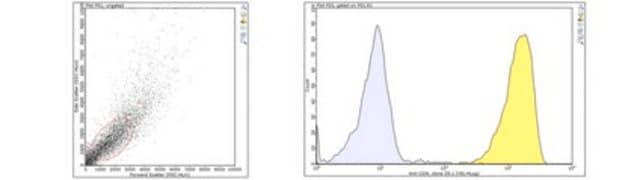
Der Anti-CD9-Antikörper (Klon MM2/57) weist die Konzentration von CD9 nach und wurde publiziert und für die Verwendung in FC, IP, WB und IH validiert.
Forschungskategorie
Entzündung & Immunologie
Forschungsunterkategorie
Immunglobuline & Immunologie
Immunhistochemie: Gefrorene Schnitte von Thrombozyten, Monozyten und Prä-B-Zellen mit Differenzialfärbung auf lymphatischen und epithelialen Geweben
Thrombozytenhemm- und Aggregationsstudien
Optimale Arbeitsverdünnungen müssen vom Endanwender bestimmt werden.  

Biochem/physiol Actions

Dieser Antikörper reagiert auf Gelen von nichtreduzierten Thrombozytenmembranen mit einer Bande mit einem Molekulargewicht von 25 kDa und führt zu einer Immunpräzipitation eines ähnlichen Bands von Jod-125-markierten Thrombozyten. Das Antigen wird auf Eosinophilen, Granulozyten, Monozyten und zahlreichen Stromazellen exprimiert. Dieses CD9-Antigen gehört zur TM4-Superfamilie der Zelloberflächenproteine, bei denen die N- und C-Termini im Zytoplasma lokalisiert sind.

Physical form

Der monoklonale Antikörper liegt in einer Konzentration von 100 μg/ml in phosphatgepufferter Kochsalzlösung mit 10 mmol/l Natriumazid und 1 mg/ml Rinderserumalbumin vor. Wir empfehlen, dass jedes Labor einen optimalen Arbeitstiter zur Verwendung in seiner speziellen Anwendung bestimmt.
Format: Aufgereinigt
Mit Protein A aufgereinigt

Preparation Note

Bei 4 °C ab Versanddatum 1 Jahr haltbar

Other Notes

Konzentration: Die chargenspezifische Konzentration entnehmen Sie bitte dem Analysenzertifikat.

Legal Information

CHEMICON is a registered trademark of Merck KGaA, Darmstadt, Germany

Disclaimer

Sofern in unserem Katalog oder anderen Begleitdokumenten unserer Produkte nicht anders angegeben, sind unsere Produkte nur für Forschungszwecke vorgesehen und nicht für andere Zwecke zu verwenden, einschließlich, jedoch nicht beschränkt auf unautorisierte kommerzielle Verwendung, zur In-vitro-Diagnostik, für Ex-vivo- oder In-vivo-Therapiezwecke oder jegliche Art der Einnahme oder Anwendung bei Menschen oder Tieren.

Ähnliche Artikel vergleichen

Vollständigen Vergleich anzeigen

Unterschiede anzeigen

1 of 1

Dieser Artikel
SAB4700093MABT914SAB1402143
conjugate

unconjugated

conjugate

Allophycocyanin conjugate

conjugate

unconjugated

conjugate

unconjugated

clone

MM2/57, monoclonal

clone

MEM-61, monoclonal

clone

Z9.1, monoclonal

clone

4A2, monoclonal

biological source

mouse

biological source

mouse

biological source

mouse

biological source

mouse

Gene Information

human ... CD9(928)

Gene Information

human ... CD9(928)

Gene Information

human ... CD9(928)

Gene Information

human ... CD9(928)

species reactivity

human, rabbit, mouse

species reactivity

human

species reactivity

human

species reactivity

human

antibody form

purified antibody

antibody form

purified immunoglobulin

antibody form

purified immunoglobulin

antibody form

purified immunoglobulin


Still not finding the right product?

Probieren Sie unser Produkt-Auswahlhilfe, um Ihre Auswahl einzugrenzen


Lagerklasse

12 - Non Combustible Liquids

wgk

WGK 2


Analysenzertifikate (COA)

Suchen Sie nach Analysenzertifikate (COA), indem Sie die Lot-/Chargennummer des Produkts eingeben. Lot- und Chargennummern sind auf dem Produktetikett hinter den Wörtern ‘Lot’ oder ‘Batch’ (Lot oder Charge) zu finden.

Besitzen Sie dieses Produkt bereits?

In der Dokumentenbibliothek finden Sie die Dokumentation zu den Produkten, die Sie kürzlich erworben haben.

Die Dokumentenbibliothek aufrufen


Verwandter Inhalt

As the focus of stem cell research undergoes a transition from animal to human models, researchers are in critical need of validated products to support the isolation, maintenance, differentiation, and characterization of human stem cells. While many reagents designed for rodent systems can be applied to human stem cell studies, they are not truly optimized for robust human stem cell culture or analysis. This is why human stem cell researchers have always trusted EMD Millipore, the first provider of commercially available human embryonic stem cells and human neural stem cell lines, to accelerate their research. All of our human stem cell systems are extensively tested in defined media culture, and differentiated progeny are comprehensively characterized with highly validated antibodies and detection reagents.


V Zvereff et al.
British journal of cancer, 97(7), 941-948 (2007-09-13)
CD9, a member of the tetraspanin family of proteins, is involved in a variety of cellular interactions with many other proteins and molecules. Although CD9 has been implicated in cell fusion, migration and cancer progression, the detailed function of this
Dmitry Ter-Ovanesyan et al.
eLife, 10 (2021-11-17)
Extracellular vesicles (EVs) are released by all cells into biofluids and hold great promise as reservoirs of disease biomarkers. One of the main challenges in studying EVs is a lack of methods to quantify EVs that are sensitive enough and
Xiaoman Zhang et al.
PloS one, 17(6), e0270634-e0270634 (2022-06-25)
Extracellular vesicles (EVs) have attracted much attention as potential diagnostic biomarkers for human diseases. Although both plasma and serum are utilized as a source of blood EVs, it remains unclear whether, how and to what extent the choice of plasma


Global Trade Item Number

SKUGTIN
CBL16204053252320408

Questions

Reviews

No rating value

Active Filters